Kompas (diduga; belum diverifikasi) · Diperkirakan Kompas, Maret 2015; rubrik Opini (kepala halaman tidak tersedia pada kliping; tanggal dan nama surat kabar belum diverifikasi) · 2015-03
Abstract
An opinion article by Apridar, professor of economics and Rector of Universitas Malikussaleh, on the promises made by President Joko Widodo during his visit to Aceh on 9–10 March 2015. The author inventories the promises of runway extensions at several airports, the reopening of PT Kertas Kraft Aceh, the construction of the Keureuto Dam, Arun regasification, a fuel refinery, and the sea toll road, and assesses their impact on economic growth and unemployment in Aceh. He recalls that a previous president's promises, such as reviving PT ASEAN Aceh Fertilizer, were not realised, and calls on the central government to keep its promises and on Aceh's elites to be proactive in order to maintain Aceh–Jakarta relations after the Helsinki Agreement.
Identifier
KBA-KLP-2015-0005
Type
Kliping
Publisher
Kompas (diduga; belum diverifikasi)
Date Issued
2015-03
Bibliographic Citation
Diperkirakan Kompas, Maret 2015; rubrik Opini (kepala halaman tidak tersedia pada kliping; tanggal dan nama surat kabar belum diverifikasi)
Aceh (Indonesia) -- Economic conditionsInfrastructure (Economics) -- Indonesia -- AcehWidodo, Joko, 1961-
BISAC Category
POL024000 POLITICAL SCIENCE / Public Policy / Economic Policy
Language
Indonesia
Description
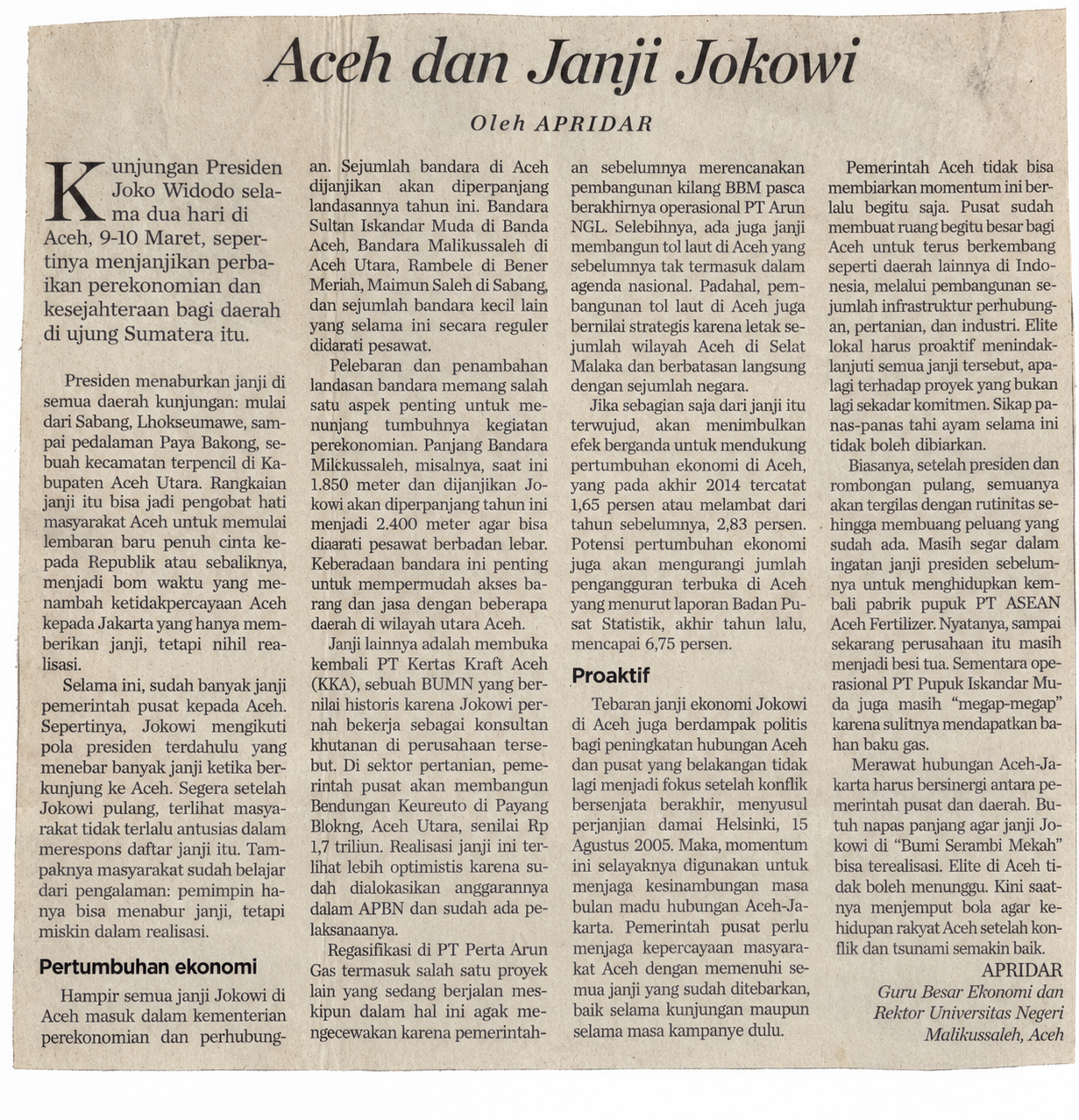
This clipping contains an opinion article by Apridar entitled "Aceh dan Janji Jokowi" (Aceh and Jokowi's Promises). The author is listed as Professor of Economics and Rector of Universitas Negeri Malikussaleh, Lhokseumawe, Aceh. This clipping does not include a dated page header. The content of the article refers to President Joko Widodo's visit to Aceh on 9–10 March 2015 and cites economic growth data for the end of 2014, so the article was almost certainly published in March 2015. The layout, typeface, and headline format are identical to the opinion page of the daily Kompas, as with other clippings in this collection, but the name of the newspaper and the exact date of publication still need to be checked against the archive. The clipping page shows a large italic headline, the author's name, four columns of text, and two subheadings, namely "Pertumbuhan ekonomi" (Economic growth) and "Proaktif" (Proactive).
Apridar opens his piece by describing the President's two-day visit to Sabang, Lhokseumawe, and Paya Bakong, a subdistrict in the interior of North Aceh. During the visit the President made a series of promises to improve the economy and welfare. The author sees these promises as having two possible outcomes: an antidote that restores Aceh's trust in the Republic, or a time bomb that adds to distrust if they are not realised. He reminds readers that previous presidents had also scattered many promises when visiting Aceh, so the public appeared not particularly enthusiastic. In his view, the people of Aceh have learned from experience that leaders are often rich in promises but poor in delivery.
The section "Pertumbuhan ekonomi" details these promises. Most of them fall under the ministries responsible for the economy and transport. Several airports were promised runway extensions, among them Sultan Iskandar Muda in Banda Aceh, Malikussaleh in North Aceh, Rembele in Bener Meriah, and Maimun Saleh in Sabang. The author gives the example of the runway of Malikussaleh Airport, which was to be extended so that wide-bodied aircraft could land, and stresses the importance of air access for the flow of goods and services in the northern part of Aceh. Another promise was to reopen PT Kertas Kraft Aceh, a state-owned enterprise of historical significance because Jokowi had once worked as a forestry consultant at the company. In agriculture, the central government would build the Keureuto Dam in Paya Bakong with a budget of around Rp 1.7 trillion, a promise considered the most realistic because its budget had been allocated and work had already begun.
The author also mentions the regasification project at PT Perta Arun Gas, the plan to build a fuel refinery after the end of PT Arun NGL's operations, and the promise to build a sea toll road (tol laut) that had previously not been part of the national agenda. He stresses Aceh's strategic value on the Strait of Malacca, which borders directly on several countries. According to Apridar, if even some of these promises were realised, multiplier effects would emerge and drive Aceh's economic growth, which at the end of 2014 had slowed compared with the previous year. Economic improvement was also expected to reduce the open unemployment rate, which according to Statistics Indonesia (Badan Pusat Statistik) was still above six per cent.
The section "Proaktif" highlights the political dimension. The author judges that these economic promises could improve relations between Aceh and the central government, which had received less attention lately after the armed conflict ended with the Helsinki Peace Agreement of 15 August 2005. This momentum, in his view, needs to be used to sustain the honeymoon period of Aceh–Jakarta relations. The central government must keep its promises, while the Aceh Government and local elites must not simply wait. He recalls a previous president's promise to revive the fertiliser plant PT ASEAN Aceh Fertilizer, which in reality remained scrap iron, as well as the difficulties PT Pupuk Iskandar Muda faced in obtaining gas feedstock. The author closes with a call for Aceh's elites to take the initiative (menjemput bola) so that people's lives after the conflict and the tsunami become better.
This clipping is important for the study of the political economy of post-conflict Aceh. The article records a moment when the new government in Jakarta sought to build legitimacy in Aceh through infrastructure projects and industrial revival. The list of promises recorded by the author can be used as a basis for assessing the implementation of policy in subsequent years. The Keureuto Dam, for example, was indeed built as a national strategic project, while the plan to revive PT Kertas Kraft Aceh continued to be a subject of debate for years. The Arun area was later developed as the Arun Lhokseumawe Special Economic Zone. Researchers can trace these records to compare promises and reality.
The article also shows the perspective of a regional academic who at the same time led a state university in the former centre of Aceh's gas industry. Lhokseumawe and North Aceh were once the backbone of Indonesia's liquefied natural gas exports through PT Arun, but later faced decline as gas reserves dwindled and supporting plants ceased operation. Apridar's concern about industrial scrap iron and unemployment reflects the region's experience of deindustrialisation after conflict and disaster.
For students and researchers, this clipping can be read together with the literature on Aceh's special autonomy, the special autonomy funds, and centre-region relations after Law No. 11 of 2006 on the Governing of Aceh. The question the author raises about public trust in the centre's promises remains relevant for understanding the dynamics of Aceh's politics, including the debate over the extension of the special autonomy funds and the implementation of the provisions of the Helsinki Agreement.
As a critical note, the article mostly inventories promises and calls for a proactive attitude, without discussing in depth institutional obstacles, regional governance, or problems of the investment climate in Aceh. The economic data cited are also brief. Nevertheless, as the record of a regional university leader at the time of a presidential visit, this piece provides a useful primary source on Aceh's hopes for and suspicions of the Jokowi administration.
This clipping also shows the position of Universitas Malikussaleh as an institution born and grown in the midst of the industrial area of North Aceh. The university has had state status since 2001 and has often been involved in studies of the socio-economic impact of the gas industry, conflict, and post-tsunami development in the coastal areas of eastern Aceh. The voice of its rector in this article can be read as part of the efforts of Aceh's academic community to help shape the direction of regional development, while also reminding the central government not to repeat the pattern of unkept promises. Researchers can trace Apridar's other writings to see the consistency of his views on Aceh's economy.
Physically, the clipping consists of a cut-out of a yellowish newspaper page without a page header. The four-column text is clearly legible. The uploaded image has been straightened and sharpened for legibility. The full text of the article is not copied into this catalogue because its copyright belongs to the author and the publisher; this description is a curatorial account to help users understand its content, context, and research value.
Suitable search subjects include Aceh, Joko Widodo, regional economic development, infrastructure, the industry of North Aceh and Lhokseumawe, centre-region relations, and post-conflict Aceh. For citation purposes, a provisional reference can be written as follows: Apridar, "Aceh dan Janji Jokowi", Kompas, March 2015 (date and newspaper name not yet verified), Opinion section.
Apridar, “Aceh dan Janji Jokowi [Aceh and Jokowi's Promises]”, Kompas (diduga; belum diverifikasi), Diperkirakan Kompas, Maret 2015; rubrik Opini (kepala halaman tidak tersedia pada kliping; tanggal dan nama surat kabar belum diverifikasi), 2015-03. KBA13 Academy Archive and Library, KBA-KLP-2015-0005.