
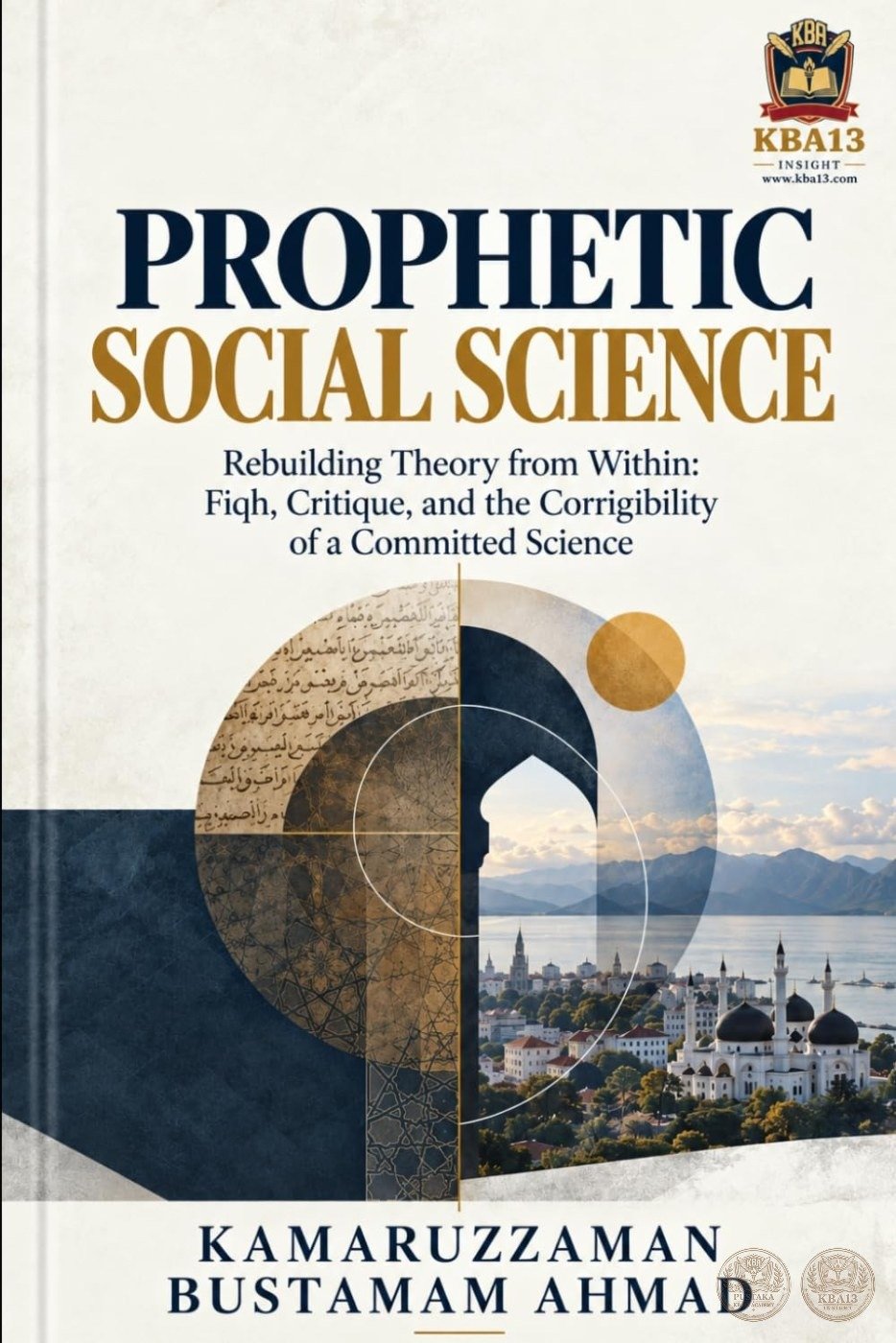
Prophetic Social Science: Rebuilding Theory from Within: Fiqh, Critique, and the Corrigibility of a Committed Science
Independently published · Paperback; 235 halaman; ISBN 979-8174117419 · 2026-09-13
Ringkasan
Can a social science be openly committed to moral ends and still remain genuinely scientific?Modern social science is often built around a difficult bargain: describe society rigorously, but remain cautious about declaring what society ought to become. Prophetic Social Science challenges that bargain.Kamaruzzaman Bustamam Ahmad develops a sustained argument for rebuilding social theory from within an Islamic intellectual tradition—without rejecting modern social science, romanticizing the past, or protecting religious interpretation from criticism.The book begins with a provocative question: Can fiqh be understood not only as jurisprudence, but as a historically developed science of human action and social order? From there, the inquiry expands into a major conversation across intellectual traditions. Plato's thumos illuminates the problem of moral motivation; Hegel raises the danger of totalizing history; Nietzsche teaches suspicion toward inherited values; Foucault exposes the entanglement of power, knowledge, and subject formation; Habermas tests the possibility of normativity through communication; Mészáros reveals the social determination of method; and Karl Popper provides the language of fallibility and correction.At the center stands Kuntowijoyo's prophetic social science, reconstructed as a serious epistemological and social-theoretical project organized around humanization, liberation, and transcendence.Yet this is not a defense of certainty. Its central claim is more demanding: a committed science can preserve a normative orientation while keeping its human interpretations permanently corrigible. Doctrine may provide direction; interpretation remains human work and must remain open to evidence, argument, criticism, and revision.The book develops friction as a method for placing intellectual traditions into productive tension without forcing them into synthesis. Islamic and Western thought are neither collapsed into one system nor arranged as civilizational opposites.Prophetic Social Science is a book about social theory, epistemology, Islamic intellectual history, and the possibility of producing theory from places too often treated merely as sites where imported theory is applied.For readers of social theory, sociology of knowledge, philosophy of social science, Islamic studies, critical theory, decolonial thought, and Southeast Asian intellectual history, this book offers a demanding question:What would social science look like if it knew what it was committed to—and still allowed itself to be wrong?
Cara mengutip
Kamaruzzaman Bustamam Ahmad, “Prophetic Social Science: Rebuilding Theory from Within: Fiqh, Critique, and the Corrigibility of a Committed Science”, Independently published, Paperback; 235 halaman; ISBN 979-8174117419, 2026-09-13. Arsip dan Pustaka KBA13 Academy, KBA-BKU-2026-0050.
Dokumen terkait
Islam historis: Dinamika studi Islam di Indonesia
Kamaruzzaman Bustamam Ahmad
Islamic Law in Southeast Asia: A Study of Its Application in Kelantan and Aceh (Islam in Southeast Asia: Views from Within)
Kamaruzzaman Bustamam Ahmad
Islamic Thought In Southeast Asia: New Interpretations And Movements
Kamaruzzaman Bustamam Ahmad & Patrick Jory
From Islamic Revivalism to Islamic Radicalism in Southeast Asia: A Study of Jamā‘ah Tablīgh in Malaysia and Indonesia
Kamaruzzaman Bustamam Ahmad