
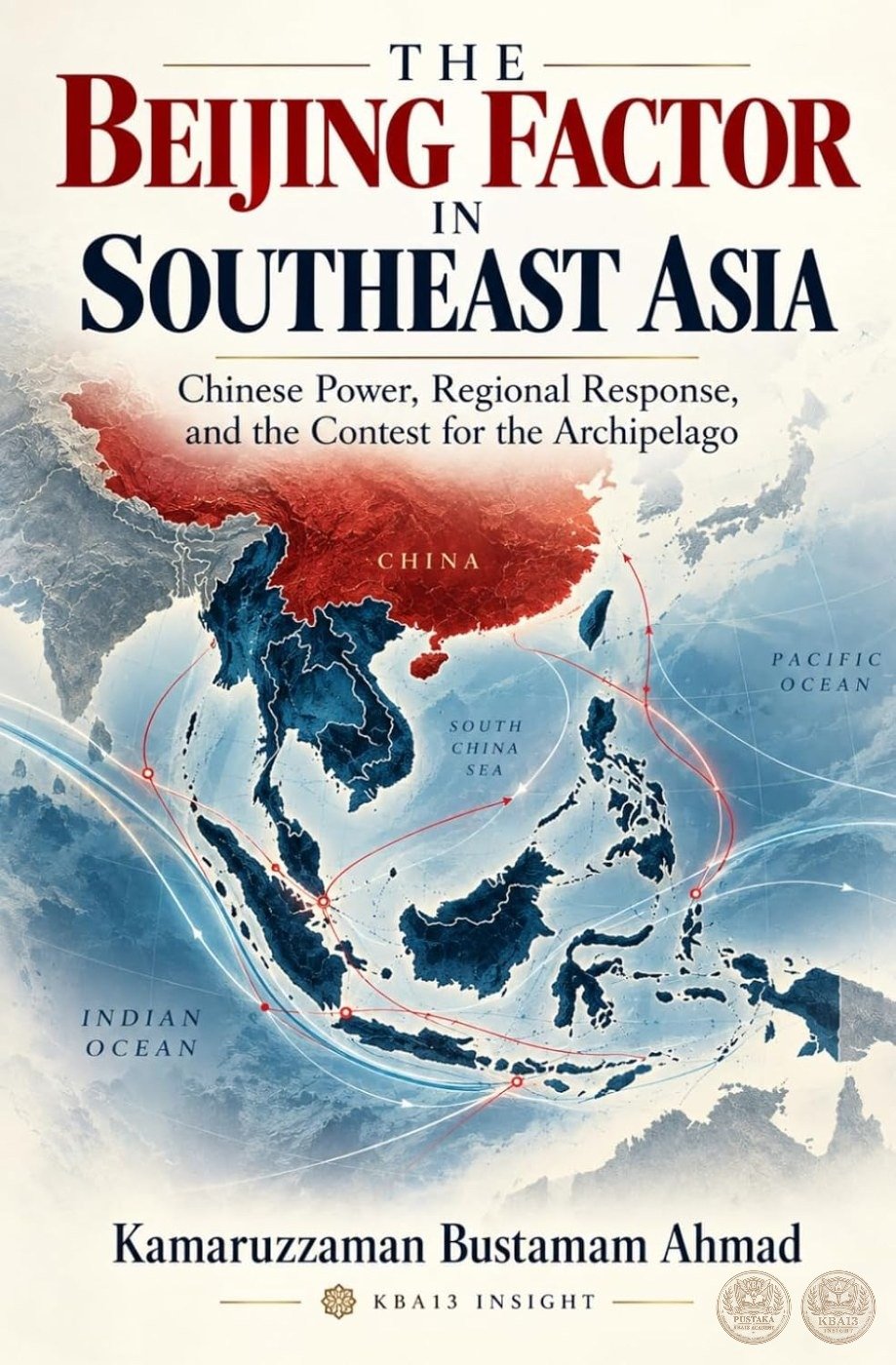
THE BEIJING FACTOR IN SOUTHEAST ASIA: Chinese Power, Regional Response, and the Contest for the Archipelago
Independently published · Paperback; 226 halaman; ISBN 979-8178191200; Seri Southeast Asian Studies #13 · 2026-10-01
Abstract
China’s rise is transforming Southeast Asia—but not in the way either Beijing’s admirers or its critics often assume. From the South China Sea and the Natuna Islands to industrial parks, mineral processing, digital infrastructure, trade corridors, and the Belt and Road Initiative, Chinese power now reaches deep into the economic and strategic architecture of Southeast Asia. Yet presence is not the same as influence, influence is not the same as control, and economic dependence does not automatically produce political obedience. The Beijing Factor in Southeast Asia examines how Chinese power actually operates—and how Southeast Asian states respond. Written from an Indonesian and archipelagic perspective, Kamaruzzaman Bustamam Ahmad moves beyond familiar narratives of Chinese domination and U.S.–China rivalry. He shows a region that is neither passive nor simply divided between competing great powers. Indonesia, Vietnam, Malaysia, the Philippines, Singapore, Thailand, Cambodia, Laos, and other Southeast Asian states bargain, hedge, accommodate, resist, diversify, and exploit the opportunities created by strategic competition. The book explores: China’s trade, investment, infrastructure, and Belt and Road strategy the politics of critical minerals, downstreaming, and supply chains the South China Sea, maritime coercion, UNCLOS, and operational control Indonesia’s Natuna dilemma and the strategic logic of the archipelago ASEAN’s convening power—and the limits of consensus U.S.–China competition beyond simplistic Cold War analogies tariffs, transshipment, and the restructuring of Asian production networks cables, clouds, digital infrastructure, and the emerging contest for the technological stack knowledge, narrative, and influence in contemporary Southeast Asia the future of Indonesia’s bebas-aktif strategy in an era of asymmetric multipolarity Drawing on official documents, scholarly research, legal materials, economic evidence, and regional observation, Ahmad argues that the central question is not whether China will “take over” Southeast Asia. It is how Chinese power interacts with the agency, vulnerabilities, institutions, and strategic choices of the states that surround it. For readers of geopolitics, international relations, China studies, Southeast Asian studies, maritime security, ASEAN affairs, and Indo-Pacific strategy, this is a regional account of one of the defining power shifts of the twenty-first century.
How to cite
Kamaruzzaman Bustamam Ahmad, “THE BEIJING FACTOR IN SOUTHEAST ASIA: Chinese Power, Regional Response, and the Contest for the Archipelago”, Independently published, Paperback; 226 halaman; ISBN 979-8178191200; Seri Southeast Asian Studies #13, 2026-10-01. KBA13 Academy Archive and Library, KBA-BKU-2026-0059.
Related documents

Islam historis: Dinamika studi Islam di Indonesia [Historical Islam: The Dynamics of Islamic Studies in Indonesia]
Kamaruzzaman Bustamam Ahmad

Islamic Law in Southeast Asia: A Study of Its Application in Kelantan and Aceh (Islam in Southeast Asia: Views from Within)
Kamaruzzaman Bustamam Ahmad
Islamic Thought In Southeast Asia: New Interpretations And Movements
Kamaruzzaman Bustamam Ahmad & Patrick Jory
From Islamic Revivalism to Islamic Radicalism in Southeast Asia: A Study of Jamā‘ah Tablīgh in Malaysia and Indonesia
Kamaruzzaman Bustamam Ahmad