
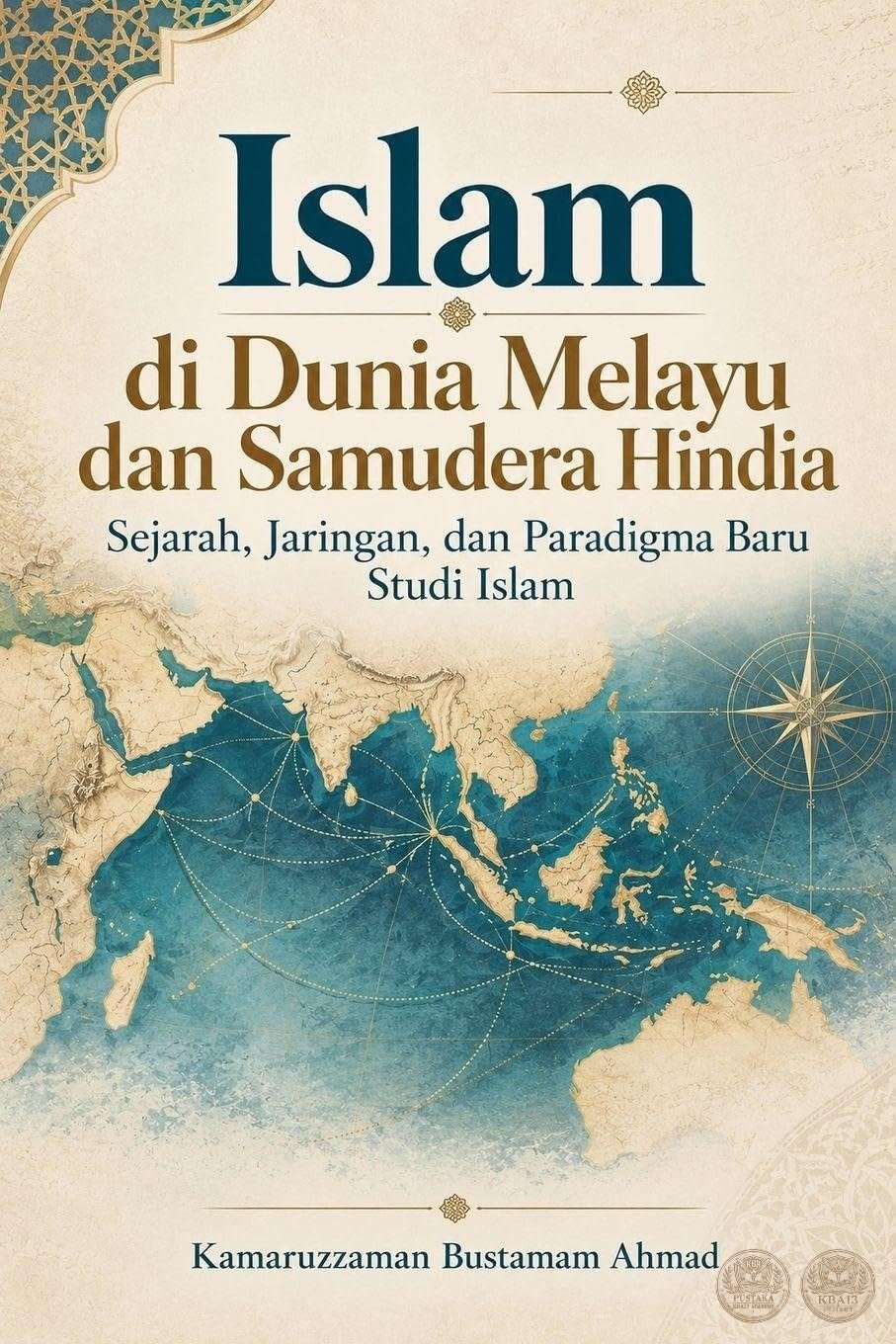
Islam di Dunia Melayu dan Samudera Hindia: Sejarah, Jaringan, dan Paradigma Baru Studi Islam (Indonesian Edition) [Islam in the Malay World and the Indian Ocean: History, Networks, and a New Paradigm of Islamic Studies (Indonesian Edition)]
Kba13 Insight · Paperback; 372 halaman; ISBN 979-8235286436 · 2026-10-09
Abstract
How might we understand Islam in the Malay World if we stop seeing it through the boundaries of modern states and begin to view the sea as a space of history, civilisation, and knowledge production? Islam di Dunia Melayu dan Samudera Hindia: Sejarah, Jaringan, dan Paradigma Baru Studi Islam offers a comprehensive reading of the development of Islam in the Malay region through the horizon of the Indian Ocean. This book places Aceh, Melaka, Patani, Java, and various Muslim centres in Southeast Asia not as peripheral regions that merely received influence from the Middle East, but as active nodes in networks of people, trade, manuscripts, knowledge, power, and spirituality that connected Southeast Asia with the Haramain, Hadramaut, Gujarat, Coromandel, Bengal, Persia, and other regions around the Indian Ocean. Through fifteen chapters arranged in four parts, the book moves from conceptual foundations to the questions of Islamisation, Malay manuscripts and the genealogy of knowledge, dayah and pesantren, Islamic sultanates, trade and waqf (endowments), the networks of Nusantara-Haramain ulama, colonialism, contemporary Islamic political movements, Malay literature and Sufism, the Muslim diaspora, and finally research methodology and the production of academic knowledge. This work engages in dialogue with the thought of Fernand Braudel, K.N. Chaudhuri, Sanjay Subrahmanyam, Sugata Bose, Richard Eaton, Anthony Reid, Azyumardi Azra, Talal Asad, Syed Hussein Alatas, Syed Muhammad Naquib al-Attas, and various other important scholars, while placing the experience and intellectual traditions of the Malay World as a source of theory, not merely as an object of research. Its main argument is that Malay Islam must be understood as the result of connected histories: ulama, traders, sailors, hajj pilgrims, manuscripts, sultanates, educational institutions, and diaspora communities continually moved across the ocean and shaped an Islamic world that is at once local and transregional. In its final part, the book goes further by proposing Malay-Indian Ocean Islam as an epistemic field—a space in which Islamic knowledge is produced, exchanged, debated, and transmitted. Written as both a reference book and a research guide, this work is intended for undergraduate and postgraduate students, lecturers, researchers, teachers at dayah and pesantren, and anyone who wishes to understand Southeast Asian Islam through the perspectives of history, anthropology, networks, and the Indian Ocean.
How to cite
Kamaruzzaman Bustamam Ahmad, “Islam di Dunia Melayu dan Samudera Hindia: Sejarah, Jaringan, dan Paradigma Baru Studi Islam (Indonesian Edition) [Islam in the Malay World and the Indian Ocean: History, Networks, and a New Paradigm of Islamic Studies (Indonesian Edition)]”, Kba13 Insight, Paperback; 372 halaman; ISBN 979-8235286436, 2026-10-09. KBA13 Academy Archive and Library, KBA-BKU-2026-0062.
Related documents
Islam historis: Dinamika studi Islam di Indonesia [Historical Islam: The Dynamics of Islamic Studies in Indonesia]
Kamaruzzaman Bustamam Ahmad
Islamic Law in Southeast Asia: A Study of Its Application in Kelantan and Aceh (Islam in Southeast Asia: Views from Within)
Kamaruzzaman Bustamam Ahmad
Islamic Thought In Southeast Asia: New Interpretations And Movements
Kamaruzzaman Bustamam Ahmad & Patrick Jory
From Islamic Revivalism to Islamic Radicalism in Southeast Asia: A Study of Jamā‘ah Tablīgh in Malaysia and Indonesia
Kamaruzzaman Bustamam Ahmad