
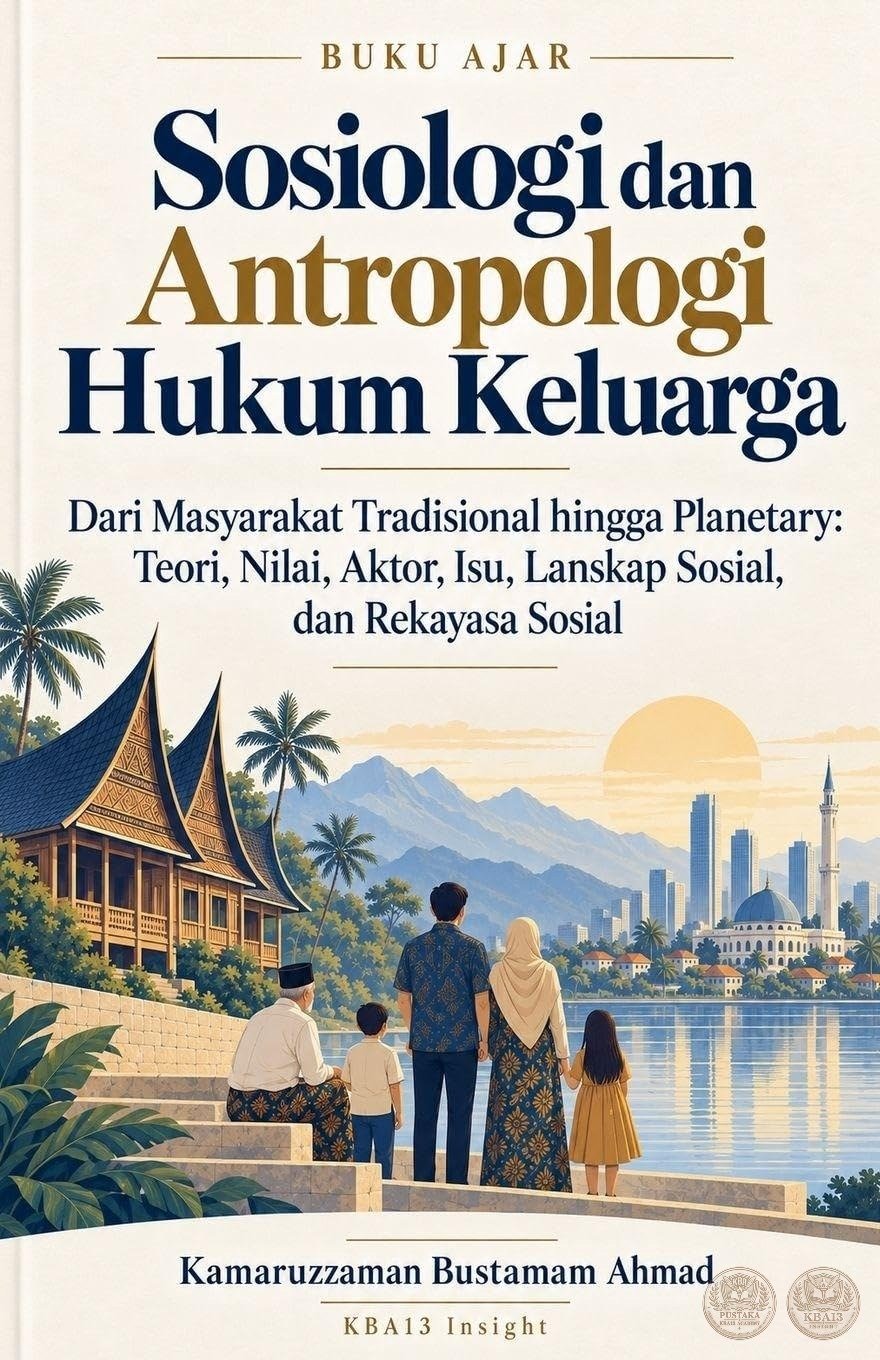
Sosiologi dan Antropologi Hukum Keluarga (Indonesian Edition) [Sociology and Anthropology of Family Law]
Kba13 Insight · Paperback; 458 halaman; ISBN 979-8237328714 · 2026-10-09
Abstract
How are we to understand family law when society, values, and family life change faster than the law that governs them? Marriage, divorce, relations between husband and wife, child-rearing, and kinship relations never take place in an empty social space. All of them are shaped by religion, adat (customary tradition), power, economics, culture, and technological development. Understanding family law, therefore, is not enough merely by reading statutes and books of fiqh (Islamic jurisprudence). We must also understand the society that practises it. Sosiologi dan Antropologi Hukum Keluarga by Kamaruzzaman Bustamam Ahmad offers an interdisciplinary approach to understanding the relationship between law, the family, and social change, bringing together sociological and anthropological theory, Islamic family law, Indonesian positive law, adat, and the dynamics of contemporary society. The book is built on a framework of five phases of social change: traditional, modern, postmodern, global, and planetary. These five phases are understood not as evolutionary stages that replace one another, but as layers of social life that may be present simultaneously within a single family. Through six main areas of discussion—theory, values and ethics, actors, family issues, the social landscape, and social engineering—readers are invited to understand a range of fundamental and contemporary problems, including: Theories of the sociology and anthropology of the family, from Durkheim, Weber, Marx, Malinowski, Lévi-Strauss, and Ibn Khaldun to contemporary social thinkers. Living law and legal pluralism, including the relationship between state law, Islamic law, and adat in the life of society. Marriage and divorce, covering mahar (dower), nikah siri (unregistered marriage), changing values of marriage, gender relations, and the dynamics of Muslim families. The family in digital society, as social media, influencers, algorithms, and artificial intelligence begin to influence family relationships. Anomie, anomaly, and social pathology, including domestic violence, online gambling, drugs, and intergenerational social problems. The family under planetary conditions, including globalisation, migration, climate change, disasters, and the transformation of civilisation. Law as an instrument of social engineering, to understand how policies, values, and institutions can contribute to social change. By making Aceh and Indonesia one of its main fields of analysis, the book also presents comparative cases from Asia, Africa, Europe, and the Americas. Each chapter is equipped with theoretical discussion, case studies, key terms, discussion questions, and mini-ethnography assignments that connect academic knowledge with the realities of life. Written by a Professor of the Anthropology of Religion, the book is intended for students of family law, sharia, sociology, anthropology, and Islamic studies; lecturers and researchers; judges and legal practitioners; and readers who wish to understand changes in family life in contemporary society. A book that invites readers to move beyond legal texts towards a deep understanding of human beings, the family, society, and an ever-changing civilisation.
How to cite
Kamaruzzaman Bustamam Ahmad, “Sosiologi dan Antropologi Hukum Keluarga (Indonesian Edition) [Sociology and Anthropology of Family Law]”, Kba13 Insight, Paperback; 458 halaman; ISBN 979-8237328714, 2026-10-09. KBA13 Academy Archive and Library, KBA-BKU-2026-0063.
Related documents
Islam historis: Dinamika studi Islam di Indonesia [Historical Islam: The Dynamics of Islamic Studies in Indonesia]
Kamaruzzaman Bustamam Ahmad
Islamic Law in Southeast Asia: A Study of Its Application in Kelantan and Aceh (Islam in Southeast Asia: Views from Within)
Kamaruzzaman Bustamam Ahmad
Islamic Thought In Southeast Asia: New Interpretations And Movements
Kamaruzzaman Bustamam Ahmad & Patrick Jory
From Islamic Revivalism to Islamic Radicalism in Southeast Asia: A Study of Jamā‘ah Tablīgh in Malaysia and Indonesia
Kamaruzzaman Bustamam Ahmad