
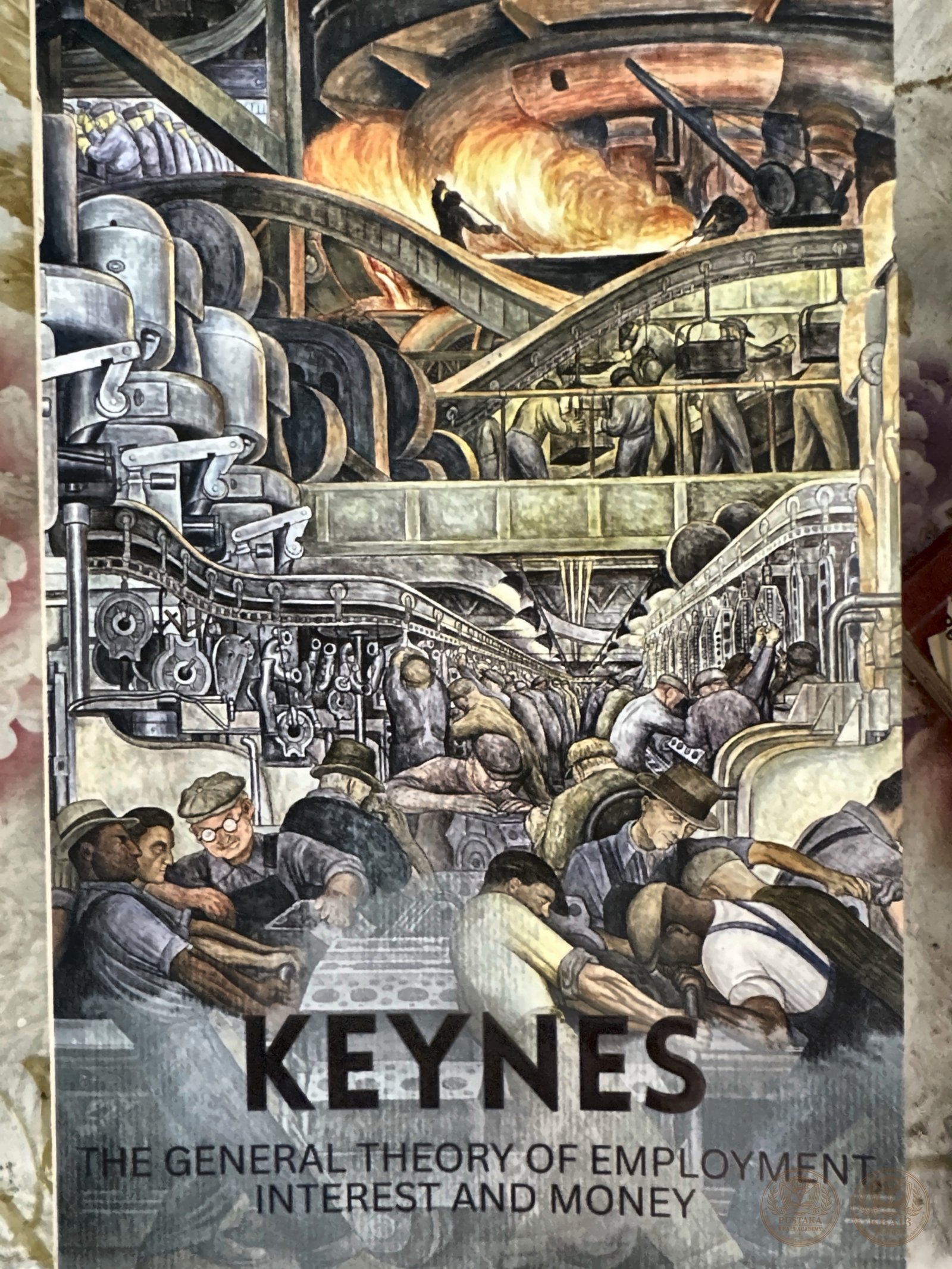
The General Theory of Employment, Interest and Money
2017
Abstract
The General Theory of Employment, Interest and Money, first published in 1936, is the crowning work of the British economist John Maynard Keynes (1883–1946) and is generally regarded as the book that gave birth to modern macroeconomics. Written in the midst of the Great Depression, when mass unemployment persisted for years in Europe and America, the book challenged the classical economic belief that the market would by itself return to an equilibrium of full employment. Keynes argued that the level of output and employment is determined by aggregate demand (effective demand), so that an economy can remain trapped for a long time in an equilibrium with high unemployment. To explain this he introduced a number of key ideas: the propensity to consume and the concept of the multiplier, the marginal efficiency of capital as influenced by the expectations and "animal spirits" of investors, the theory of liquidity preference as the determinant of the interest rate, and the role of uncertainty in investment decisions. Its policy consequences were enormous: the state was seen as needing to manage demand actively through public spending and fiscal and monetary policy in order to stabilise the economic cycle. The book became the foundation of the Keynesian revolution that shaped world economic policy after the Second World War, and it remains a point of reference to this day in debates about financial crises, recessions, fiscal stimulus, and the role of the state in the economy. This edition in the collection (2017) has a cover reproducing Diego Rivera's mural Detroit Industry (1932–1933), which depicts workers on the production line of an automobile factory, a visual that resonates with the book's central themes: work, industry, and the fate of workers amid the upheavals of capitalism.
How to cite
John Maynard Keynes, “The General Theory of Employment, Interest and Money”, 2017. KBA13 Academy Archive and Library, KBA-BKU-2017-0002.