
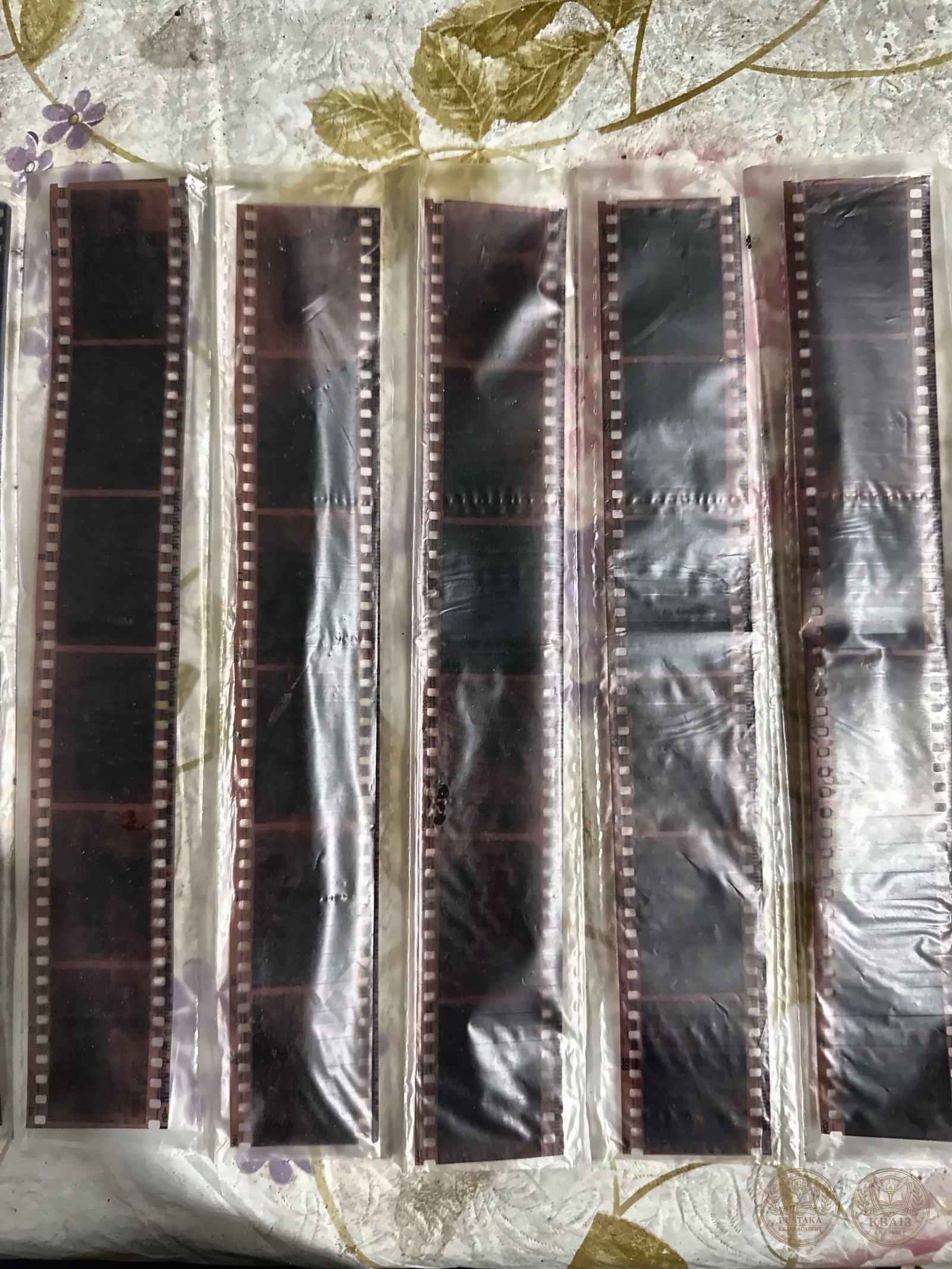
35 mm Colour Negative Film Strips (Analogue Photography Artefact)
Tanpa tahun
Abstract
Sheets of 35 mm colour negative film (klise) from the personal collection of Prof. Kamaruzzaman Bustamam Ahmad, stored in transparent plastic sleeves cut to six frames per strip, documented as an artefact of the history of photography. In the era of analogue photography, taking pictures meant loading a roll of film containing 24 or 36 frames into the camera; each shot exposed a light-sensitive silver halide emulsion layer. Once the roll was finished, the film was taken to a photo studio or laboratory to be developed (the C-41 chemical process for colour negatives), producing negatives with inverted colours and a reddish-orange base layer such as can be seen on these strips. From the negative, photographs were printed on light-sensitive paper, usually in 3R or 4R size, and the negatives were kept so that the photographs could be reprinted at any time. 35 mm film derives from the cinema film used by Oskar Barnack for the Leica camera (1925); Kodak introduced Kodacolor colour negative film in 1942, and from the 1970s to the early 2000s colour film of the Kodak, Fujifilm, Konica, and Agfa brands was the main means for families to record weddings, graduations, journeys, and scholarly activities. In Indonesia, photo developing-and-printing shops such as Fuji Image Plaza and Kodak Express were found even in small towns. The transition came when consumer digital cameras spread in the late 1990s, followed by camera phones (around 2000) and smartphones from 2007. Images are now recorded by electronic sensors (CCD or CMOS) as digital files that can be viewed, deleted, edited, and shared via the internet immediately, without developing and printing costs, so that demand for film collapsed: Kodak filed for bankruptcy in 2012 and many photo laboratories closed. Speed, an almost zero cost per shot, and ease of sharing were the main reasons the new tools replaced film. Negatives of this kind are now valuable as archives, because they can be scanned to rescue old photographs, and analogue film has even regained popularity among some young photographers for its visual character.
How to cite
“35 mm Colour Negative Film Strips (Analogue Photography Artefact)”. KBA13 Academy Archive and Library, KBA-DOK-TT-0002.