
Magazine
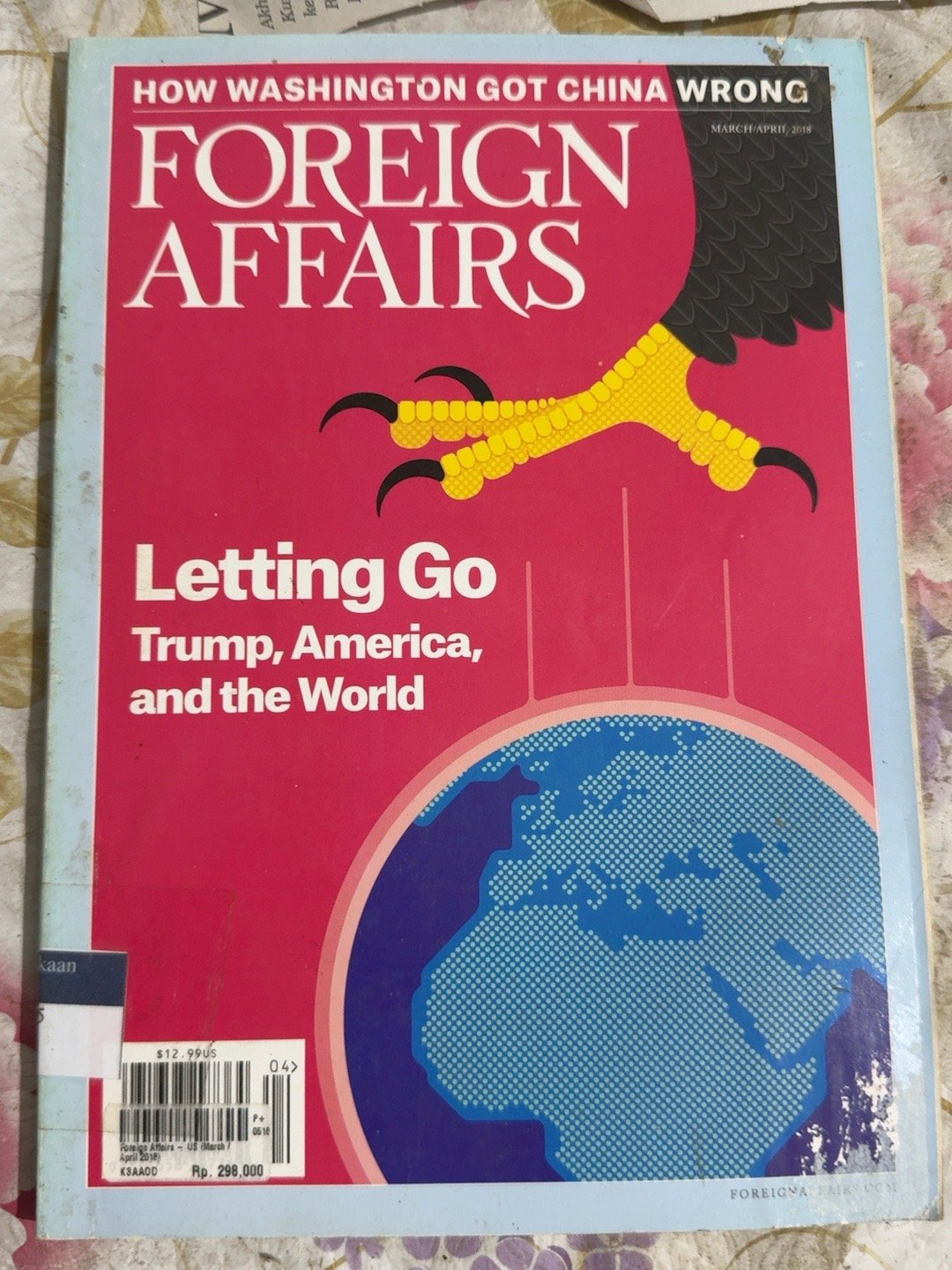
Foreign Affairs — Letting Go: Trump, America, and the World (March/April 2018)
Council on Foreign Relations, New York · Vol. 97, No. 2, Maret/April 2018; sampul · 2018-03
Abstract
The March/April 2018 issue of Foreign Affairs focuses on the foreign policy of Donald Trump's first administration and the debate over America's position in the world order. An additional cover line discusses how Washington understands China.
- Identifier
- KBA-MJL-2018-0001
- Type
- Majalah
- Publisher
- Council on Foreign Relations, New York
- Date Issued
- 2018-03
- Bibliographic Citation
- Vol. 97, No. 2, Maret/April 2018; sampul
- Subject
- Hubungan internasional Kebijakan luar negeri Amerika Serikat Donald Trump Amerika Serikat dan Tiongkok Tatanan internasional
- LC Classification
- D410 — Sejarah dunia abad ke-20: terbitan berkala
- LCSH Subject
- International relations -- Periodicals United States -- Foreign relations -- Periodicals
- BISAC Category
- POL011000 POLITICAL SCIENCE / International Relations / General
- Language
- Inggris
- Description
- Identity and place in the collection The March/April 2018 issue of Foreign Affairs, volume 97 number 2, takes as its cover theme Letting Go: Trump, America, and the World. This periodical is published by the Council on Foreign Relations. The photograph of the copy shows a red cover with an illustration of a bird's talon above a globe, the magazine's title in white, and the additional cover line How Washington Got China Wrong. The identification of the issue has been checked against the publisher's official archive. This entry documents one issue of the magazine as a whole, so the name of an individual contributor is not used as the sole author of the entire issue. [1] The position of this issue within the collection of Pustaka KBA13 Academy can be understood through three search paths: the foreign policy of the United States, the debate over the international order, and America's relations with China. All three help connect this material with books, clippings, and other magazine issues that discuss changes in the distribution of world power. The following notes are a curatorial introduction based on the cover and the publisher information available. They do not state that all the articles or pages of the physical copy have been read and checked for completeness. Theme of the issue and the time frame of reading The publisher presents the main package of this issue as an assessment of foreign policy after one year of Donald Trump's first administration. [2] This dating is important because the material records the debate of early 2018. Readers should not read later developments into the original intentions of the authors. In research on the history of ideas, writing published before an event has a different standing from interpretation made after the outcome is known. The magazine can serve as material for comparing the questions posed at that time with the changes later studied using other sources. The term letting go in the cover title opens a curatorial question about the relationship between power, responsibility, and international commitment. A state can maintain its military capability while changing the way it uses treaties, institutions, or partnerships. To read material of this kind carefully, researchers need to distinguish material capability from political will, and the statements of leaders from the implementation of policy. These distinctions are reading tools suggested by this catalogue, not quotations or collective conclusions attributed to all the authors in the magazine. Several entry points to the contents The official table of contents lists writings by Eliot A. Cohen, Jake Sullivan, Barry R. Posen, Adam S. Posen, and Sarah Margon in the main theme group. The essays section also contains The China Reckoning by Kurt M. Campbell and Ely Ratner, as well as contributions on Asia, energy, Iran, and decisions on the use of nuclear weapons. These names are contributors to different sections. This short list is not a complete transcription of the table of contents, and each article title needs to be recorded as part of the same magazine issue if separate analytical entries are created in future. [1] For teaching purposes, this diversity of topics makes it possible to design exercises on levels of analysis. Students can distinguish questions about a leader, a government organisation, a state, a region, and the international system. A change in rhetoric does not automatically prove a change in structure, just as the continuity of an institution does not always mean that its practice remains the same. Reading a policy magazine can begin by identifying the unit of analysis of each piece before assessing its argument. This simple step helps prevent mismatched comparisons between articles that are in fact answering different questions. US-China relations as a research path The cover line about Washington's misreading of China, printed at the top of the cover, can be used as an additional access term. That headline shows that relations between the two countries were one of the editorial attractions of this issue. However, a cover line is not sufficient to establish the full argumentative position of the authors. Users researching this topic should open the relevant article and examine the definitions, periods, and evidence used. The catalogue provides a way into the material, while assessing the strength of the arguments still requires direct reading. Research paths that might be developed include the relationship between policy expectations and political change, the use of trade as an instrument of foreign relations, and the difference between diplomatic engagement and strategic competition. In a research design, such questions need to be narrowed by actor and time period. For example, a researcher could map how the concept of leadership is used across several consecutive issues of the magazine. This example is a proposed use of the collection; it does not mean that such research has been carried out or that this magazine provides all the data needed to answer it. Reading the cover as a visual document The cover illustration is an important part of the object's documentation. The bird's talon, the globe, and the spatial relationship between them can be studied as choices of visual representation of power. Such an interpretation must be given the status of a researcher's reading. Without information from the illustrator or the editors, the catalogue does not establish any single symbolic meaning as the official intention of the image's creator. Colour, composition, and typographic hierarchy are nonetheless worth recording because they help identify the issue and to study how international issues are packaged to attract readers' attention. The photographed copy has a library label, a sales sticker with a barcode, fold marks, and worn areas on the surface. These marks are information about the condition of the object visible in the image. The price sticker is not taken as a present market value, and a label that cannot be fully read is not used to invent a provenance. Separating bibliographic information from the history of the copy is important so that readers know which information applies to the published edition and which relates only to the physical object in this collection. Documentation, access, and development of the entry The original photograph needs to be retained as the documentary reference. If a cleaned-up image is included, it must be labelled as a visual derivative, especially if it was made with the help of AI. Perspective correction and lighting adjustment do not prove that parts that were originally illegible have been accurately restored. The title, date, illustration, and labels need to be compared with the original photograph before the image is used as the main cover. If any letters have changed or details have been lost, the processed version must be withheld from publication as a documentary image. Further development of the entry could include photographs of the table of contents page, the publisher's information page, the spine, and the back cover. A physical examination is needed to confirm the number of pages and the completeness of the copy. The year of publication must remain 2018, while the date of documentation is recorded separately. Subjects should be stored as multiple values so that they can be searched individually. With careful recording, this issue becomes a meeting point between the history of policy, media studies, and collection documentation. Its value lies in its ability to bring readers together with a source whose identity and the limits of whose description are clear. Verification sources: [1] Foreign Affairs. March/April 2018. Volume 97, Number 2. https://www.foreignaffairs.com/issues/2018/97/2 (accessed 18 October 2026). [2] Council on Foreign Relations. Walking Away From World Order: Weighing Trump’s First Year of Foreign Policy. 13 February 2018. https://www.cfr.org/articles/walking-away-world-order-weighing-trumps-first-year-foreign-policy (accessed 18 October 2026).
- Rights
- Koleksi pribadi KBA13 Academy
- Collection
- Magazines
How to cite
“Foreign Affairs — Letting Go: Trump, America, and the World (March/April 2018)”, Council on Foreign Relations, New York, Vol. 97, No. 2, Maret/April 2018; sampul, 2018-03. KBA13 Academy Archive and Library, KBA-MJL-2018-0001.
Related documents
Magazine
Prisma No. 3, Maret 1981: Damai di Dunia? [Prisma No. 3, March 1981: Peace in the World?]
Book
Pengantar Hubungan Internasional: Keadilan dan Power [Introduction to International Relations: Justice and Power]
Theodore A. Couloumbis

Book
Globalisation and the New Realities
Mahathir Mohamad
Document (presentation)
Apa Itu Geopolitik? Definisi dan Ruang Lingkup [What Is Geopolitics? Definition and Scope]
Kamaruzzaman Bustamam Ahmad