Magazine
Foreign Affairs — America’s Forgotten Wars (November/December 2017)
Council on Foreign Relations, New York · Vol. 96, No. 6, November/Desember 2017; sampul · 2017-11
Abstract
The America’s Forgotten Wars issue, with lines of inquiry on Afghanistan, Iraq, Syria, and security strategy. Material for studying the relationship between political objectives, military action, and the distribution of public attention to war.
- Identifier
- KBA-MJL-2017-0002
- Type
- Majalah
- Publisher
- Council on Foreign Relations, New York
- Date Issued
- 2017-11
- Bibliographic Citation
- Vol. 96, No. 6, November/Desember 2017; sampul
- Subject
- Perang Intervensi Afghanistan Irak Suriah
- LC Classification
- D410 — Sejarah dunia abad ke-20: terbitan berkala
- LCSH Subject
- International relations -- Periodicals United States -- Foreign relations -- Periodicals
- BISAC Category
- POL011000 POLITICAL SCIENCE / International Relations / General
- Language
- Inggris
- Description
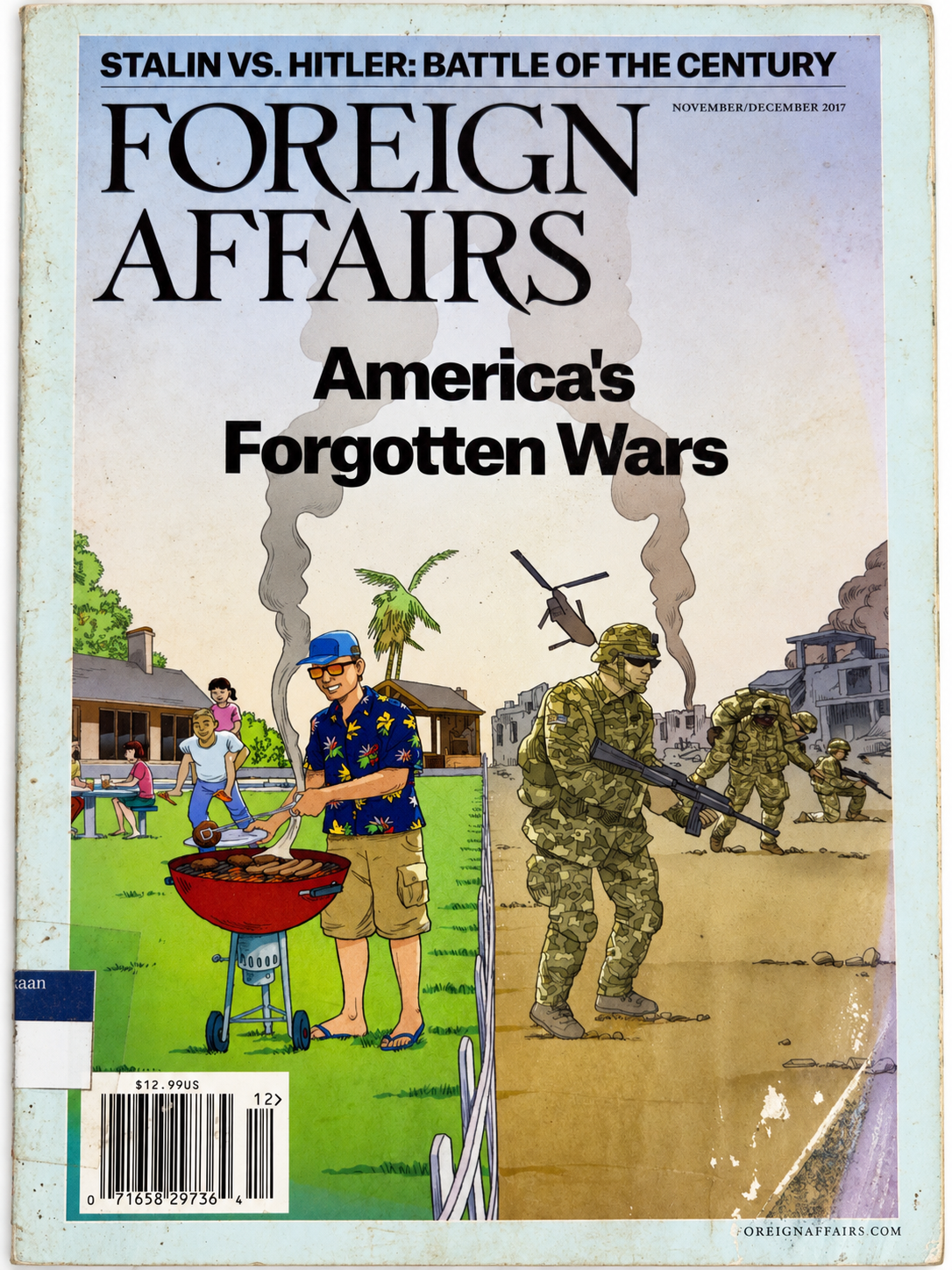
- Identity of the magazine issue The November/December 2017 issue of Foreign Affairs, volume 96, number 6, features the theme America’s Forgotten Wars. The cover brings together a relaxed, leisurely atmosphere and a war scene within a single illustrative landscape. The additional cover line mentions Stalin and Hitler. The date, volume, number, and theme have been confirmed through the publisher's official archive. This publication of the Council on Foreign Relations is documented as a single magazine issue. The title does not refer to a history book of a similar name, and the word forgotten is recorded as an editorial frame that needs to be read through its context, not as a conclusion that no community remembers these wars. [1] War and the distribution of attention As a curatorial point of entry, the theme can be developed into questions about how public attention is divided. Events that are still unfolding may be less visible in news coverage, while their consequences continue to be felt by particular communities. Research needs to distinguish media visibility, political attention, and direct experience. The three do not always move in the same direction. The word forgotten should be clarified by asking who forgets, by what measure, and over what period. In this way, an editorially powerful term can be turned into a more specific and testable research problem. The official table of contents includes Kosh Sadat and Stan McChrystal on Afghanistan, Emma Sky on Iraq, Robert S. Ford on Syria, and Lisa Monaco on strategy against terrorism. Contributions by Ivo H. Daalder and Susan Hennessey are also listed, on the Russia track and on cyberattacks. [1] These names and topics provide orientation, not a complete summary of the authors' positions. Users need to select the relevant articles and preserve the differences between voices. A magazine that carries differing recommendations does not have a single conclusion that can be inferred from the cover title alone. Political objectives and military action The material can be used to examine the relationship between operational targets and political objectives. Success in one activity does not automatically explain the attainment of the desired end state. Research needs to show how intermediate results are connected to final outcomes. Users can construct a table of objectives, instruments, implementers, and indicators. If objectives change during the process, those changes must be recorded. The catalogue does not judge particular operations as successes or failures without reading and additional sources. It offers a way of understanding the structure of arguments that is often hidden behind terms such as victory or mission sustainability. Researchers can also pay attention to how costs are distributed. Budgets, risks to personnel, damage to infrastructure, and the experiences of the population are different dimensions. A debate may appear complete from the policymakers' side yet not give sufficient space to the affected communities. If the research question concerns the experiences of citizens, sources capable of recording them are needed. Strategy articles are not a substitute for all testimony. Distinguishing types of sources helps maintain the link between research aims and evidence, while preventing a single perspective from being taken as sufficiently representative of all the consequences of war. Sustainability and the decision to end Another line of inquiry is to examine the reasons for maintaining or changing engagement. Research can distinguish considerations of security, obligations to partners, and estimates of the consequences of withdrawal. Each reason carries assumptions that need to be examined. Comparing options requires attention to the alternatives that were actually available at the time, not only those that appear possible once the outcome is known. Users can mark the conditions stated by the authors and the things that were not yet known. This approach ensures that contemporaneous recommendations are not turned into unconditional claims. For teaching peace studies, the issue can help distinguish the cessation of operations from the formation of a stable political order. The two may be related but do not always occur together. Research needs to specify the outcomes and the time frame of assessment. A change may reduce one risk while giving rise to other problems. This curatorial note does not offer a resolution to the conflicts, but suggests ways of reading the trade-offs and limitations in policy arguments. Official documents, local sources, and appropriate historical material are needed to examine the processes in greater detail. Memory and everyday life The juxtaposition of a leisurely atmosphere with war on the cover opens a reading about the distance of experience. Users can examine how people who are not in the conflict zone understand actions carried out in the name of their state. However, the illustration does not prove the attitudes of all citizens. Research on attention or indifference requires relevant sources, such as news coverage or surveys. The catalogue maintains the distinction between describing an image and drawing sociological conclusions. Visual interpretation is the beginning of a question, not a substitute for evidence about the behaviour or beliefs of a society. In memory studies, the material can be compared with The Undead Past. The two issues offer different points of entry: attention to wars that are still being discussed, and the relationship between the past and politics. The connection is thematic. Users should not assume that both use the same concepts. Research can choose one aspect, such as who is remembered or how responsibility is discussed, and then assemble a commensurate corpus. The rules for selecting material need to be stated so that conclusions do not depend merely on two covers that appear to match. Time limits of the source The 2017 issue must be read as a contemporaneous source. Later developments should not be silently inserted into the original intentions of the authors. If readers wish to assess their forecasts, new sources and their dates need to be cited. Differences in outcomes can be a reason to examine assumptions, changes in circumstances, or information that was not available. The value of the archive does not depend on a requirement that all its recommendations later proved correct. It provides a record of debate that can be used to understand how choices and uncertainty were shaped at a particular time. Condition of the copy and metadata The photograph shows a library label, a sales sticker, and signs of use. The original photograph serves as the documentary reference; the AI output is included as a labelled visual derivative because small details may change. The number of pages, completeness, and inventory number have not been determined from the cover. The year of publication is 2017 and the date of documentation is recorded separately. The subjects war, intervention, Afghanistan, Iraq, and Syria are stored as multiple values. Photographs of the table of contents and the publisher's page would help complete the metadata, followed by a check for duplicates before the entry is published to the catalogue. Mapping public attention If research aims to test the idea of forgotten wars, users can determine the type of media, the time span, and the measure of attention before collecting material. The number of news items differs from the depth of discussion or public engagement. The three measures can be examined separately. Researchers also need to pay attention to events that cause attention to rise temporarily. With such a design, the word forgotten can be tested more carefully than if it were merely used as an impression. This issue is a source on editorial framing, while research on attention requires a media corpus and measurement rules that are stated openly. This copy of the November/December 2017 issue is held in the Pustaka KBA13 Academy Magazine collection together with other issues of Foreign Affairs, so that readers can trace shifts in foreign policy debates from one issue to the next and compare how authors read the same events at different times. For citation purposes, references should give the article title, the author's name, volume 96, number 6, and the pages read directly in the copy, not merely the cover theme. The original photograph of the cover is included as documentary evidence of the physical condition of the copy, while the AI-processed version only aids visual legibility and is not used to establish bibliographic data. [1] Foreign Affairs. November/December 2017, Volume 96, Number 6. https://www.foreignaffairs.com/issues/2017/96/6. Accessed 18 October 2026. The explanations of method and use are curatorial notes.
- Rights
- Koleksi pribadi KBA13 Academy
- Collection
- Magazines
How to cite
“Foreign Affairs — America’s Forgotten Wars (November/December 2017)”, Council on Foreign Relations, New York, Vol. 96, No. 6, November/Desember 2017; sampul, 2017-11. KBA13 Academy Archive and Library, KBA-MJL-2017-0002.