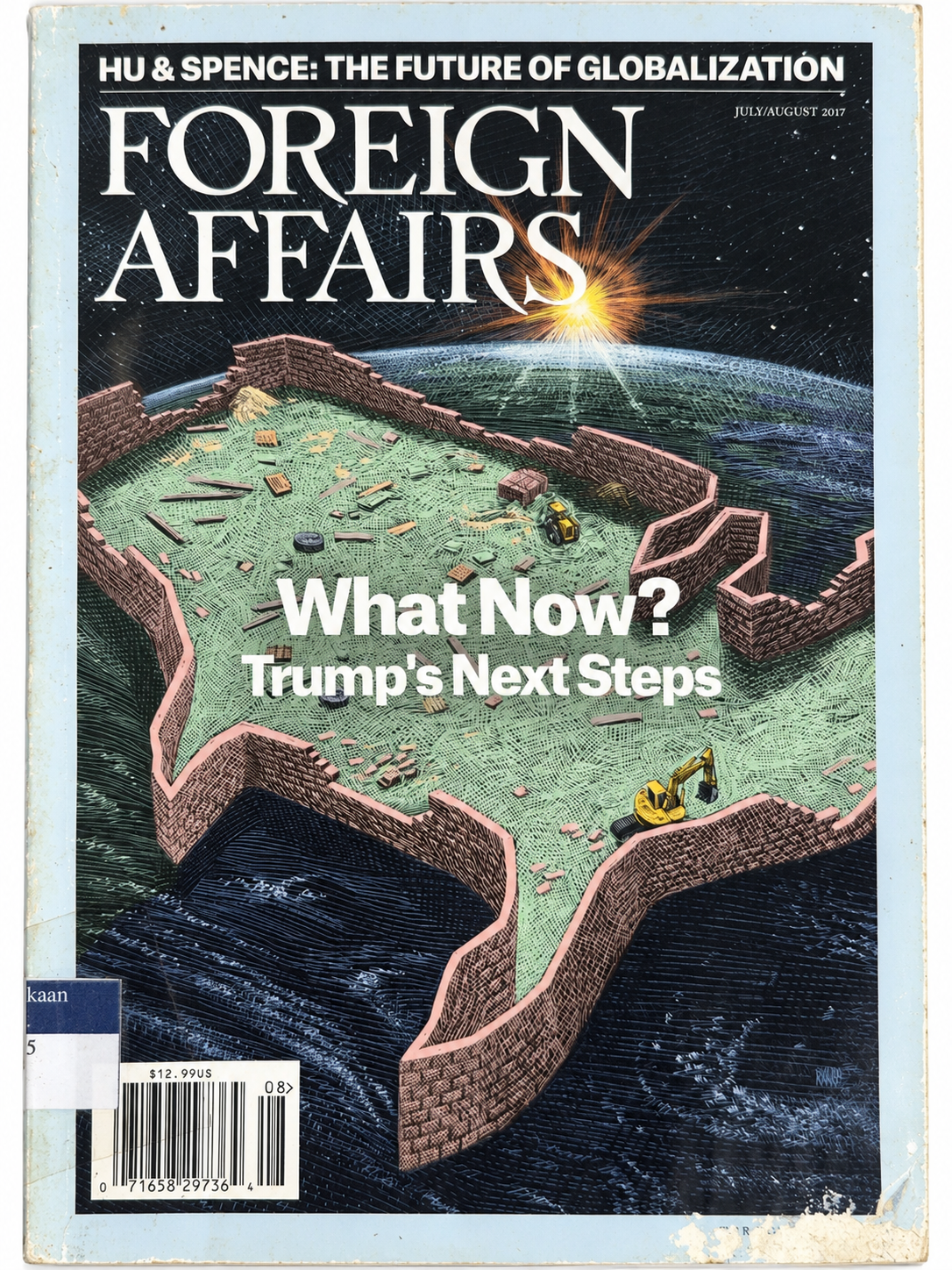
Foreign Affairs — What Now? Trump's Next Steps (July/August 2017)
Council on Foreign Relations, New York · Vol. 96, No. 4, Juli/Agustus 2017; sampul · 2017-07
Abstract
The July/August 2017 issue weighs the next steps after the first six months of the Donald Trump administration. The package "What Now?" contains Richard N. Haass on the direction to be taken, Elliott Abrams, who sees Trump as a traditionalist, Tim Kaine on a "new Truman Doctrine", as well as pieces on health-care reform, the tax plan, environmental policy (Fred Krupp), and the Paris Agreement (Brian Deese). The additional cover headline refers to the essay by Fred Hu and Michael Spence on why globalisation has stalled. Other essays discuss a course correction in Asia policy (Ely Ratner), terrorist financing, the nuclear debate in Germany, entrepreneurship in Palestine, and the next energy revolution.
- Identifier
- KBA-MJL-2017-0005
- Type
- Majalah
- Publisher
- Council on Foreign Relations, New York
- Date Issued
- 2017-07
- Bibliographic Citation
- Vol. 96, No. 4, Juli/Agustus 2017; sampul
- Subject
- Donald Trump Kebijakan luar negeri Amerika Serikat Globalisasi Kebijakan iklim Reformasi kesehatan Perpajakan Tiongkok
- LC Classification
- D410 — Sejarah dunia abad ke-20: terbitan berkala
- LCSH Subject
- International relations -- Periodicals United States -- Foreign relations -- Periodicals
- BISAC Category
- POL011000 POLITICAL SCIENCE / International Relations / General
- Language
- Inggris
- Description
- Issue identity Foreign Affairs, July/August 2017 issue, volume 96 number 4, features the theme What Now? Trump’s Next Steps. The cover shows the surface of the earth with a wall, rubble, and heavy equipment. The top headline names Fred Hu and Michael Spence on the future of globalisation. The date, volume, number, and theme were confirmed through the publisher's official archive. The magazine is published by the Council on Foreign Relations and is recorded as a single issue of a periodical. The additional headline is neither the name of a separate book nor the author of the entire contents of the issue. [1] The question of next steps The question form on the cover offers an entry point for reading recommendations at a particular stage of an administration. Users can ask which problems are considered most urgent, which changes are judged possible, and who is expected to take the decisions. A proposal always starts from a diagnosis and an assessment of options. Readers therefore need to separate the description of a situation from a call to action. This curatorial note does not state that all the proposals in the issue were subsequently implemented. The value of the material lies in its ability to record a debate when outcomes were not yet known. The official table of contents lists Richard N. Haass on policy direction, Elliott Abrams on the Trump administration, and Fred Hu and Michael Spence on globalisation. Contributions by Tim Kaine, Ely Ratner, Brian Deese, and Peter R. Neumann are also listed on different topics. [1] This short list provides orientation towards the articles, not a complete transcription of the issue's contents. Users should preserve the identity of each author when quoting. The presence of different pieces in one magazine does not prove that the contributors share the same diagnosis or recommendations. Changes of direction and organisational limits One possible line of research is to distinguish the desire to change policy from the ability to implement it. Procedures, resources, political support, and relations with partners can shape outcomes. Users can draw up a map of who decides and who executes. Such a map helps show that an administration is not a single, fully uniform voice. If research finds differences in statements, the next step is to examine their positions and context before concluding chaos or deliberate strategy. Both explanations require evidence that cannot be replaced merely by an assessment of communication style. Students can also compare the stated goals with the outcomes observers use to judge success. Comparability of measures must be maintained. A policy intended for one goal cannot be directly regarded as successful because it produced something else without explaining the relationship between the two. Conversely, unintended consequences can be an important finding. Magazine material helps formulate questions and hypotheses, while testing implementation requires documents that directly record decisions, timing, and the changes observed in the field of research. Globalisation and economic relations The additional headline provides a path for discussing globalisation as a process with several dimensions. Trade, investment, mobility, and the exchange of knowledge do not always move in the same pattern. As a reading framework, users can ask which domain is discussed and what indicators are used. Saying that globalisation has stalled or strengthened requires temporal comparisons and measures. Careful research does not take a single example as an explanation of the whole process. This entry offers analytical tools, not a detailed summary of Hu and Spence's argument, which still needs to be read directly. Economic relations can also be studied through the difference between aggregate benefits and the experiences of groups. An increase in national measures does not automatically explain equity or a sense of security. Conversely, one experience of loss does not represent all the consequences of a policy. Users can separate the household, firm, and state levels before connecting them. This helps prevent policy debate from becoming merely a clash of slogans. For empirical research, data appropriate to the chosen unit and period are needed, in addition to argumentative writing as a source on how problems are formulated. The environment and international commitments The presence of an environmental strand allows a reading of the relationship between domestic decisions and cross-national cooperation. Users can ask whether commitment is measured by statements, rules, financing, or outcomes. A change in one part does not always indicate a similar change in another. Research can trace how different institutions and actors maintain or change their activities. The catalogue does not assume that an article's title proves a particular consequence. Conclusions about implementation and outcomes need to be built on clear supporting sources, especially when readers assess conditions after the time of publication. Sequence within the collection This issue can be placed after Present at the Destruction? and before Trump and the Allies in the 2017 publication sequence. That sequence allows research into the development of the kinds of questions asked throughout the administration's first year. However, a change of cover is not automatic evidence of a change in an author's opinion. Researchers need to select comparable articles and show the relationship they intend to test. Comparisons can be directed at the language of goals, assessments of institutions, or ways of portraying partners. A clear corpus is more useful than a series of quotations chosen only because they support an initial conclusion. A reading exercise can ask students to compile notes in two parts: what the source states and what they conclude from it. Each conclusion is given reasons and limits. This practice separates understanding from agreement. A piece of writing can be important to study even if the reader does not accept its recommendations. Research on the history of policy requires sources that show differences of view, not only those later judged correct. In this way, old magazines are understood as records of choices and uncertainty, not as a list of predictions that must always be accurate. Cover and documentation The landscape and boundary on the cover can be interpreted as a representation of direction and the reach of action. This interpretation is a visual reading that does not establish the creator's intention. The original photograph preserves the copy's labels, stickers, and traces of use. The AI output is included only as a labelled visual derivative because small details may change. The page count and completeness have not been confirmed from the cover. The year 2017 is the year of publication, distinct from the date of documentation. Subjects are stored as separate values; the inventory number and publication are assigned only after a duplication check and completion of the available data. Reading choices as a sequence A next step may mean continuing, correcting, or halting an action. Research needs to show which options are actually discussed and why. A recommendation does not always presuppose a comprehensive change. Users can write down the sequence of actions and the intermediate outcomes expected. If the relationship between the parts is not explained, that gap is recorded as a question. This way of reading helps assess whether a programme has a sufficiently clear path of implementation. It also separates criticism of goals from criticism of the means of achieving them, so that differences of opinion can be understood in greater detail. This copy of the July/August 2017 issue is held in the Magazine collection of the Pustaka KBA13 Academy together with other issues of Foreign Affairs, so that readers can trace shifts in foreign policy debate from one issue to the next and compare how authors read the same events at different times. For citation purposes, references should name the article title, the author's name, volume 96, number 4, and the pages read directly in the copy, not merely the cover theme. The original photograph of the cover is included as documentary evidence of the physical condition of the copy, while the AI-processed version only aids visual legibility and is not used to establish bibliographic data. [1] Foreign Affairs. July/August 2017, Volume 96, Number 4. https://www.foreignaffairs.com/issues/2017/96/4. Accessed 18 October 2026. The explanations of method and use are curatorial notes.
- Rights
- Koleksi pribadi KBA13 Academy
- Collection
- Magazines
How to cite
“Foreign Affairs — What Now? Trump's Next Steps (July/August 2017)”, Council on Foreign Relations, New York, Vol. 96, No. 4, Juli/Agustus 2017; sampul, 2017-07. KBA13 Academy Archive and Library, KBA-MJL-2017-0005.
Related documents
Foreign Affairs — Letting Go: Trump, America, and the World (March/April 2018)
Foreign Affairs — The Power of Populism (November/December 2016)
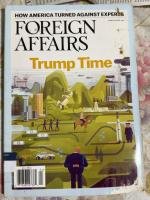
Foreign Affairs — Trump Time (March/April 2017)