Foreign Affairs — Trump and the Allies: The View From Abroad (September/October 2017)
Council on Foreign Relations, New York · Vol. 96, No. 5, September/Oktober 2017; sampul · 2017-09
Abstract
The September/October 2017 issue views the Trump administration from the perspective of America's allies. The package "Trump and the Allies: The View From Abroad" contains Natalie Nougayrède on France's gamble, Stefan Theil on Berlin's balancing act, David Goodhart on the "Trump trap" for the United Kingdom, Takako Hikotani on Japan, Michael Fullilove on Australia, Jonathan Kay on Canada under Trudeau, and Shannon K. O'Neil on the impasse with Mexico. The top cover line refers to Jon D. Michaels's essay on Trump and the "deep state". Other essays include Andrew J. Bacevich on saving the idea of "America First", Niall Ferguson on the false prophecy of a hyperconnected world, and Graham Allison on Chinese-American rivalry.
International relations -- PeriodicalsUnited States -- Foreign relations -- Periodicals
BISAC Category
POL011000 POLITICAL SCIENCE / International Relations / General
Language
Inggris
Description
Publication identity
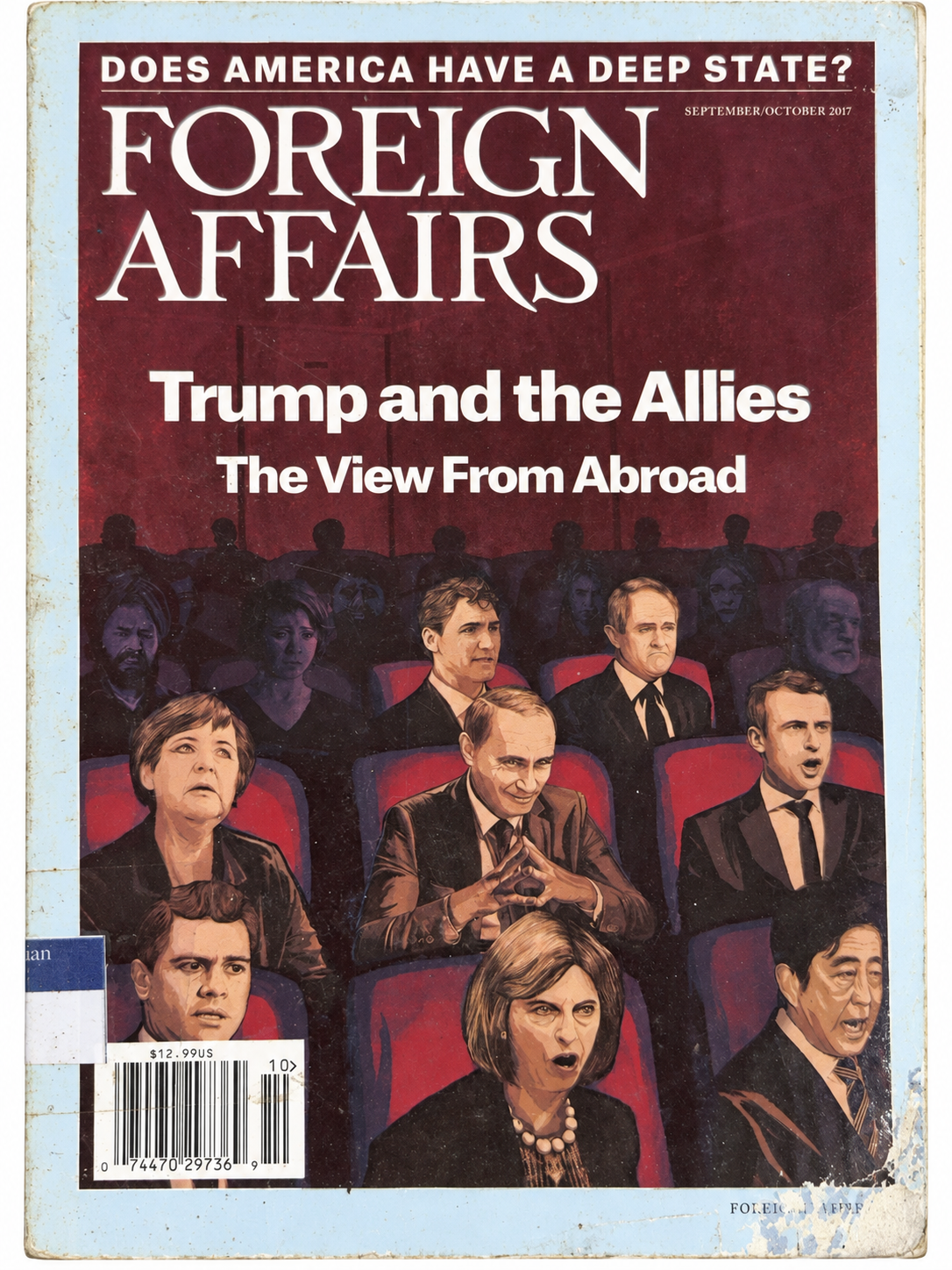
The September/October 2017 issue of Foreign Affairs, volume 96 number 5, takes as its theme Trump and the Allies: The View From Abroad. The cover shows a number of portraits of political figures arranged like an audience, with the additional cover line Does America Have a Deep State?. The dating and theme have been checked against the publisher's archive. The magazine is published by the Council on Foreign Relations and is recorded as a single issue of a periodical. The identities of all the figures in the illustration are not established merely from facial resemblance; recording names requires more direct information from the publisher or supporting sources. [1]
The view from abroad as a source
The subtitle places the perspective of outsiders as the entry point for reading. In international relations research, how a policy is received may differ from the intentions of its makers. Therefore, statements by the American government need to be distinguished from the interpretations of its partners. An analysis also does not automatically represent all the citizens or all the institutions of a country. Users can record the author's position, the type of source, and its audience. These distinctions make the term view from abroad more precise, while also preventing a single piece of writing from being used as the sole voice of the entire society being discussed.
Alliances as negotiated relationships
As a curatorial framework, alliances can be studied through obligations, expectations, and practices of cooperation. A formal agreement does not always explain the whole relationship. Trust can be built through communication, joint activities, and the experience of facing problems together. Research needs to show the processes that connect these elements. Calling an alliance strong or weak is not enough without indicators. Users can determine whether what is being studied is the capacity to act, public acceptance, shared goals, or institutional continuity. Each measure answers a different question and requires appropriate evidence.
One possible exercise is to map the expectations of each party. What is regarded as an obligation? What is judged to be a burden? Which party feels it benefits? Research need not start from the assumption that all partners have the same yardsticks. Differences in priorities can arise even while cooperation continues. The magazine's material can help identify questions, but assessment of particular treaties requires official documents and sources from the parties involved. The catalogue does not establish legal obligations or explain the entire content of any particular security relationship.
Credibility and communication
The relationship between words and trust is another path. A leader's statements may be read differently by observers with different experiences and interests. Researchers can trace the context, the channels of communication, and the documented responses. Ambiguity does not automatically mean a deliberate strategy, just as firm wording does not always guarantee implementation. To assess the influence of communication, evidence of reception and changes in action is needed. This entry proposes a way of reading the debate, not a statement that a single mechanism has been proven to operate in all the articles in this issue.
Students can create a table that distinguishes the original statement, the author's interpretation, and the responses of other actors. Such a table helps prevent voices from shifting in summaries. When an article says that allies feel anxious, the source of that claim needs to be recorded. Does it come from officials, surveys, or an observer's assessment? The type of evidence determines the scope of the conclusion. This exercise is useful for research on perceptions, because the term state attitude often lumps together institutions and groups that may in fact hold differing views at the same time.
The domestic politics of partners
Views of America may be related to debates within partner countries, but such a connection needs to be demonstrated. Users can examine how domestic actors use foreign policy as part of arguments about security, the economy, or identity. Researchers should not assume that every statement is merely a direct reaction to Washington. Choices that look one way from outside may have local histories and aims. Adding domestic sources will help show how international considerations meet political competition and institutional needs in the place being studied.
This path is relevant for comparative learning. Two countries may face the same American action yet respond differently because their circumstances and options are not the same. Research needs to specify the factors being compared, rather than immediately assuming geographical distance or type of government as the explanation. A table can include goals, sources of dependence, alternatives, and forms of response. The results are used to formulate narrower questions. The magazine provides orientation material, whereas causal conclusions require proof that goes beyond surface similarities or differences.
The cover line on the deep state
The additional cover line about the deep state must be recorded as the title of a question, not as evidence of the existence of any particular secret network. Users can examine how the term is defined and used in public debate. The distinction between bureaucracy, organisational habits, policy resistance, and conspiracy needs to be maintained. Claims about hidden activities require their own evidence. The catalogue does not infer either their existence or their absence from the cover alone. The separation between recording a term and endorsing its claims is important so that metadata does not turn into statements unsupported by sources.
Connections across the collection
This issue can be compared with Trump Time, What Now?, and Letting Go. That sequence opens up research into how assessments of policy developed at different stages. However, a change of cover theme does not directly indicate a change in the stance of the whole magazine. The authors and the aims of the writing must be examined. Users can choose one path, for example the perceptions of allies, and then look for comparable articles. With clear selection rules, comparison reveals changes in questions and evidence, rather than merely assembling a story that makes use of a few attractive titles.
Condition and limits of documentation
The photograph of the copy shows a library label, a sales sticker, and signs of use. The original photograph is retained as evidence; the AI-processed version is only a labelled visual derivative that needs to be checked for small lettering and faces. The number of pages, completeness, and inventory number have not been established from the cover. The year 2017 is stored as the year of publication, separate from the documentation. The subjects alliances, Donald Trump, diplomacy, and international perceptions are stored as separate values. Photographs of the table of contents and the publisher's page could complete the catalogue before duplication checks and publication are carried out.
Recording asymmetric relationships
Cooperation does not always take place between parties of equal capability. Users can examine how such differences shape choices without assuming that the smaller party has no agency. Sources can be examined to see the room for bargaining, the alternatives, and the limits of dependence. Each of these needs to be demonstrated through corresponding actions or statements. This note helps readers avoid two simplifications at once: assuming that all partners are entirely free, or assuming that all of them merely accept the decisions of the stronger party. Real relationships need to be read through identified processes and contexts.
This copy of the September/October 2017 issue is held in the Magazine collection of Pustaka KBA13 Academy together with other issues of Foreign Affairs, so that readers can trace the shifts in foreign-policy debate from one issue to the next and compare the ways the authors read the same events at different times. For citation purposes, references should state the article title, the author's name, volume 96, number 5, and the pages read directly in the copy, not merely the cover theme. The original photograph of the cover is included as documentary evidence of the physical condition of the copy, while the AI-processed version only aids visual legibility and is not used to establish bibliographic data.
[1] Foreign Affairs. September/October 2017, Volume 96, Number 5. https://www.foreignaffairs.com/issues/2017/96/5. The identity of the issue was checked against the publisher's archive on 18 October 2026; direct access to the page was temporarily restricted. The section on analysis and use is a curatorial note.
“Foreign Affairs — Trump and the Allies: The View From Abroad (September/October 2017)”, Council on Foreign Relations, New York, Vol. 96, No. 5, September/Oktober 2017; sampul, 2017-09. KBA13 Academy Archive and Library, KBA-MJL-2017-0006.