
Magazine
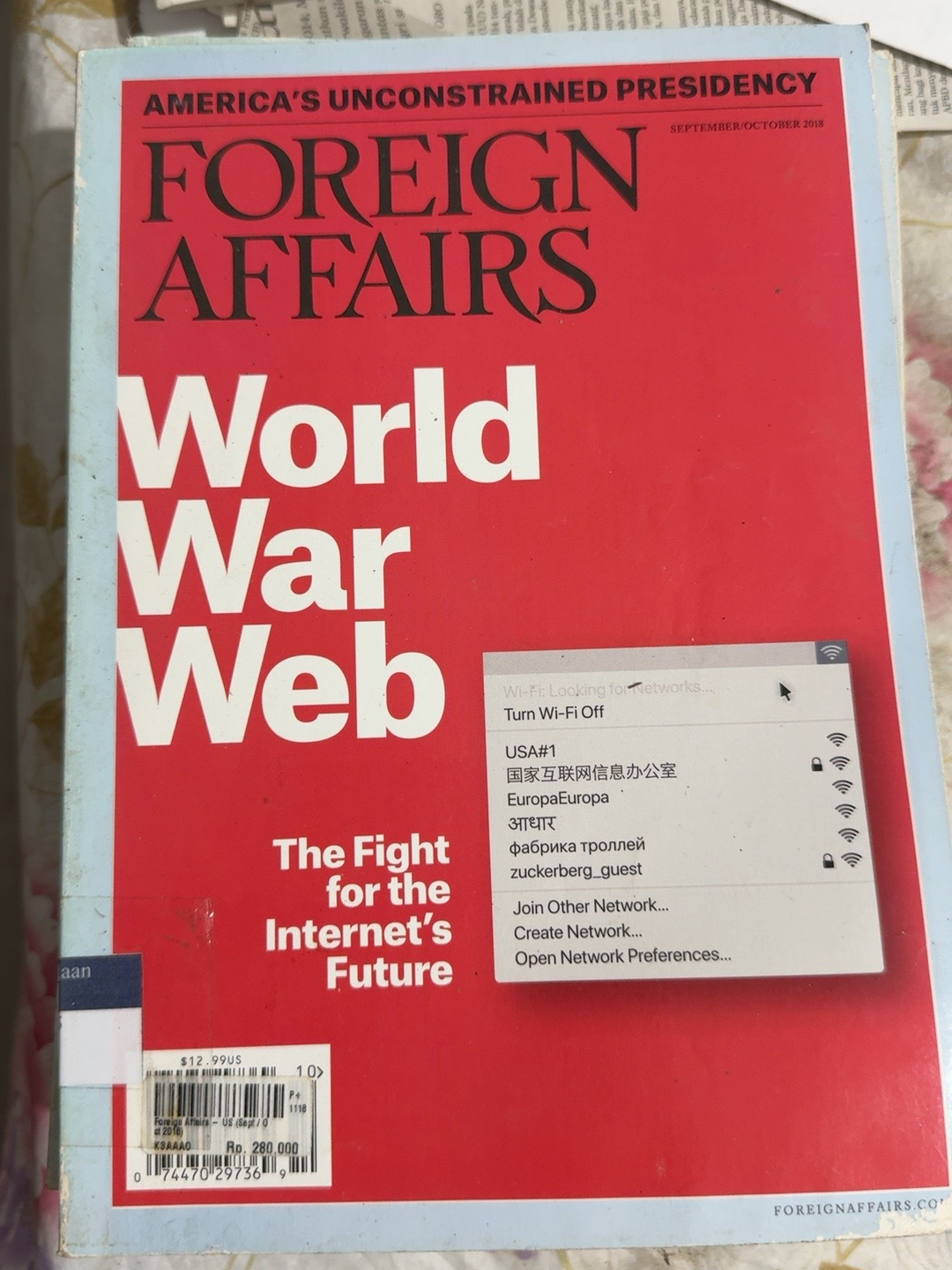
Foreign Affairs — World War Web: The Fight for the Internet’s Future (September/October 2018)
Council on Foreign Relations, New York · Vol. 97, No. 5, September/Oktober 2018; sampul · 2018-09
Abstract
The World War Web issue, which discusses the future of the internet through the paths of the state, regulation, data, and cybersecurity. Material for the study of digital sovereignty and of the relationship between technology, authority, and user experience.
- Identifier
- KBA-MJL-2018-0004
- Type
- Majalah
- Publisher
- Council on Foreign Relations, New York
- Date Issued
- 2018-09
- Bibliographic Citation
- Vol. 97, No. 5, September/Oktober 2018; sampul
- LC Classification
- D410 — Sejarah dunia abad ke-20: terbitan berkala
- LCSH Subject
- International relations -- Periodicals United States -- Foreign relations -- Periodicals
- BISAC Category
- POL011000 POLITICAL SCIENCE / International Relations / General
- Language
- Inggris
- Description
- Identity and theme The September/October 2018 issue of Foreign Affairs, volume 97 number 5, uses the cover theme World War Web: The Fight for the Internet’s Future. The red cover shows a panel resembling a menu of wireless network options. An additional cover line refers to an unchecked American presidency. The date, volume, number, and theme have been confirmed through the publisher's official archive. This publication of the Council on Foreign Relations is recorded as a single magazine issue. The panel on the cover is a printed element of the illustration, not a screenshot of KBA's device settings or a list of currently available networks. [1] The internet as a political space The cover theme allows users to examine the relationship between communication technology and authority. As a curatorial framework, the internet can be viewed through the layers of infrastructure, services, rules, and user practices. These four layers do not always change in the same way. Restricting a single service is different from altering the physical network or assigning legal responsibility. Careful research explains which layer is being discussed. In this way, the word control does not become a catch-all explanation that lumps together all forms of technical, economic, and political influence without showing their mechanisms. The official table of contents lists Adam Segal on China and the web, Nandan Nilekani on India, Helen Dixon on European regulation, Karen Kornbluh on the internet, and Michèle Flournoy and Michael Sulmeyer on cybersecurity. Viktor Mayer-Schönberger and Thomas Ramge are also listed in the discussion of data. [1] These names and paths provide orientation, not a complete summary of the authors' positions. The issue brings together different topics, so users need to select the articles that suit their research question. The opinion of one contributor is not taken as the sole voice of the entire magazine. States, companies, and users One possible line of research is to compare the kinds of authority held by states with the control held by service providers. Public rules, user contracts, technical decisions, and design choices have consequences that may be interrelated. However, each has a different basis and a different mode of proof. Users can trace who makes decisions and who has avenues for objection. The catalogue does not assume that all companies act alike or that all states have equal capabilities. Relationships need to be examined according to the organisation, field, and period chosen. For law students, the material can serve as an introduction to differences of jurisdiction and cross-border governance. A service can be used in many places, while legal obligations are determined by particular rules. Researchers need to examine primary legal texts if they wish to make judgements about authority or responsibility. Magazine articles help formulate problems, but do not replace examination of the provisions in force at the time and in the territory of the research. This entry discusses the value of the material for study, not legal advice on the use of any particular digital service. Data and participation The theme of data opens questions about the relationship between the collection of information, access, and the capacity to act. Possessing data is not the same as understanding it or being able to make use of it. Research can distinguish the parties that generate information, the parties that store it, and the parties that benefit from processing it. The choice of categories and the design of access also need attention. Students can draw up a flow map to show the movement of information and the decisions made at each stage. Such a map helps reveal points that are often hidden when the whole process is simply called digitalisation. User participation needs to be distinguished from the mere existence of a service. A system may be technically available yet difficult to use or offer no room for choice. Research on people's experiences requires sources that record actual practice, not merely the claims of providers. Users can compare policy documents, interfaces, and user experiences with the same questions. This issue can help identify themes and terms, while specialised research requires more direct material. This distinction ensures that accounts of technology do not erase the social circumstances of the people who use it. Security without oversimplification The cybersecurity path can be studied through the relationship between vulnerabilities, threats, and organisational responses. These three are not identical. The existence of a loophole does not prove that it has been exploited; the occurrence of a disruption also does not always explain who the perpetrator was. In open-source research, attribution claims need to be accompanied by their basis and the limits of their certainty. This description does not provide guidance for attacks or draw conclusions about particular incidents. Its focus is to help readers understand how policy writing constructs risk assessments and links them to choices of protection and responsibility. Students can create a table listing the object being protected, the disruption envisaged, the responsible party, and the cost of the response. This step helps show that security recommendations may prioritise different goals. Service availability, confidentiality, freedom, and ease of use are not always given equal weight. Comparison of arguments improves when these values are made explicit rather than hidden in the term security. Users can then assess whether a recommendation really answers the problem described or instead shifts the risk onto other parties. Connections with other parts of the collection This issue can be linked with Innovation Power, Autocracy Now, and Come Home, America?, which provide paths on technology and power. These connections are thematic and do not indicate that all the authors respond to one another. Research can trace changes in the language about states and companies from 2018 into later periods. However, later developments must not be read in as though they were known when this issue was published. Its temporal identity needs to be preserved so that users can distinguish contemporaneous debate from retrospective assessment using newer sources. Documentation and condition of the copy The network panel on the cover can be studied as the transformation of an everyday object into a geopolitical metaphor. Any specific interpretation is the user's reading unless supported by information from the illustrator. The photograph shows a label, a sales sticker, and signs of use. The original photograph serves as evidence; the AI output is a labelled visual derivative that may alter small lettering. The number of pages, physical completeness, and inventory number have not been established from the cover. The publication year 2018 is stored separately from the documentation date. Photographs of the table of contents and the publisher's page will help complete the catalogue more accurately. Examining metaphorical language The word war in the cover theme can be analysed as a way of framing competition. Researchers need to check whether the articles discuss armed conflict, technology policy, or contests over authority in different senses. The same language does not automatically indicate the same kind of activity. Reading notes can record a term together with the context and evidence of its use. In this way, a metaphor is not accepted as a classification without examination. This exercise helps students see how word choices shape a sense of urgency and the limits of what actions are considered reasonable in digital debates. This copy of the September/October 2018 issue is held in the Magazine collection of Pustaka KBA13 Academy together with other issues of Foreign Affairs, so that readers can trace the shifts in foreign-policy debate from one issue to the next and compare the ways the authors read the same events at different times. For citation purposes, references should state the article title, the author's name, volume 97, number 5, and the pages read directly in the copy, not merely the cover theme. The original photograph of the cover is included as documentary evidence of the physical condition of the copy, while the AI-processed version only aids visual legibility and is not used to establish bibliographic data. [1] Foreign Affairs. September/October 2018, Volume 97, Number 5. https://www.foreignaffairs.com/issues/2018/97/5. Accessed 18 October 2026. The section on method and use is a curatorial note.
- Rights
- Koleksi pribadi KBA13 Academy
- Collection
- Magazines
How to cite
“Foreign Affairs — World War Web: The Fight for the Internet’s Future (September/October 2018)”, Council on Foreign Relations, New York, Vol. 97, No. 5, September/Oktober 2018; sampul, 2018-09. KBA13 Academy Archive and Library, KBA-MJL-2018-0004.