
Magazine
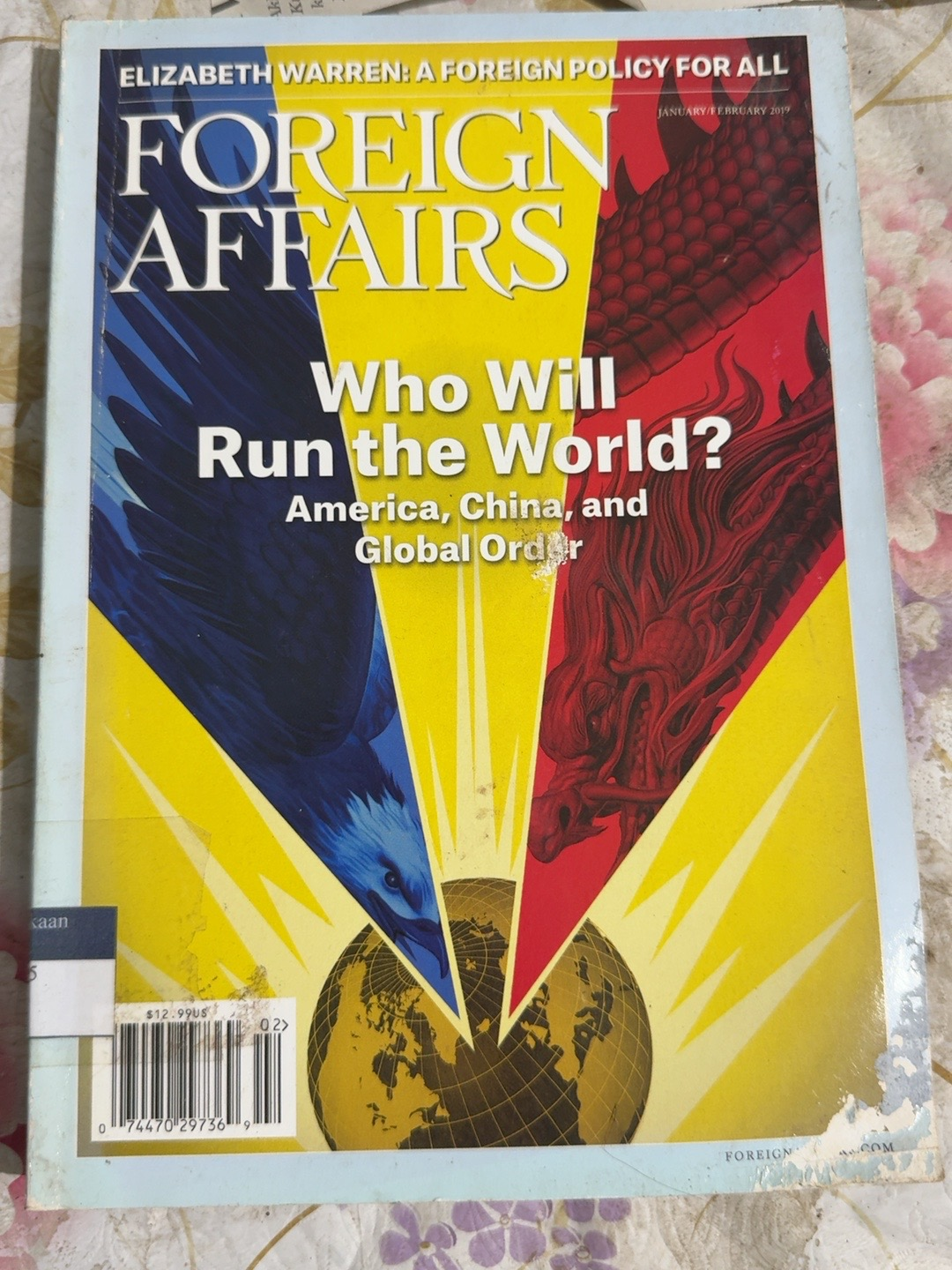
Foreign Affairs — Who Will Run the World? America, China, and Global Order (January/February 2019)
Council on Foreign Relations, New York · Vol. 98, No. 1, Januari/Februari 2019; sampul · 2019-01
Abstract
The issue Who Will Run the World? America, China, and Global Order, which brings together discussion of order, leadership, and foreign policy. Material for examining the differences between capability, influence, and the acceptance of rules.
- Identifier
- KBA-MJL-2019-0004
- Type
- Majalah
- Publisher
- Council on Foreign Relations, New York
- Date Issued
- 2019-01
- Bibliographic Citation
- Vol. 98, No. 1, Januari/Februari 2019; sampul
- LC Classification
- D410 — Sejarah dunia abad ke-20: terbitan berkala
- LCSH Subject
- International relations -- Periodicals United States -- Foreign relations -- Periodicals
- BISAC Category
- POL011000 POLITICAL SCIENCE / International Relations / General
- Language
- Inggris
- Description
- Identity and scope The January/February 2019 issue of Foreign Affairs, volume 98 number 1, presents the theme Who Will Run the World? America, China, and Global Order. The cover photograph shows fields of colour and the shapes of an eagle and a dragon heading towards a globe. The top cover line mentions Elizabeth Warren and a foreign policy for all. The date, volume, number, and theme have been confirmed through the publisher's official archive. This publication of the Council on Foreign Relations is recorded as a single magazine issue, not as the sole work of an author whose name appears on the cover. The editorial question is preserved, without being turned into an answer that has not been proven. [1] Power and the ordering of the world The title opens a question about the difference between having capabilities and setting the rules. As a curatorial framework, users can distinguish economic influence, security, institutions, and acceptance by others. Not all forms of power can be ranked on a single scale. A state may excel in one field yet still require cooperation in others. Research needs to determine what is meant by running the world. With a clear definition, the cover metaphor can be turned into questions about processes and relationships that can be examined through sources. The official table of contents lists Gideon Rose, Richard Haass, Oriana Skylar Mastro, and Yan Xuetong in the main theme group. Other sections contain Elizabeth Warren, Mara Karlin and Tamara Cofman Wittes, and Robert Chesney and Danielle Citron. [1] These names and groupings provide orientation to debates on order, policy, and digital information. This description does not summarise all the conclusions or assume that the authors share the same understanding of leadership. Users who need a particular position must read the relevant article and preserve the context when quoting. America and China as a relationship One research path is to view the rivalry as a relationship shaped by both parties and by other actors. An explanation that uses only the aims of one state may miss the acceptance, resistance, or adjustment of other parties. Users can draw up a map showing actions and responses over a particular period. Such a map helps avoid the assumption that all changes were designed from the outset. In research on the history of policy, stated aims need to be distinguished from the outcomes that eventually occurred. The catalogue proposes this tool; it does not establish a single explanation for the whole of US-China relations. Readers can also separate competition over capabilities from competition over rules or legitimacy. The two forms can proceed together, but the evidence for each is different. Economic size does not directly explain the acceptance of an idea, just as support in a forum does not necessarily indicate willingness to follow all policies. Research requires appropriate indicators. Students can record what is actually observed and how far the conclusions are extended. This step helps avoid using a single example as proof that a change in world order has already occurred across the board. Order as a layered arrangement In teaching, order can be read through institutions, habits, rules, and the distribution of capabilities. A change in one layer does not always erase the other layers. Users can ask which parts are seen as enduring and which are contested. An organisation can continue to function even though its purpose is reinterpreted. Conversely, the same institutional name does not prove that its practice has not changed. This reading tool makes terms such as transition or collapse more precise, and helps research show the mechanisms that connect events with structural change. The role of states outside the two great powers also needs attention. They may have different choices, interests, and sources of influence. Research need not assume that all of them simply follow one side. However, claims about the room for choice need to be substantiated through sources appropriate to the case. This magazine issue can help formulate broad questions, while analysis of a particular country or region requires additional material. In this way, a global theme does not erase the diversity of experiences and decisions at levels closer to the actors. Domestic politics and the foreign agenda The cover line about Elizabeth Warren provides a path for examining how domestic ideas are linked to international action. Users can ask which groups are the focus of attention, what aims are stated, and how obligations are explained. However, a single programmatic piece of writing is not evidence that an agenda has been implemented. Research needs to distinguish proposal, adoption, and implementation. When an author holds a political role, that position is recorded as of the time of publication. The author's position helps in understanding the source without replacing assessment of the arguments and evidence presented. For a class exercise, students can create a table of diagnosis, aims, instruments, and expected consequences. Each part is given a reference to the text. Such a table shows whether a proposal follows from the diagnosis or requires additional assumptions. Differences in values can also be recorded openly. Agreement on one aim does not mean agreement on all the means of achieving it. Reading with these distinctions helps avoid summaries that turn a debate into a simple choice between supporting or rejecting a country's entire foreign policy. Information and the public sphere The presence of a path on deepfakes in the table of contents opens questions about the relationship between visual evidence and trust. [1] Users can separate the capacity to create a piece of media, its dissemination, its reception, and its political consequences. A technical possibility does not automatically indicate an impact that has already occurred. Research requires sources for each stage of the relationship. This description does not provide guidance on media manipulation. Its focus is the possibility of using the magazine to study how information problems are formulated in international debate and how the limits of certainty are stated by the authors. Connections with the collection and documentation This issue can be linked with Letting Go, The World According to Xi Jinping, and The Age of Uncertainty. A thematic connection does not mean that all the articles respond to one another. Users need to keep track of the dates and definitions used. The cover itself can be studied as a composition about direction and the meeting of powers; any specific meaning is the reader's interpretation. The original photograph preserves the label and signs of use. The AI-processed version is only a labelled visual derivative, not evidence identical to every letter. The number of pages, completeness, and inventory number have not been confirmed from the cover. The year 2019 is kept separate from the documentation date. Reading global questions in a limited way A study need not answer the entire question on the cover. Users can choose one field, such as trade rules or agenda-setting in a particular institution. Actors and periods are then clearly defined. With such limits, the concept of influence can be linked to the evidence available. Findings from one field are not directly generalised to all international relations. This step keeps material on a large theme useful for student assignments or preliminary research, because it is used to clarify problems, not to force a comprehensive answer about the future of the world. This copy of the January/February 2019 issue is held in the Magazine collection of Pustaka KBA13 Academy together with other issues of Foreign Affairs, so that readers can trace the shifts in foreign-policy debate from one issue to the next and compare the ways the authors read the same events at different times. For citation purposes, references should state the article title, the author's name, volume 98, number 1, and the pages read directly in the copy, not merely the cover theme. The original photograph of the cover is included as documentary evidence of the physical condition of the copy, while the AI-processed version only aids visual legibility and is not used to establish bibliographic data. [1] Foreign Affairs. January/February 2019, Volume 98, Number 1. https://www.foreignaffairs.com/issues/2019/98/1. Accessed 18 October 2026. The section on method and use is a curatorial note.
- Rights
- Koleksi pribadi KBA13 Academy
- Collection
- Magazines
How to cite
“Foreign Affairs — Who Will Run the World? America, China, and Global Order (January/February 2019)”, Council on Foreign Relations, New York, Vol. 98, No. 1, Januari/Februari 2019; sampul, 2019-01. KBA13 Academy Archive and Library, KBA-MJL-2019-0004.
Related documents

Magazine
Siasah: Menjana Minda Bangsa, Bil. 6/01, Oktober 2001 [Siasah: Shaping the Nation's Mind, No. 6/01, October 2001]
Magazine
Tamadun: Membina Wawasan Ummah, Bil. 84, Oktober 2001 [Tamadun: Building the Vision of the Ummah, No. 84, October 2001]
Magazine
Foreign Affairs — The New Nationalism (March/April 2019)
Magazine