Magazine
Foreign Affairs — Searching for a Strategy (May/June 2019)
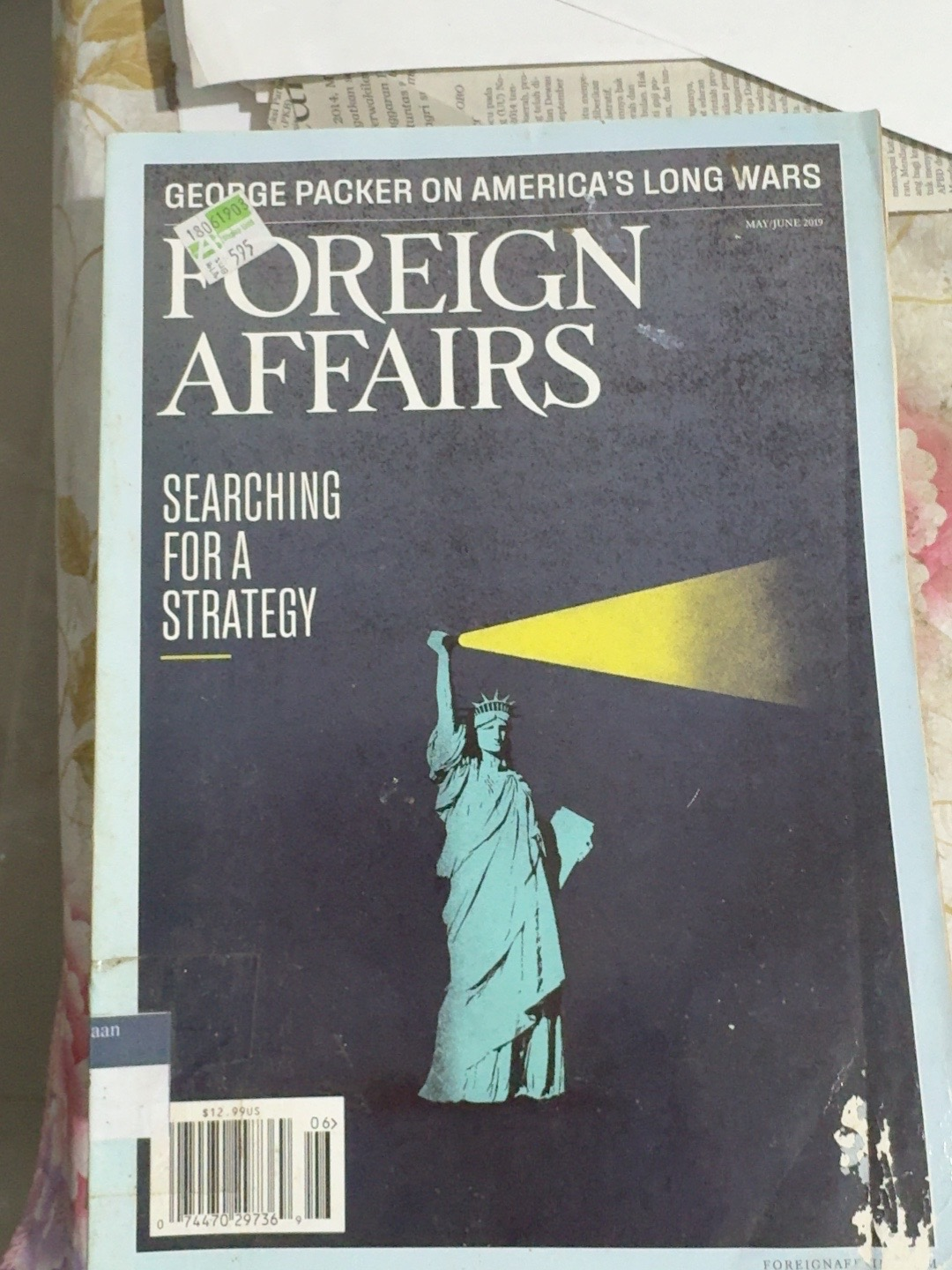
Council on Foreign Relations, New York · Vol. 98, No. 3, Mei/Juni 2019; sampul · 2019-05
Abstract
The Searching for a Strategy issue, which brings together discussions of the direction of American foreign policy, diplomacy, and the adaptation of intelligence. Material for studying the relationship between objectives, capabilities, and policy choices in 2019.
- Identifier
- KBA-MJL-2019-0005
- Type
- Majalah
- Publisher
- Council on Foreign Relations, New York
- Date Issued
- 2019-05
- Bibliographic Citation
- Vol. 98, No. 3, Mei/Juni 2019; sampul
- LC Classification
- D410 — Sejarah dunia abad ke-20: terbitan berkala
- LCSH Subject
- International relations -- Periodicals United States -- Foreign relations -- Periodicals
- BISAC Category
- POL011000 POLITICAL SCIENCE / International Relations / General
- Language
- Inggris
- Description
- Identity of the publication The May/June 2019 issue of Foreign Affairs, volume 98, number 3, takes up the theme Searching for a Strategy. The cover photograph shows the Statue of Liberty with a beam resembling a searchlight pointing sideways. The additional cover line mentions George Packer and America's long wars. The publisher's official archive confirms the date, volume, number, and theme. This publication of the Council on Foreign Relations is recorded as a single magazine issue. The name of the author in the cover line is not treated as the sole author of the entire publication, because this issue contains several contributions with different questions and positions. [1] Distinguishing strategy from a list of policies As a curatorial point of entry, the search for strategy invites readers to ask about the relationship between objectives, capabilities, and choices of action. A list of policies does not necessarily show how priorities are set or how costs are weighed. Research needs to show the reasoning that links instruments to the desired outcomes. If objectives change, the measures of success also need to be clarified. This material can be used to study how authors build such connections without assuming that similar slogans always mean similar strategies. A detailed assessment still requires reading each article and examining supporting documents. The official table of contents lists Daniel W. Drezner, Mira Rapp-Hooper and Rebecca Friedman Lissner, Stephen M. Walt, and Kori Schake in the main theme. Other sections include George Packer, William J. Burns, and Amy Zegart and Michael Morell. [1] These names provide avenues of inquiry on the direction of policy, diplomacy, and intelligence. The entry does not merge their conclusions into a single opinion. Readers need to separate articles that offer a diagnosis, articles that propose change, and pieces that assess past experience through different forms of discussion. Change and continuity One question that can be developed is whether the problem stems from the choices of particular leaders or from a longer-standing arrangement of policy. An answer requires temporal comparison. If researchers use only events in a single administration, conclusions about historical change will be limited. Students can construct a table of stated objectives, the instruments used, and the implementing institutions across several periods. Such a table helps distinguish changes in rhetoric from changes in action. The catalogue proposes this method of reading; it does not assert that all the articles in the issue make the same historical periodisation. Comparison also needs to take account of circumstances that are not the same. Similar policies can produce different consequences when the environment changes. Conversely, different actions can be used to pursue relatively constant objectives. Careful research does not immediately judge inconsistency merely on the basis of changes in instruments. Users can trace how actors explain changes and whether the evidence supports those reasons. In this way, the word strategy becomes an object of examination, not praise for policies of which the reader approves or an accusation against decisions the reader dislikes. Diplomacy and organisational capacity The diplomacy track allows research on the relationship between political objectives and organisational knowledge and experience. Someone may propose a new direction, but implementation requires an apparatus, coordination, and relationships with partners. Users can examine how such capabilities are built or diminished. However, magazine writing is no substitute for more direct institutional data. To explain a particular process, decision documents, organisational records, or appropriate testimony are needed. The catalogue provides orientation for finding questions, while testing must follow the relevant type of evidence. For students, a useful exercise is to map those who know, recommend, decide, and implement. These roles are not always held by the same people or institutions. Deadlock may arise in any one of these relationships, so an explanation of failure needs to be more detailed than simply citing a lack of will. Source notes can show which parts are visible and which are still estimated. This distinction helps ensure that limited information is not covered over with a story that sounds plausible but is not yet supported by evidence. Intelligence and technology The presence of contributions on intelligence and algorithms offers a path for researching how technological change affects knowledge work. Researchers can distinguish the collection, analysis, delivery, and use of information. A change in one stage does not automatically explain the entire outcome of a decision. In research based on open sources, the limits of access must be stated. Policy articles may record professional concerns or proposals, but they do not reveal all the activities of an organisation. This note does not present operational information; rather, it proposes questions about the quality of assessment and the capacity to adapt. The theme can also be connected with Innovation Power. The comparison can focus on how technology is viewed as a capability and how institutions make use of it. Users need to keep in mind the differences in time and in form of writing. A sentence about potential is not the same as a report on implementation. If research seeks to assess changes after 2019, new sources need to be added separately. An orderly corpus shows whether the reader is tracing the development of ideas or testing the real consequences of a technological change in a particular institution. Reading the metaphor of searching The Statue of Liberty with a beam of light can be studied as a composition about orientation and the limits of vision. That interpretation is a visual reading, not an established intention of the creator. Users can note the direction of the light, the dark space, and the relationship between the title and the image. The image should not be used to infer the position of a particular article without reading it. The original photograph preserves surface damage and the marks of the copy, which can be useful for research on the history of the collection. Any tidied version should preserve the whole cover and should not turn the illustration into a new design. Use and completeness The subjects grand strategy, diplomacy, foreign policy, and the United States are stored as separate values to make searching easier. The original photograph serves as documentary evidence; the AI processing is only a labelled visual derivative because small details may change. The year 2019 is the year of publication, distinct from the date of documentation. The number of pages, physical completeness, and inventory number have not been determined from the cover. The entry can be supplemented with photographs of the table of contents and the publisher's page. After a duplicate check, this package can be used as the basis for completing the catalogue without guessing at information that is not yet available. Setting research priorities Strategy as an object of study can be narrowed through a single choice that sets several objectives against one another. Users can ask why a particular area receives greater attention and who provides the reasons for that priority. The evidence needs to show the decision, not merely comments made afterwards. If different sources offer different explanations, those differences are recorded before being assessed. This step helps produce questions that can be worked on within a limited research scope. It also ensures that broad accounts of a state's direction do not substitute for proof concerning more specific processes of choice. This copy of the May/June 2019 issue is held in the Pustaka KBA13 Academy Magazine collection together with other issues of Foreign Affairs, so that readers can trace shifts in foreign policy debates from one issue to the next and compare how authors read the same events at different times. For citation purposes, references should give the article title, the author's name, volume 98, number 3, and the pages read directly in the copy, not merely the cover theme. The original photograph of the cover is included as documentary evidence of the physical condition of the copy, while the AI-processed version only aids visual legibility and is not used to establish bibliographic data. [1] Foreign Affairs. May/June 2019, Volume 98, Number 3. https://www.foreignaffairs.com/issues/2019/98/3. Accessed 18 October 2026. The explanations of method and use are curatorial notes.
- Rights
- Koleksi pribadi KBA13 Academy
- Collection
- Magazines
How to cite
“Foreign Affairs — Searching for a Strategy (May/June 2019)”, Council on Foreign Relations, New York, Vol. 98, No. 3, Mei/Juni 2019; sampul, 2019-05. KBA13 Academy Archive and Library, KBA-MJL-2019-0005.