
Magazine
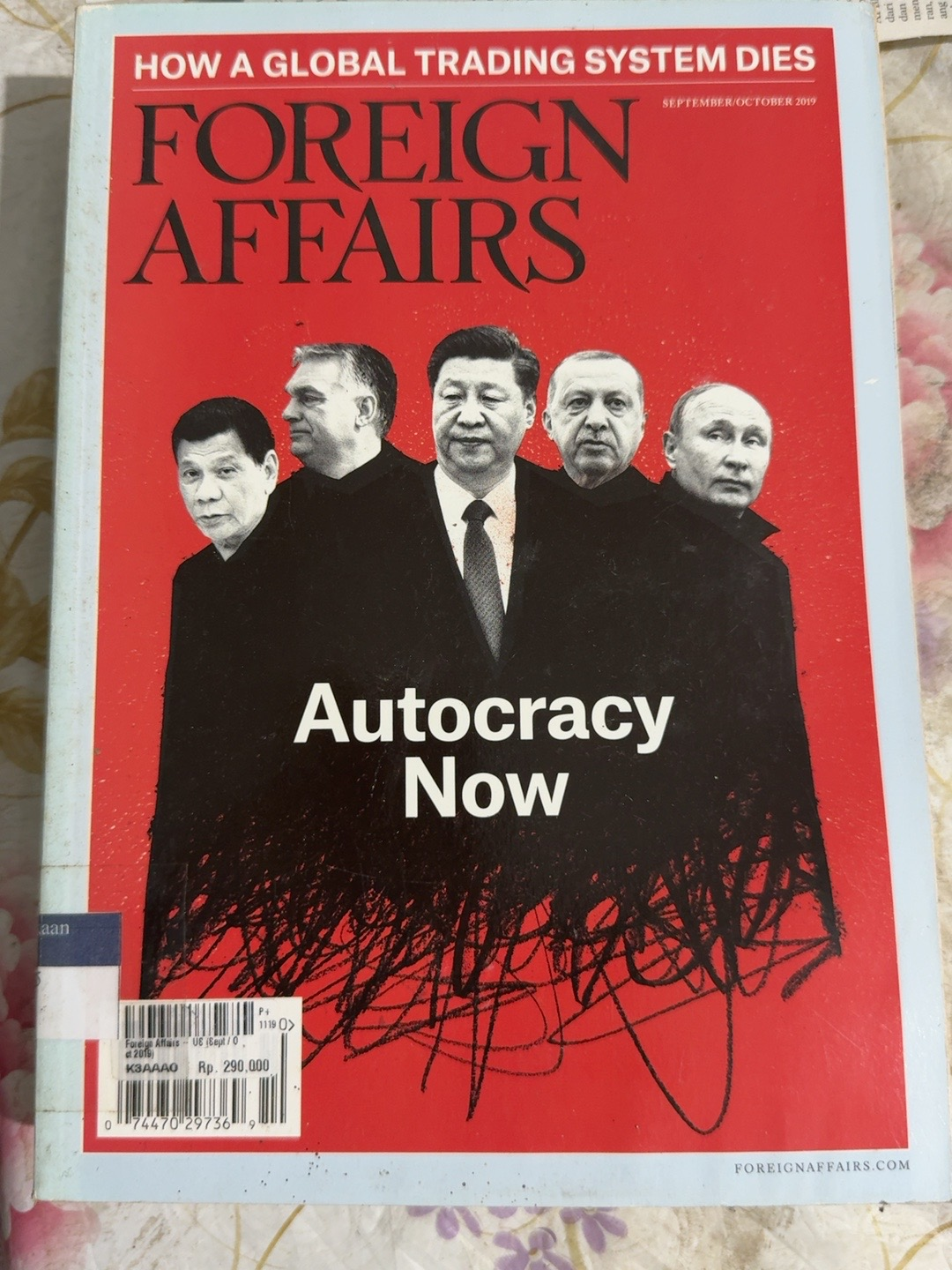
Foreign Affairs — Autocracy Now (September/October 2019)
Council on Foreign Relations, New York · Vol. 98, No. 5, September/Oktober 2019; sampul · 2019-09
Abstract
The Autocracy Now issue, with portraits of several paths of leadership as well as articles on US-China relations and trade. Material for the comparative study of power that nonetheless preserves the differences between cases.
- Identifier
- KBA-MJL-2019-0006
- Type
- Majalah
- Publisher
- Council on Foreign Relations, New York
- Date Issued
- 2019-09
- Bibliographic Citation
- Vol. 98, No. 5, September/Oktober 2019; sampul
- Subject
- Otoritarianisme Kepemimpinan Tiongkok Rusia
- LC Classification
- D410 — Sejarah dunia abad ke-20: terbitan berkala
- LCSH Subject
- International relations -- Periodicals United States -- Foreign relations -- Periodicals
- BISAC Category
- POL011000 POLITICAL SCIENCE / International Relations / General
- Language
- Inggris
- Description
- Identity and theme The September/October 2019 issue of Foreign Affairs, volume 98 number 5, takes up the theme Autocracy Now. The photograph shows an illustration of a number of leaders in a red field with tangled lines at the bottom. An additional headline discusses the global trading system. The date, volume, number, and theme were confirmed through the publisher's official archive. This Council on Foreign Relations publication is recorded as a single magazine issue, not as a collective biography. The autocracy label is part of the editorial theme; the analytical category of each article must be examined through its text and not inferred from the cover image alone. [1] Attending to differences between cases The official table of contents lists Susan B. Glasser on Putin, Richard McGregor on Xi Jinping, Kaya Genc on Erdogan, Sheila S. Coronel on Duterte, and Paul Lendvai on Orban. [1] This group of contributions provides distinct paths for comparing leadership. The catalogue does not assume that all these governments share the same structure or history. Users need to distinguish biography, organization, and political rules before drawing conclusions. The names of the figures discussed are also not the names of authors, so the record must preserve the distinction between the subject of an article and its writer. Leaders and institutions As a curatorial framework, users may begin with the question of how authority is constituted, constrained, and maintained. Personal traits may be part of an argument, but they do not replace an examination of organizational relationships. Research can look at parties, bureaucracies, security institutions, and channels of communication with society. The term personal power needs to be explained through indicators that can be examined. Attributing every action to the will of one person can overlook the role of implementers and supporters. Conversely, explaining institutions without actors can erase choices that genuinely influence the direction of change. Students can construct a table that separates the means of obtaining office, the means of making decisions, and the means of maintaining support. These stages do not always use the same mechanisms. Elections, law, patronage, and the use of the language of legitimacy can be examined through relevant sources. Comparison requires equivalent units and a clear time span. The catalogue does not assert that all these mechanisms are fully discussed in this issue. It offers a way of developing the theme of leadership into a more specific and testable research design. Support, compliance, and resistance This material can be used to clarify the difference between voluntary support, pragmatic acceptance, and compliance under pressure. Behaviour that looks similar can have different reasons. Research seeking to understand public attitudes requires evidence that allows those reasons to be examined. Articles by observers do not automatically replace the voice of society. Users can add surveys, interviews, or other documents as the question requires. In this way, the discussion of regimes does not become merely an account of elites, but also attends to how society experiences and responds to political change. The relationship between information and power can also be examined through the media and spaces of debate. Users can ask who is speaking, what information circulates, and how errors are corrected. However, the existence of uniform messages does not by itself prove that all recipients believe them. Research needs to distinguish production, dissemination, reception, and action. This distinction helps to avoid the automatic explanation that a message always produces the attitude its makers intended. The catalogue proposes these tools as teaching material, not as a summary of all the contributors' conclusions. International relations and trade The publisher's archive also lists Odd Arne Westad, Kurt M. Campbell and Jake Sullivan, as well as Chad P. Bown and Douglas A. Irwin on the US-China and trade track. [1] The presence of this theme shows the breadth of the issue beyond portraits of leaders. Users can examine how foreign relations intersect with questions of domestic governance, but must not assume that one type of regime automatically produces one foreign policy. Explanation requires intermediaries, such as organizational interests, economic choices, and responses to the international environment. The headline on the trading system can be used as an additional access term if the entry is developed at the article level. Users need to distinguish changes in rules, changes in trade flows, and assessments of the sustainability of institutions. The three do not always point to the same outcome. A system can persist while undergoing changes in practice. Research should set indicators before assessing damage or resilience. The magazine provides a traceable debate, while testing the consequences of policy requires documents and data directly related to the chosen field and period. Relationships between materials The issue can be linked with The World According to Xi Jinping, The Desperation of the Dictators, and Come Home, America?. These links make it possible to trace how leadership and technology were discussed at different times. However, similar titles do not prove that the authors use the same concepts. Users need to examine definitions and types of evidence. A good comparison can show shifts in emphasis without assuming that all events follow a single predetermined path. Contemporaneous sources must be kept in their context, even though readers know the developments that followed publication. For academic exercises, students can be asked to write down alternative explanations for one event discussed. Each alternative is accompanied by the evidence needed to distinguish it. The aim is not to make all explanations appear equally strong, but to show what makes a conclusion assessable. If evidence is limited, that limitation becomes part of the result. This habit is important when reading analyses of leadership whose language is often assertive. Assertiveness of presentation does not replace the traceability of sources or the need to examine the relationship between fact, interpretation, and recommendation. Cover and condition of the copy The tangled lines in the illustration can be interpreted as connections or the depth of influence, but that meaning is the user's reading without any explanation from the artist. The original photograph preserves the stickers, labels, and surface damage. The AI output is a labelled visual derivative; small details are not guaranteed to be identical. The number of pages, completeness, and inventory number have not been confirmed from the cover. The year 2019 is recorded separately from the documentation date. Subjects are stored as separate values. Photographs of the table of contents and the publisher's page would strengthen the metadata before duplicate checking and publication of the entry are carried out. Assessing the comparability of leadership When several leaders are placed in one group, the researcher needs to state the basis for the grouping. Terms of office, organizational rules, and career paths can differ. Users can start with variables that are truly equivalent, then note what cannot be compared directly. Difference is not a disturbance to be removed so that conclusions look tidy. It can be an important part of explaining variation in power. This approach ensures that categories useful for orientation do not turn into the assumption that every case follows the same pattern at every stage. This copy of the September/October 2019 issue is held in the Magazine collection of Pustaka KBA13 Academy together with other issues of Foreign Affairs, so that readers can trace the shifts in foreign policy debate from one issue to the next and compare how authors read the same events at different times. For citation purposes, references should state the article title, the author's name, volume 98, number 5, and the pages read directly in the copy, not just the cover theme. The original photograph of the cover is included as documentary evidence of the physical condition of the copy, while the AI-processed version serves only to aid visual legibility and is not used to establish bibliographic data. [1] Foreign Affairs. September/October 2019, Volume 98, Number 5. https://www.foreignaffairs.com/issues/2019/98/5. Accessed 18 October 2026. The method and use sections are curatorial notes.
- Rights
- Koleksi pribadi KBA13 Academy
- Collection
- Magazines
How to cite
“Foreign Affairs — Autocracy Now (September/October 2019)”, Council on Foreign Relations, New York, Vol. 98, No. 5, September/Oktober 2019; sampul, 2019-09. KBA13 Academy Archive and Library, KBA-MJL-2019-0006.
Related documents

Magazine
Foreign Affairs — Tell Me How This Ends: Is There a Path to Victory in Ukraine? (July/August 2023)

Magazine
Foreign Affairs — The Desperation of the Dictators (September/October 2023)

Book
Leaders Eat Last: Why Some Teams Pull Together and Others Don't
Simon Sinek
Document (presentation)
Visi, Misi, dan Program Peningkatan Mutu IAIN Lhokseumawe: Kandidat Rektor Periode 2025–2029 [Vision, Mission, and Quality Improvement Programme of IAIN Lhokseumawe: Rector Candidate for the 2025–2029 Term]
Kamaruzzaman Bustamam Ahmad