Magazine
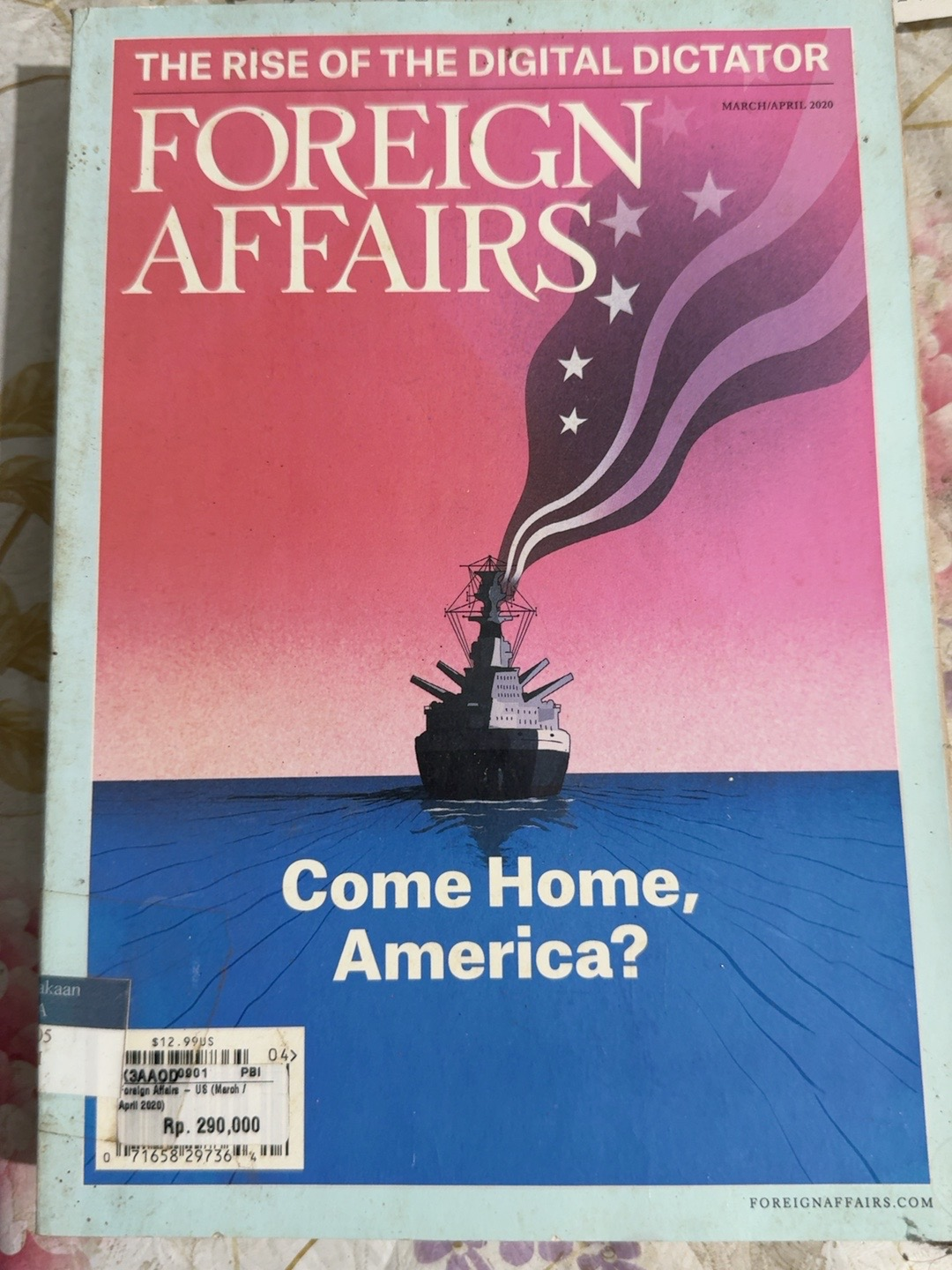
Foreign Affairs — Come Home, America? (March/April 2020)
Council on Foreign Relations, New York · Vol. 99, No. 2, Maret/April 2020; sampul · 2020-03
Abstract
The Come Home, America? issue, which brings together debates on international engagement, priorities, and America's limits. An additional headline on digital dictators opens a line of inquiry into technology and political institutions.
- Identifier
- KBA-MJL-2020-0002
- Type
- Majalah
- Publisher
- Council on Foreign Relations, New York
- Date Issued
- 2020-03
- Bibliographic Citation
- Vol. 99, No. 2, Maret/April 2020; sampul
- LC Classification
- D410 — Sejarah dunia abad ke-20: terbitan berkala
- LCSH Subject
- International relations -- Periodicals United States -- Foreign relations -- Periodicals
- BISAC Category
- POL011000 POLITICAL SCIENCE / International Relations / General
- Language
- Inggris
- Description
- Identity of the issue The March/April 2020 issue of Foreign Affairs, volume 99 number 2, uses the cover theme Come Home, America?. The cover shows a ship with a flag shape stretching upward, between blue and pink fields. The additional headline reads The Rise of the Digital Dictator. The date, volume, number, and theme were confirmed through the publisher's official archive. The magazine is published by the Council on Foreign Relations and is recorded as a single issue of a periodical. The question mark in the title is retained because it indicates the form of a debate, not a directive agreed upon by all contributors. [1] Engagement and restraint The theme provides an entry point for examining how international goals are adjusted to capabilities and priorities. As a curatorial framework, reducing engagement in one area differs from withdrawing from all relationships. Diplomacy, trade, aid, and the use of force can change along different paths. Research needs to explain the form of engagement under discussion. If every action is labelled either presence or retreat, important distinctions will be lost. Users can use this issue to map the choices and trade-offs underlying the recommendations, without assuming that there is a single universally applicable measure of success. The official table of contents lists Stephen Wertheim, Thomas Wright, Graham Allison, Jennifer Lind and Daryl G. Press, Stephen D. Krasner, and Kathleen Hicks in the main theme group. [1] Their titles show lines of argument concerning dominance, restraint, influence, and defence. This note is not a complete summary of each position. The presence of differing views is one of the values of the issue as research material. Users need to read the articles and note the conditions attached to their conclusions. The name of one contributor must not be treated as the sole author of the entire magazine issue. Reading costs and goals One suggested use is to separate costs from the assessment of goals. An action may be expensive yet considered necessary, or cheap yet fail to address the problem. Research must show the measures of cost and goals being used. Budgets, human risk, political attention, and lost opportunities are different dimensions. Users can construct a table so that comparison does not stop at a single figure. The catalogue does not recommend any particular policy, but suggests a way of understanding the relationship between diagnosis and recommendation in the chosen sources. Assessments of capability also require points of comparison. Large resources do not mean that all goals can be achieved at the same time. Conversely, the existence of limits does not prove total incapacity. Students can examine how the authors set priorities and how the risks of the options left aside are discussed. A good argument shows the consequences of choices, not just the advantages of the preferred path. Disagreements can stem from assessments of threat, values, or estimates of others' behaviour. These elements need to be separated before drawing conclusions about where the disagreement lies. Alliances and leadership Relations with partners can be examined through the question of what is expected when America's role changes. Statements by the American government are not complete evidence of acceptance by others. Users need sources from partners if they wish to explain their interpretations or responses. Research also needs to distinguish formal obligations from political expectations. The possibility that a country might take on a larger role does not automatically mean it has the capability or domestic support to do so. This note proposes questions; it does not establish that all the scenarios in the issue have been tested or realized. The material can be linked with Trump and the Allies and Searching for a Strategy. Thematic links allow comparison regarding costs, priorities, and trust. However, the different authors and publication dates need to be preserved. Research using several issues should state its rules for selecting articles. Cover titles that appear close to one another are not sufficient to conclude that there is a direct debate. Users need to examine references and context so that relationships between sources are built on evidence, not merely on an impression of similar language. Digital authoritarianism The publisher's archive lists an article on digital dictators by Andrea Kendall-Taylor, Erica Frantz, and Joseph Wright. [1] This line opens questions about the relationship between technology and political institutions. Users can separate the capacity to collect information, the capacity to process it, and the ways the results are used. The availability of tools does not automatically determine political consequences. Research needs to show the organizations, incentives, and practices that connect technology to action. The catalogue does not claim that all technology always strengthens one type of government; testing must be carried out according to clearly defined cases and periods. For students, an exercise can map those who supply the technology, those who use it, and the society affected by it. Each relationship is accompanied by sources and the limits of the information. The map helps show that technology does not appear without human decisions. Users can also distinguish claims of capability from evidence of actual use. An advertisement, a design, or a policy statement has a different standing from documentation of implementation. This distinction is important when reading sources that discuss the future and when assessing changes that are only partially visible through open sources. Time of publication and rereading The March/April 2020 issue is a source bounded by its own time. Events that developed later must not be included as if the authors had known them. If research makes a retrospective evaluation, the dates and comparative sources need to be stated. Chronological precision helps distinguish changes in circumstances from errors of explanation. A forecast that did not come true can still reveal the assumptions and information available at the time. An archive becomes useful when readers can test the trajectory of ideas without altering the identity of the document under study. Cover and documentation The ship and flag on the cover can be interpreted through direction, distance, and spatial relationships; any particular meaning remains the user's reading without any explanation from the artist. The original photograph preserves the labels and stickers of the copy. The AI processing is only a labelled visual derivative, not a source of evidence for blurred small print. The number of pages, completeness, and inventory number have not been confirmed from the cover. The year 2020 is kept separate from the documentation date. Developing the entry requires photographs of the table of contents and the publisher's page, and a duplicate check. Subjects are stored as separate values so that they can be searched independently. Tracing the alternatives chosen In assessing the restraint of engagement, users can note the other options discussed by the authors. A proposal should not be compared only with an ideal state of affairs that could never be implemented. Researchers need to examine the resources and support available at the time. If alternatives are not explained, that limitation is retained in the summary. This exercise helps assess recommendations according to the questions they answer and the constraints they acknowledge. In this way, discussion can move from general slogans toward an examination of the traceable relationships between choices, costs, and risks. This copy of the March/April 2020 issue is held in the Magazine collection of Pustaka KBA13 Academy together with other issues of Foreign Affairs, so that readers can trace the shifts in foreign policy debate from one issue to the next and compare how authors read the same events at different times. For citation purposes, references should state the article title, the author's name, volume 99, number 2, and the pages read directly in the copy, not just the cover theme. The original photograph of the cover is included as documentary evidence of the physical condition of the copy, while the AI-processed version serves only to aid visual legibility and is not used to establish bibliographic data. [1] Foreign Affairs. March/April 2020, Volume 99, Number 2. https://www.foreignaffairs.com/issues/2020/99/2. Accessed 18 October 2026. The context of method and use is a curatorial note.
- Rights
- Koleksi pribadi KBA13 Academy
- Collection
- Magazines
How to cite
“Foreign Affairs — Come Home, America? (March/April 2020)”, Council on Foreign Relations, New York, Vol. 99, No. 2, Maret/April 2020; sampul, 2020-03. KBA13 Academy Archive and Library, KBA-MJL-2020-0002.