
Magazine
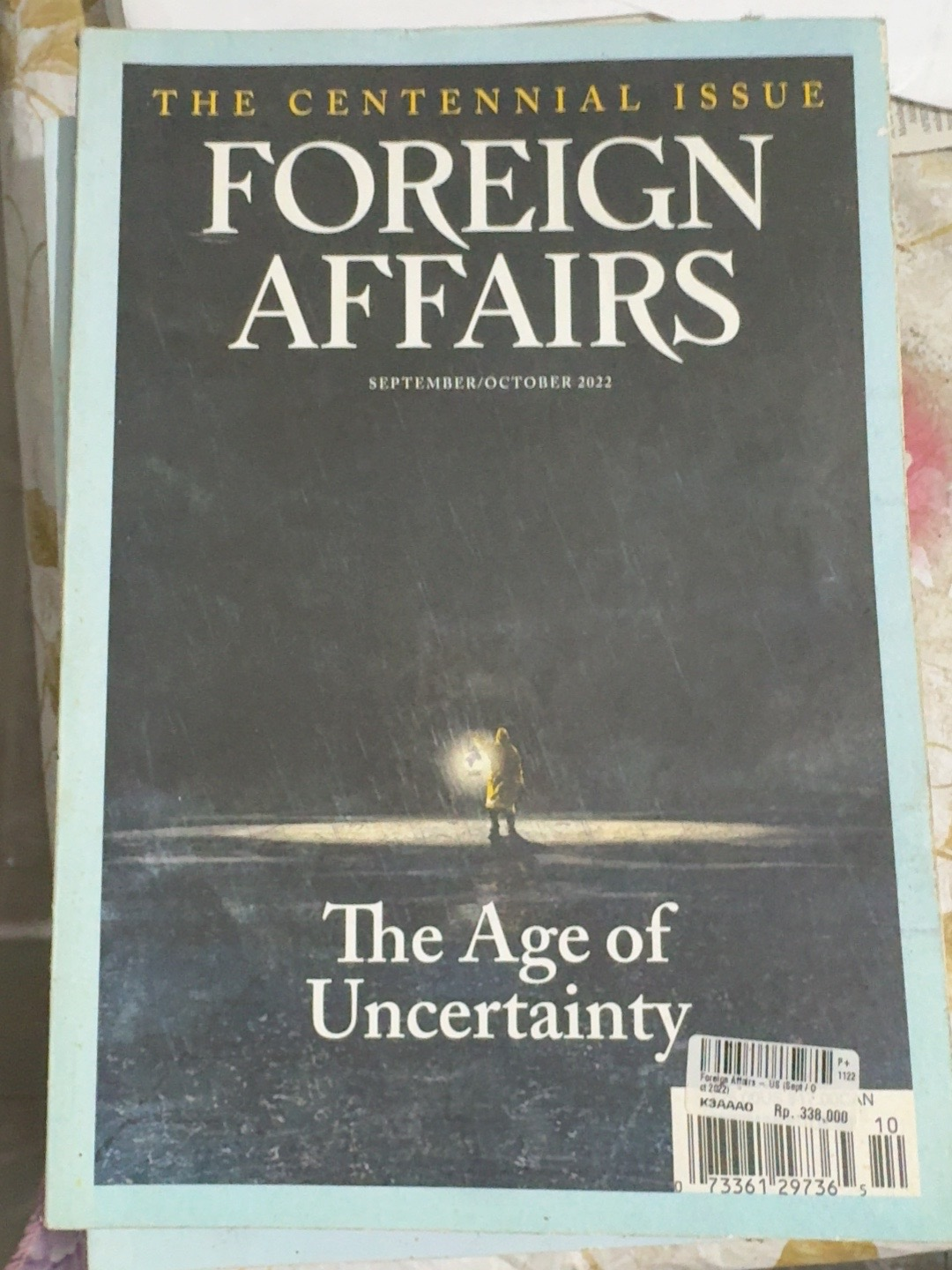
Foreign Affairs — The Age of Uncertainty (September/October 2022)
Council on Foreign Relations, New York · Vol. 101, No. 5, September/Oktober 2022; sampul · 2022-09
Abstract
The centennial issue of Foreign Affairs on the theme The Age of Uncertainty, with lines of discussion on global risk, great-power competition, and the relationship between technology and decision-making. The description separates the identity of the publication from suggestions for curatorial use.
- Identifier
- KBA-MJL-2022-0002
- Type
- Majalah
- Publisher
- Council on Foreign Relations, New York
- Date Issued
- 2022-09
- Bibliographic Citation
- Vol. 101, No. 5, September/Oktober 2022; sampul
- LC Classification
- D410 — Sejarah dunia abad ke-20: terbitan berkala
- LCSH Subject
- International relations -- Periodicals United States -- Foreign relations -- Periodicals
- BISAC Category
- POL011000 POLITICAL SCIENCE / International Relations / General
- Language
- Inggris
- Description
- Identity and position of the issue The September/October 2022 issue of Foreign Affairs, volume 101 number 5, carries the cover theme The Age of Uncertainty and the marker The Centennial Issue. The photograph shows a dark field with a small light at the lower centre. The date and number have been checked against the publisher's official archive, which also lists Daniel Kurtz-Phelan's piece on the magazine's hundred years. This publication of the Council on Foreign Relations is placed in the Magazines collection. The commemoration of the publication's age is a feature of the issue, not the founding year of Pustaka KBA13 Academy or the date on which the copy was acquired. [1] Uncertainty as a problem of knowledge The title provides an entry point for distinguishing uncertainty, change, and lack of information. As a curatorial reading framework, a situation may be difficult to forecast because data are limited, causal relationships are not yet understood, or actors change their behaviour. The three call for different research responses. Adding data does not always solve the problem if the explanatory model is wrong. Conversely, strong crisis language does not prove that all processes have become unknowable. Users can use this issue to study how the limits of knowledge are expressed in policy writing. The official table of contents includes William MacAskill on catastrophic risk, Richard Haass on the age of crisis, Jessica Chen Weiss on American-Chinese competition, and Fiona Hill and Angela Stent on Russia. Dani Rodrik and Stephen M. Walt are also listed in the discussion of the international order. [1] These names and themes provide orientation, not a complete summary of each essay. The catalogue does not assume that the contributors share the same definition of risk. Readers need to examine the texts to find out the authors' questions, evidence, and the conditions that limit their conclusions. Risk and time horizons One possible use is to compare how the writings view the near future and the long future. A forecast of a few months requires different attention from an assessment of consequences across generations. Researchers can note the time span, the actors at the centre of attention, and the type of consequences measured. A shared term such as threat is not enough to unify all risks. An action that makes sense for one goal may carry costs for another. Stating such trade-offs clearly helps prevent recommendations from being read as universal answers. For teaching, students can make a list of what is considered known, estimated, and not yet known in each article. The next step is to ask what evidence would change the conclusion. An argument that is open to testing leaves room for a change of assessment. If every outcome is taken to prove the same theory, the relationship between evidence and claim needs to be re-examined. This exercise is useful for learning anticipatory thinking without turning forecasts into certainty or treating uncertainty as a reason to stop research. The state, technology, and decisions The table of contents also offers a line on AI and decision-making through the contribution of Henry Farrell, Abraham Newman, and Jeremy Wallace. [1] For users, this topic can be linked to the question of how organizations select, filter, and interpret information. The capacity to collect large amounts of data does not automatically guarantee good decisions. Research needs to trace goals, incentives, and the ways corrections are communicated. This note does not attribute all of these questions to the content of the article; it proposes a way of developing the identified theme into a more specific research design. The relationship between the centralization of authority and the quality of knowledge can be investigated through sources that show process, not only outcomes. Who is able to raise objections? How are failures reported? When are forecasts revised? Such questions help distinguish technical capacity from the institutional conditions that determine its use. Users researching a particular organization need to add the appropriate documents and evidence. A policy magazine can help formulate alternative explanations, but it does not replace direct research on the institution or decision-making process one seeks to understand. Order and the diversity of problems The theme of uncertainty allows readers to notice that international problems do not always move at the same speed. War, technological change, economic pressure, and political relations can influence one another without having a single source. Researchers can begin by choosing one causal relationship so that the scope of the study remains manageable. Using the word era for all changes at once can produce a broad picture that is difficult to test. The catalogue suggests that general introductions be used as an initial map and then narrowed down according to actors, periods, and evidence that can be examined. This material can be linked to Innovation Power and The Sources of American Power in the collection. The link is thematic, not evidence that all the authors respond to one another. Comparison can be directed at how the future is formulated or at the relationship between information and institutional capacity. Users need to keep track of the publication date of each source. Assessments that use developments after 2022 must be marked as retrospective and accompanied by comparative sources. In this way, the meaning of a contemporaneous source does not silently change to follow knowledge acquired later. A hundred years as an object of publishing The centennial issue marker also opens research into how a magazine presents its intellectual journey. The choice of themes, introductions, and arrangement of contributions can be compared with other issues. Such research need not accept the publisher's self-image as a complete history. Users can ask which topics or regions receive attention and how that change is explained. The examination requires a clear corpus and commensurate measures. A commemorative issue provides one document that can be read together with the publishing archive, not a substitute for the whole history of the institution. Visual documentation and the limits of metadata The small light in the middle of the dark field can be interpreted as a play of scale and visibility; any specific meaning remains the reader's interpretation in the absence of a statement from its maker. The photograph shows stickers and traces of use on the copy. The original photograph is retained as evidence, while the AI output is labelled as a visual derivative and is not used to establish blurred small lettering. The number of pages, completeness, and inventory number have not been inferred from the cover. The publication year 2022 is kept separate from the date of documentation. Developing the entry requires photographs of the table of contents and the publisher's page as well as a check for duplicates before publication. Organizing conditional statements Each forecast can be recorded together with the conditions under which it holds. If the conditions are not stated, that vagueness is preserved in the notes. Readers need not fill it with their own assumptions. Students can also compare the ways authors express confidence: possibility, tendency, and certainty carry different weights. When the material is used in research, these distinctions help ensure that the interpretation is not more emphatic than its source. Statements about the limits of knowledge are an important part of the argument, not mere linguistic ornament that may be deleted when summarizing. This copy of the September/October 2022 issue is kept in the Magazines collection of Pustaka KBA13 Academy together with other issues of Foreign Affairs, so that readers can trace shifts in foreign-policy debate from one issue to the next and compare the ways authors read the same events at different times. For citation purposes, references should give the article title, the author's name, volume 101, number 5, and the pages read directly in the copy, not only the cover theme. The original cover photograph is included as documentary evidence of the physical condition of the copy, while the AI-processed version only aids visual legibility and is not used to establish bibliographic data. [1] Foreign Affairs. September/October 2022, Volume 101, Number 5. https://www.foreignaffairs.com/issues/2022/101/5. Accessed 18 October 2026. The sections on method and use are curatorial notes.
- Rights
- Koleksi pribadi KBA13 Academy
- Collection
- Magazines
How to cite
“Foreign Affairs — The Age of Uncertainty (September/October 2022)”, Council on Foreign Relations, New York, Vol. 101, No. 5, September/Oktober 2022; sampul, 2022-09. KBA13 Academy Archive and Library, KBA-MJL-2022-0002.