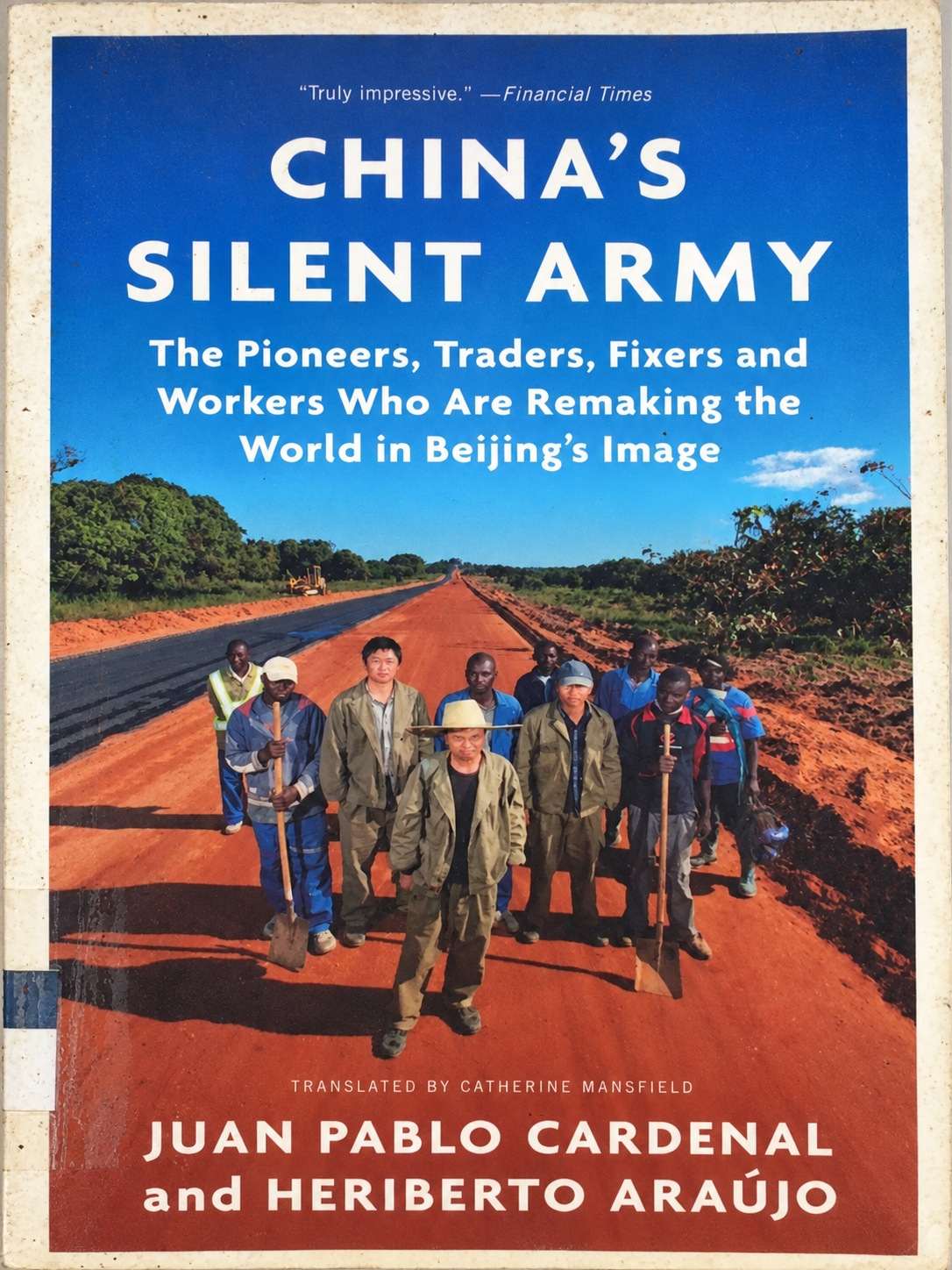
Penguin Books, London · Tahun, cetakan, jumlah halaman, dan ISBN eksemplar belum diperiksa. Rujukan pembanding: London: Allen Lane/Penguin, 2013, 368 hlm., ISBN 978-1-84614-540-7 (belum diverifikasi pada halaman hak cipta eksemplar) · Tanpa tahun
Abstract
A journalistic report by two Spanish journalists, Juan Pablo Cardenal and Heriberto Araújo, the result of travels to more than twenty-five countries in Africa, Central Asia, the Middle East, and Latin America. The book portrays China's economic expansion through the people on the ground: migrant traders, entrepreneurs, construction workers, fixers, and officials of state-owned companies. The authors trace mining, oil, timber, dam, and infrastructure projects, and their impact on local labour, the environment, and governance. Translated from the Spanish by Catherine Mansfield, this work is an important reference for understanding China's presence in developing countries and the debate over Beijing's development model.
Identifier
KBA-BKU-TT-0013
Type
Buku
Publisher
Penguin Books, London
Date Issued
Tanpa tahun
Bibliographic Citation
Tahun, cetakan, jumlah halaman, dan ISBN eksemplar belum diperiksa. Rujukan pembanding: London: Allen Lane/Penguin, 2013, 368 hlm., ISBN 978-1-84614-540-7 (belum diverifikasi pada halaman hak cipta eksemplar)
China -- Foreign economic relationsInvestments, ChineseChinese -- Foreign countries
BISAC Category
POL011000 POLITICAL SCIENCE / International Relations / General
Language
Inggris
Description
China's Silent Army: The Pioneers, Traders, Fixers and Workers Who Are Remaking the World in Beijing's Image is a work of investigative journalism by Juan Pablo Cardenal and Heriberto Araújo, two Spanish journalists long stationed in China, in an English translation by Catherine Mansfield. The cover of this copy shows a photograph of a group of Chinese workers and local African workers standing in the middle of a red dirt road under construction, with a blue sky, heavy machinery in the distance, and a quotation of praise from the Financial Times at the top. The English edition published by Penguin in January 2013 is recorded as 368 pages long with ISBN 978-1-84614-540-7, while the original version was published in Spanish under the title La silenciosa conquista china. This note is a curatorial introduction based on the cover and publisher information, not a summary of every page of the book.
The central concern of this book is China's economic expansion into various parts of the world in the first decade of the twenty-first century, when Beijing encouraged its companies and citizens to "go out" in search of raw materials, markets, and infrastructure projects. The two authors started from dissatisfaction with two kinds of explanation: the commentary of business circles, which tended to praise China's rise, and the official statements of the Chinese government about mutually beneficial cooperation. They chose to go directly into the field and trace the footprints of the Chinese presence in some twenty-five countries, from mines in Peru and forests in Siberia to dams in Sudan and jade mines in Myanmar.
The term "silent army" in the title refers to the ordinary people who form the spearhead of this expansion: pioneers who open businesses in remote places, traders who build wholesale networks, fixers who connect local officials with investors, and construction and mine workers who labour in harsh conditions. This approach is important because it shifts attention from macro figures on trade and investment to human experience on the ground. Readers are invited to see how decisions in Beijing, state bank credit, and the strategies of state-owned enterprises are translated into daily life in workers' camps, markets, and local government offices.
The book also highlights the dark side of this expansion. The authors raise the problems of harsh business practices, weak labour protection, environmental damage, corruption, and the close relationship between Chinese capital and undemocratic regimes. At the same time, they also show the hard work, tenacity, and sacrifice of Chinese migrants who leave their families for economic opportunities in foreign lands. This tension between admiration and criticism is what makes the book interesting as material for discussion, because it does not fall into a simple stance of either adulation or rejection.
The broad framework the authors offer is the idea of an "informal empire", that is, wide-ranging influence built not through military conquest or formal colonies, but through networks of investment, loans, contracts, and migration. This idea invites comparison with the history of European trading empires, including the VOC and the East India Company, as well as with contemporary debates about the Belt and Road Initiative launched in 2013. Because this book appeared in the same year the initiative was launched, it can be read as an early portrait before China's expansion acquired an official label and greater global attention.
For readers in Southeast Asia, the book has particular relevance. The presence of Chinese capital, workers, and companies in Indonesia, Malaysia, Laos, Cambodia, and Myanmar through road, railway, smelter, and industrial estate projects raises questions similar to those posed by Cardenal and Araújo. How are the economic benefits shared, who controls the resources, what is the relationship between foreign and local workers, and what are the long-term consequences for the sovereignty of the host countries. The book can be used as a point of comparison for reading cases in the region, without assuming that patterns in Africa or Latin America automatically apply in the same way.
In the Pustaka KBA13 Academy collection, this book relates to materials on geopolitics and the rise of China, for example The Beijing Variable and The Beijing Factor in Southeast Asia, as well as a number of Foreign Affairs issues discussing Xi Jinping and the rivalry between the United States and China. Reading this book alongside these materials helps readers connect strategic analysis at the state level with concrete experience at the grassroots level. The comparison also shows the difference between the approach of field journalism and that of policy analysis.
For learning activities, the book is suitable for use in courses on international relations, international political economy, development studies, the anthropology of migration, and China studies. Students can map the countries the authors visited, the types of projects discussed, the actors involved, and the social and environmental impacts reported. They can also test whether the authors' conclusions still hold for developments after 2013, for example by comparing them with reports on debt, stalled projects, or contract renegotiations in host countries.
Critical reading remains necessary. As a work of journalism, the book relies on interviews, observation, and individual stories that are narratively powerful but cannot always be generalized. Some informants may have particular interests, and the situations described can change rapidly. Users are therefore advised to combine this book with statistical data, reports from research institutions, and more recent academic studies so that the picture of China's presence in the world becomes more complete.
In terms of collection documentation, this copy shows signs of use in the form of stains on the edges of the cover and a library label on the left side. The publisher and year data in this entry refer to the 2013 Penguin edition as a point of comparison, so the publisher, printing year, and ISBN of the photographed copy still need to be checked against the copyright page. This information is recorded so that users can distinguish information that is certain from information that still requires verification.
Appropriate search subjects for this book include China's foreign economic relations, Chinese investment, Chinese labour migration, Africa, Latin America, natural resources, and geopolitics. For citation purposes, references should state the names of both authors, the full title, the translator, the publisher, the year, and the pages read directly in the copy. As a field portrait of how a great power builds influence through trade and labour, this book provides important material for anyone who wants to understand the changing world order from below.
The presence of this book in the collection also shows the importance of field-based journalism for academic study. When official data on foreign investment and projects are often limited or difficult to verify, direct reports from the sites become a valuable source for building research questions. Researchers can use the stories in this book as a starting point for tracing contract documents, local media reports, and the testimony of affected communities, so that understanding of China's presence in a given place does not stop at the grand narrative of the rise of a global power.
Juan Pablo Cardenal, Heriberto Araújo, Catherine Mansfield (penerjemah), “China's Silent Army: The Pioneers, Traders, Fixers and Workers Who Are Remaking the World in Beijing's Image”, Penguin Books, London, Tahun, cetakan, jumlah halaman, dan ISBN eksemplar belum diperiksa. Rujukan pembanding: London: Allen Lane/Penguin, 2013, 368 hlm., ISBN 978-1-84614-540-7 (belum diverifikasi pada halaman hak cipta eksemplar). KBA13 Academy Archive and Library, KBA-BKU-TT-0013.