Corgi Books (Transworld), London · Tahun, cetakan, jumlah halaman, dan ISBN eksemplar belum diperiksa. Rujukan pembanding: London: Corgi, 2016, 688 hlm., ISBN 978-0-552-17080-2; edisi pertama 2015 (belum diverifikasi pada halaman hak cipta eksemplar) · Tanpa tahun
Abstract
A book by Marc Goodman, a former Los Angeles police officer and cybersecurity adviser to international bodies, on the new face of crime in an interconnected world. Goodman explains how personal data, smartphones, social media, smart-home devices, vehicles, medical devices, robots, and synthetic biology can be exploited by hackers, organized crime syndicates, and terrorist groups. He describes a digital underground economy that operates like a corporation, and then offers protective measures for individuals, companies, and states. The work is relevant to the study of criminology, security policy, and the ethics of technology.
Identifier
KBA-BKU-TT-0014
Type
Buku
Publisher
Corgi Books (Transworld), London
Date Issued
Tanpa tahun
Bibliographic Citation
Tahun, cetakan, jumlah halaman, dan ISBN eksemplar belum diperiksa. Rujukan pembanding: London: Corgi, 2016, 688 hlm., ISBN 978-0-552-17080-2; edisi pertama 2015 (belum diverifikasi pada halaman hak cipta eksemplar)
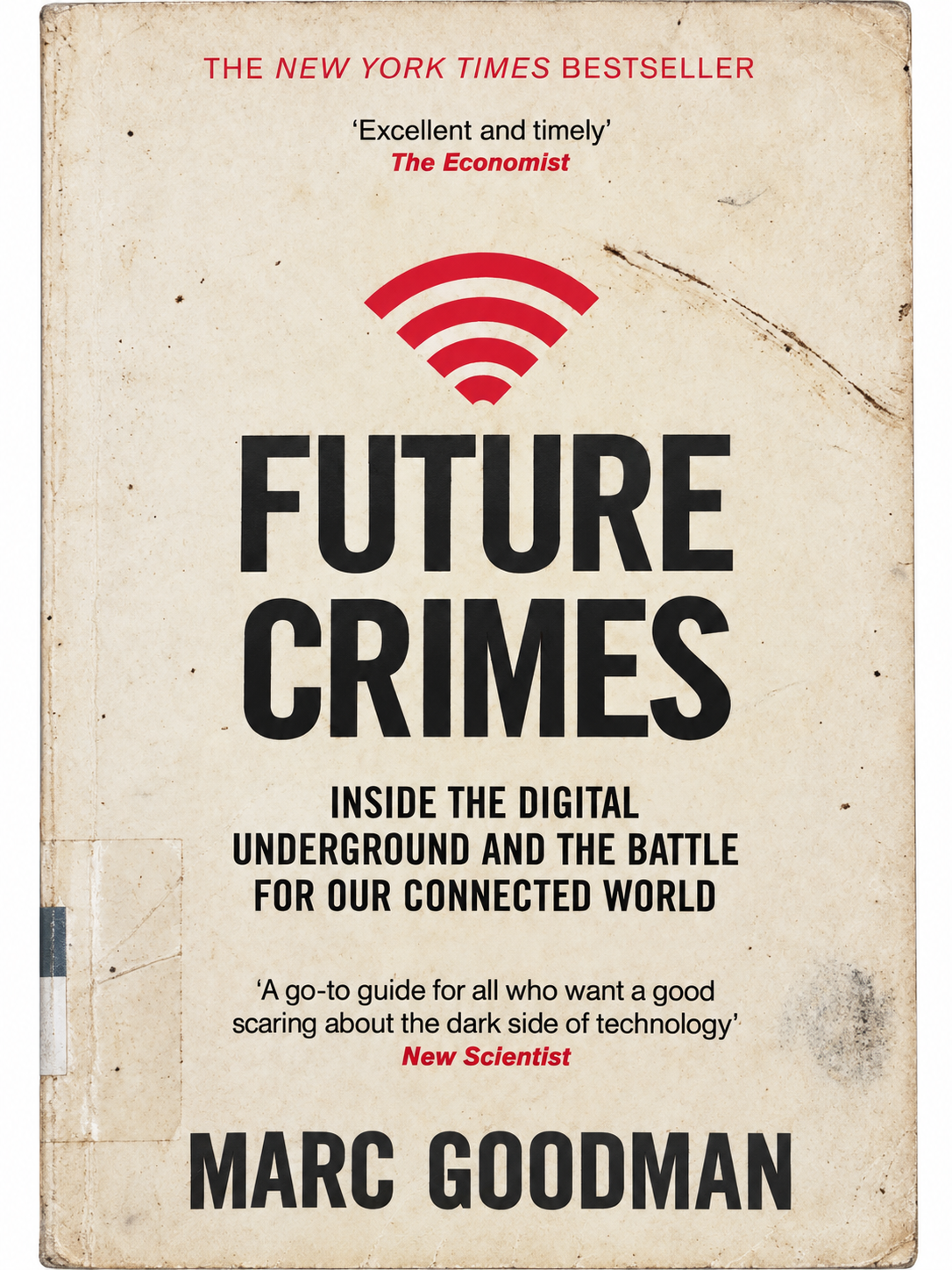
Future Crimes: Inside the Digital Underground and the Battle for Our Connected World is a work by Marc Goodman, a former member of the Los Angeles police who later worked as a cybersecurity adviser to various law-enforcement agencies and international organizations. The cover of this copy has a pale cream background with a red wireless-signal icon, the title in bold black letters, and quotations of praise from The Economist and New Scientist, with a note that the book is a New York Times bestseller. The Corgi paperback edition from the Transworld group in the United Kingdom was published in March 2016, with 688 pages and ISBN 978-0-552-17080-2, while the first edition was published in 2015. This note is a curatorial introduction based on the cover and the publisher's information, not a summary of the entire content of the book.
The main idea of the book is that every new technology brings benefits as well as new opportunities for crime, and that criminals are often the earliest and most creative users of such technology. Goodman traces how the internet, smartphones, social media, cloud computing, and interconnected devices shape a living space that is increasingly dependent on data. The more aspects of life are moved onto digital networks, the larger the attack surface that can be exploited by criminals, organized groups, and state actors.
The book sets out a variety of examples that show the breadth of these threats. Identity theft, the breaching of bank accounts, and the sabotage of computer servers are the most familiar examples. Goodman also discusses baby monitors that can be tapped, pacemakers that could in theory be hacked, thieves who monitor social media to find out when a house has been left by its owners, 3D-printed weapons, drug cartels that make use of drones, and dangerous information that is easily accessible through the internet. These examples are drawn from real cases, so that the book moves between investigative reporting and policy warning.
One important concept discussed is the shift from crime that is local in nature towards crime that can be committed remotely and on a large scale. A perpetrator in one country can attack thousands of victims in another country in a short time, while legal systems and police still operate within the boundaries of national jurisdiction. The gap between the speed of criminal innovation and the slowness of institutional response is a recurring theme. Goodman also highlights the role of technology companies that collect very large amounts of personal data, so that the problem of security cannot be separated from the problem of privacy and the business model of the digital economy.
In addition to describing threats, the book offers practical advice for individuals and organizations to protect themselves, as well as a call for digital security to be treated as an urgent public issue. The idea that cross-border cooperation, improved digital literacy among the public, and technology designed with security in mind from the outset are needed forms part of the author's argument. In this respect, the book can be read as an attempt to bridge the worlds of law enforcement, the technology industry, and the general public.
For Indonesian readers, the theme of this book is highly relevant. Indonesia has experienced rapid growth in internet users, digital financial services, and online commerce, accompanied by a proliferation of online fraud, leaks of personal data, and attacks on government systems. Debates on the Electronic Information and Transactions Law, the Personal Data Protection Law, and the capacity of the state's cyber agency show that the problems Goodman discusses are neither distant nor abstract. The book can serve as a point of comparison for understanding how similar challenges arise in other countries and how policy responses can be designed.
In the collection of Pustaka KBA13 Academy, this book can be linked with materials on intelligence, security, and digital civilization, for example The War for the Indonesian Mind, The Digital Civilization, and the Foreign Affairs issue on the theme World War Web. Such comparison helps readers see that digital threats come not only from individual criminals but also from inter-state competition, influence operations, and the struggle for control over information infrastructure. In this way, cybercrime can be read across a broader spectrum, from ordinary criminality to geopolitics.
For learning activities, the book is suitable for use in courses on criminology, cyber law, security studies, the sociology of technology, and public policy. Students can group the examples in the book according to the type of perpetrator, target, technology used, and impact. They can also compare the cases discussed with incidents in Indonesia and then assess whether the existing legal and institutional framework is adequate. Exercises of this kind help connect popular reading with academic analysis.
Critical reading is nonetheless required. As a book aimed at a broad readership, Future Crimes sometimes emphasizes worst-case scenarios to raise awareness, so some of the threats it describes may not yet have occurred on a large scale. Technological developments since 2015, including generative artificial intelligence and cryptocurrencies, also present new problems that are not discussed in depth. Users are advised to combine this book with the latest cybersecurity reports and academic studies so that the picture of the threats is more balanced.
In terms of collection documentation, the cover of this copy shows signs of use in the form of stains, scratches, and fold marks, as well as a library label on the left side. This entry presents two photographs of the cover. The publisher and year data refer to the 2016 Corgi edition as a comparison, so the printing year and ISBN of the photographed copy still need to be checked against the copyright page.
Suitable search subjects for this book include computer crime, internet security, data privacy, cyberterrorism, the Internet of Things, and cybersecurity policy. For citation purposes, references should give the author's name, the full title, the publisher, the year, and the pages read directly in the copy. As a warning about the dark side of an increasingly connected world, the book provides important material for anyone who wants to understand how technology is changing the face of crime and security in the twenty-first century.
The author's background as a law-enforcement practitioner gives the book a distinctive character. Goodman once served as a police officer in Los Angeles, was later involved in tackling high-technology crime, and worked with international agencies such as Interpol. He also founded the Future Crimes Institute and has taught at Singularity University. This experience makes his account rich in operational examples, although readers need to be aware that the perspective of security officials tends to emphasize threats and control.
The normative questions that arise from this book also deserve further discussion. To what extent may the state expand digital surveillance in order to prevent crime, and how can civil liberties be safeguarded as surveillance technology becomes ever more sophisticated? These questions are important for discussions of human rights in the digital era, because efforts to maintain security can easily shift into instruments for controlling citizens. By reading this book critically, library users can weigh the balance between security, privacy, and freedom in a society increasingly dependent on digital networks.
Marc Goodman, “Future Crimes: Inside the Digital Underground and the Battle for Our Connected World”, Corgi Books (Transworld), London, Tahun, cetakan, jumlah halaman, dan ISBN eksemplar belum diperiksa. Rujukan pembanding: London: Corgi, 2016, 688 hlm., ISBN 978-0-552-17080-2; edisi pertama 2015 (belum diverifikasi pada halaman hak cipta eksemplar). KBA13 Academy Archive and Library, KBA-BKU-TT-0014.