
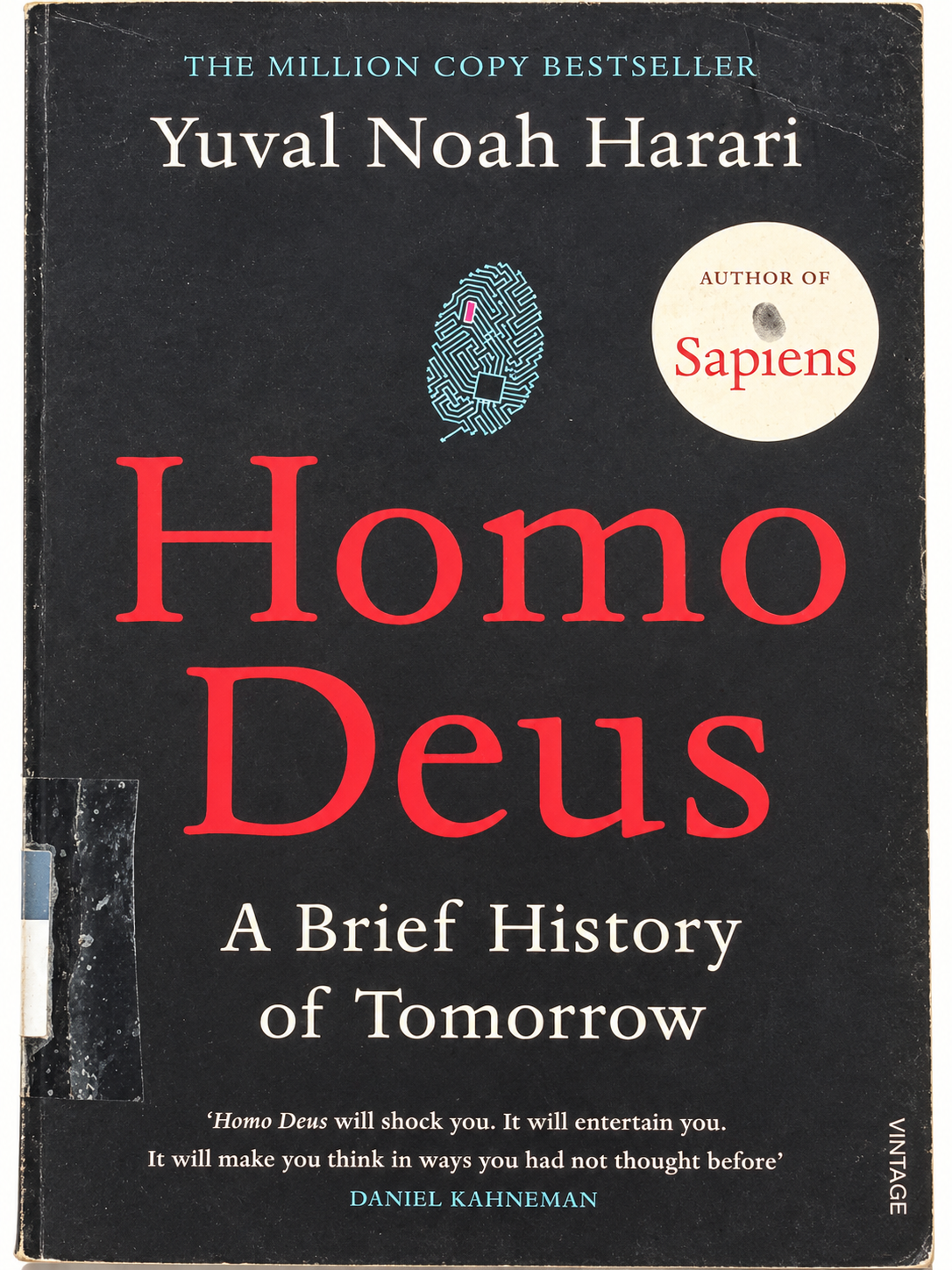
Homo Deus: A Brief History of Tomorrow
Vintage, London · Tahun, cetakan, jumlah halaman, dan ISBN eksemplar belum diperiksa. Rujukan pembanding: London: Vintage, 2017, 513 hlm., ISBN 978-1-78470-393-6 (belum diverifikasi pada halaman hak cipta eksemplar) · Tanpa tahun
Abstract
A sequel to Sapiens, this book by Yuval Noah Harari asks about the direction of humanity after famine, plague, and war have been brought relatively under control. Harari argues that humanity's new agenda is immortality, happiness, and god-like power. He traces how humanism became the modern religion, and then shows that findings in biology and computer science are unsettling the ideas of free will and the individual self. The final part discusses dataism, the belief that the universe consists of flows of data, and the possibility of algorithms taking over human decision-making. The book has become important material for discussion of the ethics of technology and the future of civilisation.
- Identifier
- KBA-BKU-TT-0015
- Type
- Buku
- Publisher
- Vintage, London
- Date Issued
- Tanpa tahun
- Bibliographic Citation
- Tahun, cetakan, jumlah halaman, dan ISBN eksemplar belum diperiksa. Rujukan pembanding: London: Vintage, 2017, 513 hlm., ISBN 978-1-78470-393-6 (belum diverifikasi pada halaman hak cipta eksemplar)
- Creator
- Yuval Noah Harari
- LC Classification
- CB158–161 — Peradaban: masa depan dan prakiraan
- LCSH Subject
- Civilization, Modern -- 21st century -- Forecasting Humanism Artificial intelligence
- BISAC Category
- SOC037000 SOCIAL SCIENCE / Future Studies
- Language
- Inggris
- Description
- Homo Deus: A Brief History of Tomorrow is a work by Yuval Noah Harari, an Israeli historian who teaches at the Hebrew University of Jerusalem and is widely known for his earlier book, Sapiens: A Brief History of Humankind. The cover of this copy is black with a large red title, an illustration of a fingerprint made up of electronic circuit patterns, a white circle reading "Author of Sapiens", and a quotation of praise from the Nobel laureate in Economics Daniel Kahneman. The Vintage logo appears at the bottom right. Library catalogues record the Vintage paperback edition, London, 2017, of 513 pages with ISBN 978-1-78470-393-6, while the first English edition was published in 2016 and the original version appeared in Hebrew in 2015. This description is a curatorial introduction based on the cover and catalogue data, not a summary of the entire contents of the book. The central question Harari poses is what humanity's agenda will be after it has succeeded in bringing under control the three great problems that have haunted its history, namely famine, plague, and war. According to Harari, for the first time in history, more people die from eating too much than from starvation, more from old age than from infectious diseases, and more from suicide than from being killed in war. This claim is the starting point for imagining humanity's new projects: the pursuit of immortality, happiness, and god-like power. The title Homo Deus depicts the possibility that human beings will seek to upgrade themselves through biotechnology and information technology. The book is organised in three major parts. The first part discusses how Homo sapiens conquered the world, above all through the capacity to cooperate in large numbers thanks to shared stories or intersubjective realities such as religion, money, states, and law. The second part examines how human beings give meaning to the world, with particular attention to modern humanism, which places the feelings and experiences of the individual as the highest source of authority in politics, economics, art, and ethics. The third part discusses the possibility that human beings will lose control of the world they have created, when algorithms and artificial intelligence are able to understand humans better than humans understand themselves. One of the most debated ideas in the book is "dataism", the view that the universe can be understood as a flow of data and that the value of every entity is determined by its contribution to data processing. Harari argues that dataism has the potential to become a kind of new religion replacing humanism, since important decisions in life, from choosing a partner to determining public policy, are increasingly handed over to algorithmic systems. This idea challenges readers to ask anew about the meaning of freedom, consciousness, and free will amid developments in the biological sciences and computing technology. Harari also foresees the emergence of a new inequality between a handful of humans able to upgrade themselves through technology and a majority who become economically and militarily irrelevant. This concern about a "useless class" has prompted wide discussion of the future of work, education, and welfare systems in the age of automation. The author stresses that the scenarios he sets out are not certain predictions, but possibilities discussed so that humanity can choose the direction of its future more consciously. For readers in the Muslim world and Indonesia, this book offers material for reflection that is both interesting and challenging. Harari's way of viewing religion as one form of intersubjective reality, on a par with money and the state, may provoke debate with religious views that understand religion as revelation and transcendent truth. The discussion of humanism and dataism can also be brought into conversation with the tradition of Islamic thought on the nature of the human being, reason, the spirit, and the purpose of life. Such an encounter opens space for critical dialogue between Harari-style big history and an epistemological framework rooted in the Islamic scholarly tradition. In the collection of Pustaka KBA13 Academy, this book is related to works on the future of civilisation, for example The History of Humans in 2050, The Digital Civilization, The Planetary Mind, and Masa Depan Dunia: Manusia dalam Peradaban Planetari. Reading Homo Deus alongside these works enables readers to compare the perspective of a secular historian with lines of thought that connect the technological future with spiritual and metaphysical dimensions. Such a comparison can enrich future studies, which have begun to be introduced in Islamic religious higher education institutions. For learning activities, this book is suitable for use in courses on the philosophy of science, future studies, the sociology of technology, ethics, and religious studies. Students can summarise the main argument of each part, identify the underlying philosophical assumptions, and then assess the evidence used by the author. They can also test the claims about the decline of famine, plague, and war by considering events after the book was published, including the COVID-19 pandemic and the wars that have broken out again in various regions. Critical reading is still necessary. A number of critics judge that Harari draws large conclusions too quickly from complex data, oversimplifies the role of religion, and pays too little attention to the different experiences of societies outside the West. Others question his views on consciousness and free will, which are considered too reductionist. These criticisms do not diminish the book's value as material for discussion, but rather make it a gateway to discussing philosophical and scientific debates about the human being. In terms of collection documentation, this copy shows signs of use on the edges of the cover and a library label on the left side. The publisher, year, and page data in this entry refer to a comparative catalogue of the 2017 Vintage edition, so the year of printing and ISBN of the photographed copy still need to be checked against the copyright page. One of the strengths of this book lies in the way Harari combines long-term history, evolutionary biology, computer science, and philosophy into a single grand narrative. He does not write as a futurologist making certain predictions, but as a historian inviting readers to see possibilities. Harari himself stresses that the scenarios in this book are not prophecies, but material for discussion about present-day choices. By understanding possible futures, humanity may hopefully change course before the worst possibilities materialise. For readers in Indonesia and Southeast Asia, this book is relevant for reading the rapidly unfolding digital transformation. The development of online platforms, the collection of personal data, artificial intelligence, and the automation of work are already felt in everyday life. Harari's questions about who owns data, how algorithms influence decisions, and what individual freedom means when behaviour can be predicted provide material for reflection for policymakers, educators, and civil society. In the context of religious studies, the idea of techno-religions also opens conversations about how faith traditions respond to new technologies and to claims about human immortality, happiness, and power. The book has also drawn criticism. Some scientists judge that Harari oversimplifies findings in neuroscience and biology when he calls organisms algorithms. Some philosophers question his claims about the absence of free will and of a unified self. Criticism of this kind in fact enriches the reading, since the book can be used as a starting point for discussion in classes, seminars, or reading groups on the ethics of technology. Suitable search subjects for this book include modern twenty-first-century civilisation, forecasting the future, humanism, artificial intelligence, biotechnology, and dataism. For citation purposes, references should state the author's name, the full title, the publisher, the year, and the pages read directly in the copy. As one of the most influential books about the human future in the past decade, Homo Deus provides important material for anyone who wishes to understand the debates about technology, meaning, and the direction of civilisation.
- Rights
- Koleksi pribadi KBA13 Academy
- Collection
- Books
How to cite
Yuval Noah Harari, “Homo Deus: A Brief History of Tomorrow”, Vintage, London, Tahun, cetakan, jumlah halaman, dan ISBN eksemplar belum diperiksa. Rujukan pembanding: London: Vintage, 2017, 513 hlm., ISBN 978-1-78470-393-6 (belum diverifikasi pada halaman hak cipta eksemplar). KBA13 Academy Archive and Library, KBA-BKU-TT-0015.