
Fields of Blood: Religion and the History of Violence
Vintage, London · Tahun, cetakan, jumlah halaman, dan ISBN eksemplar belum diperiksa. Rujukan pembanding: London: Vintage, 2015, 528 hlm., ISBN 978-0-09-956498-0; edisi pertama 2014 (belum diverifikasi pada halaman hak cipta eksemplar) · Tanpa tahun
Abstract
Karen Armstrong, the British historian of religion, challenges the assumption that religion has been the principal source of violence in history. Tracing the civilizations of Mesopotamia, India, China, ancient Israel, the Christian world, and the Islamic world up to the era of the modern nation-state, Armstrong shows that violence is more closely tied to the structures of agrarian states, empires, and political interests, while religious traditions have also given rise to an ethic of compassion that opposes violence. The final part discusses secularism, colonialism, and modern militant movements. The book is important for the study of religion, conflict, and peace.
- Identifier
- KBA-BKU-TT-0016
- Type
- Buku
- Publisher
- Vintage, London
- Date Issued
- Tanpa tahun
- Bibliographic Citation
- Tahun, cetakan, jumlah halaman, dan ISBN eksemplar belum diperiksa. Rujukan pembanding: London: Vintage, 2015, 528 hlm., ISBN 978-0-09-956498-0; edisi pertama 2014 (belum diverifikasi pada halaman hak cipta eksemplar)
- Creator
- Karen Armstrong
- LC Classification
- BL65.V55 — Kekerasan: aspek keagamaan
- LCSH Subject
- Violence -- Religious aspects Religion and politics Religions -- History
- BISAC Category
- REL084000 RELIGION / Religion, Politics & State
- Language
- Inggris
- Description
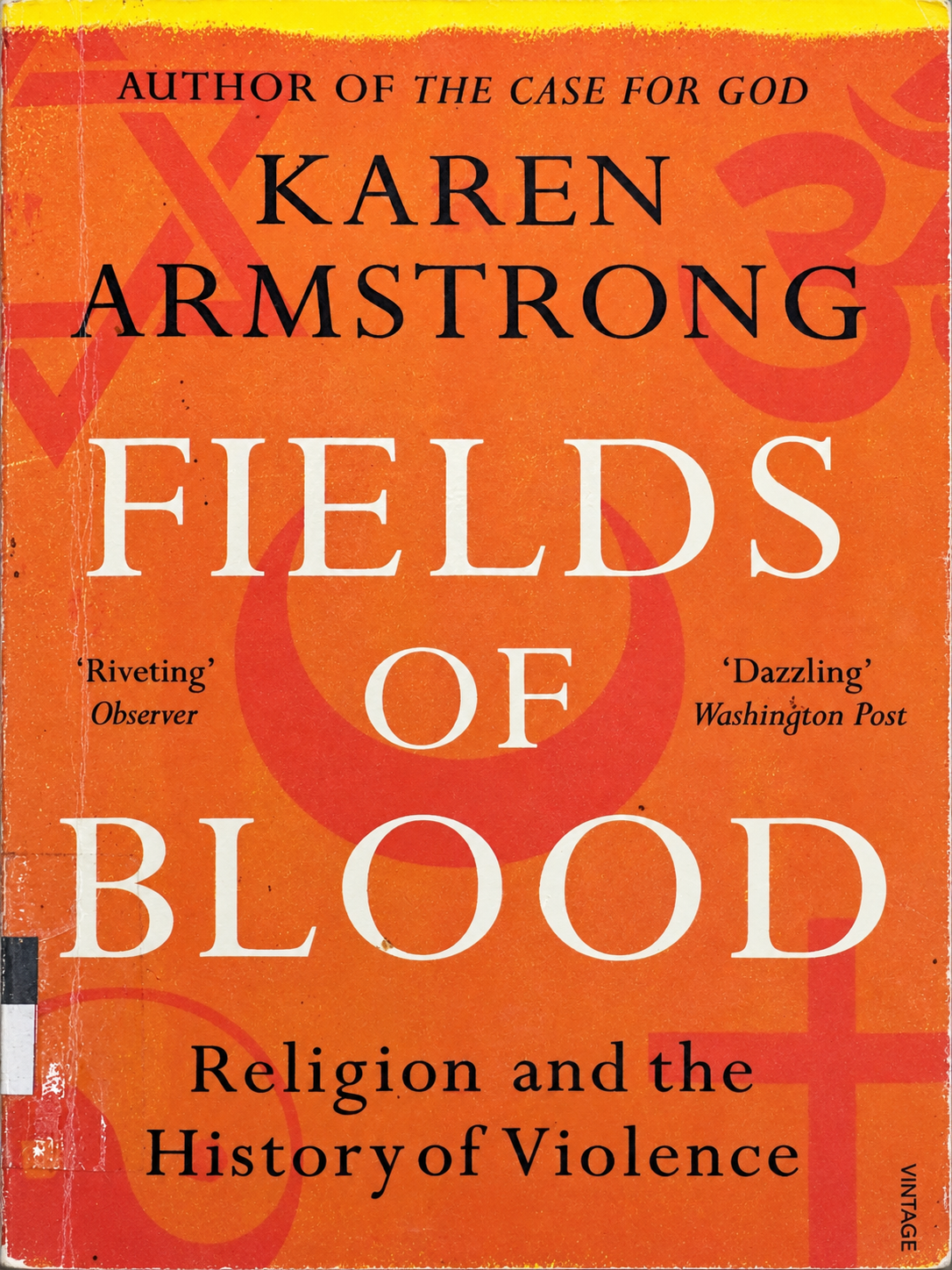
- Fields of Blood: Religion and the History of Violence is a work by Karen Armstrong, the British author widely known for her books on the history of religion, such as A History of God, The Battle for God, Muhammad: A Prophet for Our Time, and The Case for God. The cover of this copy is orange with a large title in white letters, the author's name in black letters at the top, and red religious symbols in the background, including the Star of David, the crescent moon, the cross, and the Om character. Quotations of praise from the Observer and the Washington Post appear to the left and right of the title, with the Vintage logo at the lower right. The publisher records that the Vintage paperback edition appeared in September 2015 at 528 pages with ISBN 978-0-09-956498-0, while the first edition was published in 2014. This note is a curatorial introduction based on the cover and publisher information, not a summary of the entire contents of the book. The central question Armstrong poses is whether religion is truly the principal cause of violence in human history. The view that religion fundamentally encourages war and bloodshed is very popular in public discourse, especially after the attacks of 11 September 2001 and the emergence of jihadist movements. Armstrong challenges this view by tracing the long history of the relationship between religion and violence, from hunter-gatherer societies and early agrarian civilizations, the religious traditions of India and China, Judaism, Christianity, and Islam, to the Crusades, the European wars of religion, colonialism, and modern terrorism. The main argument of this book is that for most of history, religion was never a domain separate from politics, economics, and social life. The concept of religion as a private matter separate from the state is a modern Western idea. Therefore, according to Armstrong, blaming religion specifically for violence that is actually rooted in struggles over power, land, resources, and state structures is a simplification. She shows that systemic violence was born together with the emergence of agrarian civilization and the state, when elites controlled the surplus of agricultural produce and used violence to preserve it. Armstrong also emphasizes the role of religious founders and figures in restraining violence. She describes how the teachings of the Buddha, the Jewish prophets and rabbis, Jesus, and the Prophet Muhammad sought to cultivate compassion, justice, and self-restraint as a counterweight to human aggression and structural injustice. In her reading, religious traditions often provide ethical resources for resisting violence, although they can also be dragged into justifying war when they merge with the interests of power. The final parts of the book discuss the relationship between the modern secular state, nationalism, and violence. Armstrong argues that the modern state has a far greater capacity for violence than the old agrarian empires, and that some of the violence labelled religious in the twentieth and twenty-first centuries is a reaction to imposed modernization, colonialism, and political oppression. In this context, she discusses the rise of fundamentalism, conflicts in the Middle East, and jihadist movements by placing them within a broader political history. For Muslim and Indonesian readers, the book has strong relevance. Indonesia has experienced various forms of violence associated with religion, from communal conflicts in Ambon and Poso to acts of terrorism, alongside a long history of tolerance and harmony. Armstrong's framework can help readers weigh the political, economic, and social factors behind violence that appears religious, without ignoring the role of religious interpretation itself. This approach is in line with the anthropology of religion, which attends to social and historical context in understanding religious behaviour. In the Pustaka KBA13 Academy collection, this book relates to materials on Islam and violence, radicalism, and geopolitics, for example Islam dan Kekerasan: Pengalaman untuk Aceh (Islam and Violence: Experiences for Aceh), Bloody Borders: An Acehnese Reply to the Clash of Civilizations, and presentation materials on radicalism trends and terrorism prevention strategies. Reading this book alongside these materials helps connect arguments of global history with the local experience of Aceh and Indonesia. For learning activities, the book is suitable for use in courses on the history of religion, the sociology of religion, the anthropology of religion, peace and conflict studies, and international relations. Students can choose one period or tradition discussed, summarize Armstrong's argument, and then compare it with other historical studies of that period. They can also test whether Armstrong's framework can explain contemporary conflicts in Southeast Asia. Critical reading remains necessary. A number of reviewers judge that Armstrong is too eager to defend religion and thus tends to downplay the role of religious teachings and motivations in some episodes of violence. Others question the book's very broad scope, as a result of which the treatment of some periods is considered too brief. These criticisms can become material for discussion on how historians balance religious and non-religious factors in explaining violence. In terms of collection documentation, this copy shows signs of use in the form of stains and wear on the edges of the cover and a library label on the left side. The publisher and year data in this entry refer to the 2015 Vintage edition as a point of comparison, so the printing year and ISBN of the photographed copy still need to be checked against the copyright page. Karen Armstrong wrote this book in response to the common assumption, especially after the events of 11 September 2001, that religion is the principal cause of violence in human history. According to Armstrong, this assumption ignores the role of the state, the agrarian economy, empires, and political interests that often use the language of religion to justify war. She shows that since the first civilizations, structural violence has been inherent in social systems based on agriculture and the control of surplus, while religion has frequently given rise to an ethic of compassion opposed to that violence. The structure of the book moves from the civilizations of Mesopotamia, India, China, and ancient Israel, through early Christianity, Byzantium, the Islamic caliphates, and the Crusades, to the wars of religion in early modern Europe. The final part discusses the birth of the secular nation-state, nationalism, colonialism, and modern militant movements, including groups acting in the name of Islam. Armstrong argues that the modern secular state is not free of violence; it has even produced enormous new forms of violence, such as the world wars and colonization. For readers in Aceh and Indonesia, this work is relevant for understanding armed conflict, radicalism, and the relationship between religion and the state. Armstrong's framework helps distinguish between religious teachings, political interpretations of religion, and the interests of power that exploit religious symbols. This approach is in line with the anthropology of religion, which places religious practice within its social and historical context. Nevertheless, a number of reviewers judge that the book's scope is too broad, so that some periods are discussed only briefly. There is also criticism that Armstrong tends to defend religion excessively. These criticisms need to be read together with the text so that readers can weigh the arguments fairly. Appropriate search subjects for this book include violence and religion, religion and politics, the history of religion, fundamentalism, terrorism, and peace. For citation purposes, references should state the author's name, the full title, the publisher, the year, and the pages read directly in the copy. As an ambitious effort to trace the relationship between religion and violence across human history, this book provides important material for anyone who wants to understand religious conflict more clearly and fairly.
- Rights
- Koleksi pribadi KBA13 Academy
- Collection
- Books
How to cite
Karen Armstrong, “Fields of Blood: Religion and the History of Violence”, Vintage, London, Tahun, cetakan, jumlah halaman, dan ISBN eksemplar belum diperiksa. Rujukan pembanding: London: Vintage, 2015, 528 hlm., ISBN 978-0-09-956498-0; edisi pertama 2014 (belum diverifikasi pada halaman hak cipta eksemplar). KBA13 Academy Archive and Library, KBA-BKU-TT-0016.