- Identifier
-
KBA-KLP-2014-0022
- Type
-
Kliping
- Publisher
-
Kompas
- Date Issued
-
2014-10-17
- Bibliographic Citation
-
Kompas, Jumat, 17 Oktober 2014; rubrik Opini
- Creator
-
Radhar Panca Dahana
- LC Classification
-
JQ760–779 — Pemerintahan dan politik Indonesia
- LCSH Subject
-
Widodo, Joko, 1961-
Political leadership -- Indonesia
Indonesia -- Politics and government -- 1998-
- BISAC Category
-
POL054000 POLITICAL SCIENCE / World / Asian
- Language
-
Indonesia
- Description
-
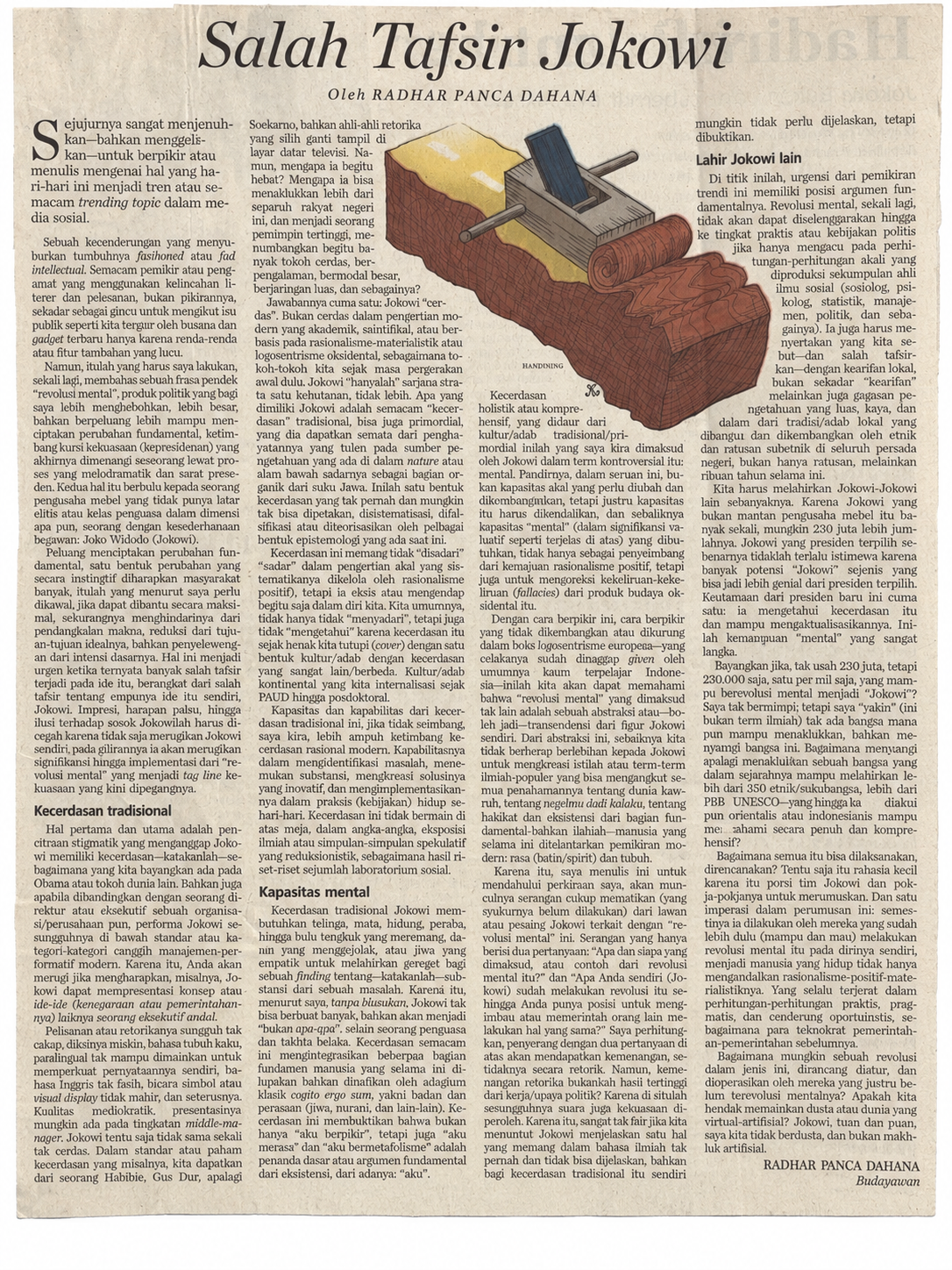
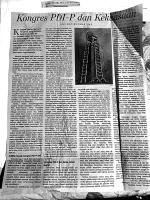
This clipping contains an opinion article by Radhar Panca Dahana entitled "Salah Tafsir Jokowi" (Misreading Jokowi) from the daily Kompas, Friday, 17 October 2014. The article appeared three days before the inauguration of Joko Widodo as the seventh President of the Republic of Indonesia on 20 October 2014. The author signed his piece with the description "Budayawan" (cultural observer). The clipping page shows a large italic headline at the top, the author's name below it, five columns of text with three subheadings, and an illustration by Handining depicting a traditional wood plane on a brick-red block of wood. The choice of illustration appears to allude to Jokowi's background as a furniture entrepreneur while also offering a metaphor of a simple tool capable of shaping raw material into something useful.
Radhar Panca Dahana (1965–2021) was known as a writer, poet, essayist, and cultural thinker. He wrote columns actively in various national media, founded the Federasi Teater Indonesia (Indonesian Theatre Federation), and taught for many years at Universitas Indonesia. His writings frequently questioned the dominance of modern Western ways of thinking in the life of the Indonesian nation and called on the nation to return to drawing wisdom from the traditions and maritime culture of the Nusantara. This article is a typical example of that intellectual position, written when the political euphoria welcoming the new president was at its height.
The central issue of the article is the phrase "revolusi mental" (mental revolution), Jokowi's campaign slogan which in mid to late 2014 was widely discussed on social media and in the public sphere. Radhar opens his piece with his reluctance to write about a trend that was in vogue, because he considered that many commentators were caught up in passing intellectual fashions. Yet he felt the need to write because, in his view, the idea had been misinterpreted from the outset, and this misinterpretation could harm Jokowi himself and give rise to false hopes in society.
The first section, entitled "Kecerdasan tradisional" (Traditional intelligence), starts from the observation that Jokowi's public image was often shaped in a belittling way. The author acknowledges that, measured by the standards of modern leadership, for example rhetorical skill, command of English, or the presentation abilities of a corporate executive, Jokowi does not stand out when compared with figures such as Soekarno, Habibie, Gus Dur, or other world leaders. According to Radhar, however, these yardsticks are precisely what mislead. Jokowi's distinctiveness lies in another kind of intelligence, a kind of traditional or primordial intelligence that grows out of life experience, interaction with nature, and the heritage of Javanese culture. Such intelligence, in the author's view, is not born of formal education and cannot be systematically mapped by modern epistemology.
The second section, "Kapasitas mental" (Mental capacity), explains how this intelligence works. Radhar describes it as the ability to understand problems with all the senses and feelings, not merely with calculating reason. He connects this idea with a critique of the Cartesian adage "I think, therefore I am", and then offers the view that human beings also exist because they feel and inwardly experience. From here he reads the meaning of the word "mental" in Jokowi's slogan. That word, in his view, does not refer to a capacity of reason that needs to be changed through rational programmes, but to an inner capacity that has long been marginalised by rationalist materialism. The mental revolution is thus read as an effort to restore the balance between reason and feeling, and at the same time as a correction to the errors of modern Western culture that the Indonesian nation has absorbed.
The third section, "Lahir Jokowi lain" (Let other Jokowis be born), draws practical implications. Radhar judges that the mental revolution will not succeed if it is left to the calculations of social scientists, economists, or technocrats accustomed to pragmatic and opportunistic approaches. He calls for the nation to produce more figures with similar abilities; one person in the palace is not enough. According to the author, Indonesia has hundreds of ethnic and sub-ethnic groups with a great wealth of civility and tradition, so the potential to produce leaders with such inner intelligence is very broad. He closes the article with a rhetorical question about whether a mental revolution is possible if it is designed by those who have not undergone an inner revolution, while reminding readers that Jokowi and his people are not artificial beings.
From the standpoint of political and cultural studies, this article is important because it shows one of the ways in which cultural figures read the Jokowi phenomenon during the transition of power in 2014. At that time, most of the public debate about the mental revolution revolved around programme plans, for example bureaucratic reform, character education, or behaviour-change campaigns. Radhar chose a different path by interpreting the idea as an epistemological and cultural problem. He positions Jokowi as a symbol of resistance to logocentrism and as a representation of local intelligence long regarded as of lesser value by the educated elite.
This kind of reading can be understood in the context of a longer discourse about local wisdom, cultural nativism, and the critique of modernity in Indonesia. Radhar's ideas intersect with an old debate dating back to the Polemik Kebudayaan (Cultural Polemic) of the 1930s, when Sutan Takdir Alisjahbana advocated an orientation towards the West while Sanusi Pane and Ki Hajar Dewantara emphasised Eastern values. The article can also be read together with other writings of the same period on Jokowi's populism, the emergence of leaders from outside the circles of the old elite, and the great public expectations of a figure regarded as simple and close to the people.
For present-day readers, this clipping has a twofold value. First, it records the intellectual atmosphere on the eve of the Jokowi administration, when public hopes for the new president were still very high. Second, it provides comparative material for assessing the course of the National Movement for Mental Revolution (Gerakan Nasional Revolusi Mental) programme that the government later implemented through the Coordinating Ministry for Human Development and Culture, including through Presidential Instruction No. 12 of 2016. Researchers can compare Radhar's cultural interpretation with the form of policy that was eventually implemented, which in fact relied heavily on bureaucratic approaches and behavioural campaigns such as integrity, work ethic, and gotong royong (mutual cooperation).
The article is also relevant to the study of political anthropology and leadership studies in Indonesia. The idea of a traditional intelligence that cannot be formalised opens discussion about the sources of leaders' legitimacy in Southeast Asian societies, the relationship between charisma and simplicity, and the role of cultural symbols in electoral politics. Students of Indonesian political thought, the sociology of knowledge, or the relationship between religion and culture can use this piece as an example of a cultural argument that rejects reducing the nation's problems to merely technocratic matters.
Of course, Radhar's argument is also open to criticism. Some readers may judge that the sharp distinction between Western rationality and the traditional intelligence of the Nusantara tends to oversimplify both traditions. Praise for a leader's inner intelligence also risks giving rise to a personality cult, something the author himself was wary of when he called for the birth of many other Jokowis. In addition, this cultural interpretation does not discuss much the institutional mechanisms, accountability, and public policy that determine the success or failure of an agenda of change. Criticism of this kind does not diminish the value of the article, but helps place it as one voice in a broader public debate.
Physically, the clipping consists of a whole yellowish newspaper page with five columns of text that are still clearly legible. The upper right edge shows the remains of the headline of another article from the same page. The uploaded image is a scan or photograph that has been straightened and sharpened for the sake of legibility. The full text of the article is not copied into this catalogue because its copyright belongs to the author and the publisher; this description is a curatorial account compiled to help users understand the content, context, and research value of the clipping.
Suitable search subjects for this clipping include Joko Widodo, the mental revolution, Indonesian political leadership, culture and politics, local wisdom, the critique of modern rationalism, and post-Reformasi Indonesian government. For citation purposes, the reference can be written as follows: Radhar Panca Dahana, "Salah Tafsir Jokowi", Kompas, 17 October 2014, Opinion section. Users are advised to check the page number against the Kompas archive if a citation requires that detail.
- Rights
-
Koleksi pribadi KBA13 Academy