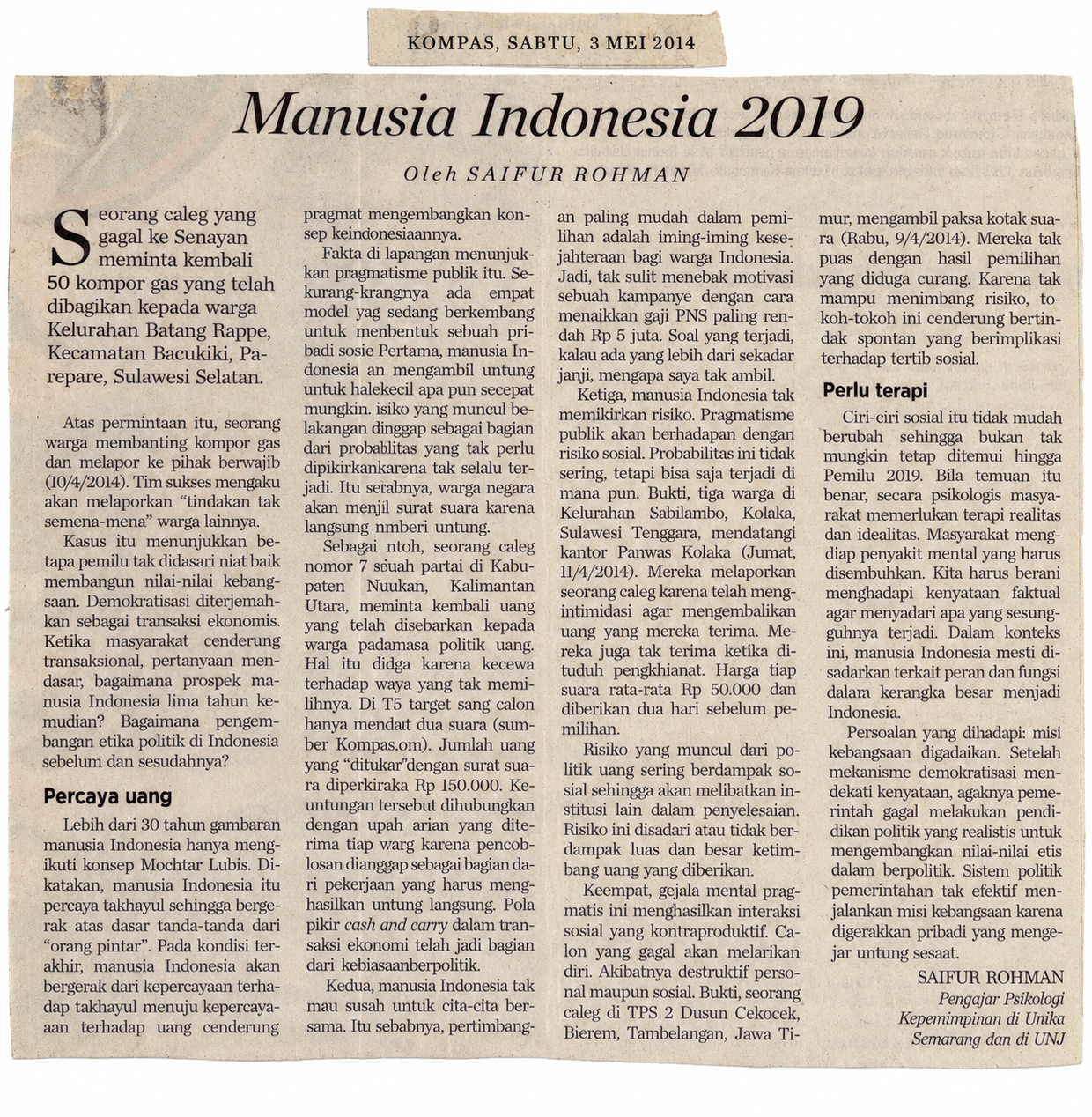
Manusia Indonesia 2019 [The Indonesian Human 2019]
Kompas · Kompas, Sabtu, 3 Mei 2014; rubrik Opini · 2014-05-03
Abstract
An opinion article by Saifur Rohman, a lecturer in the psychology of leadership, published a few weeks after the legislative election of 9 April 2014. Starting from the case of a failed legislative candidate who took back gas stoves from residents, the author argues that democratisation has been translated into economic transaction. He updates Mochtar Lubis's portrait of the Indonesian human: belief in superstition has shifted into belief in money. Four patterns of pragmatism are set out, namely pursuing momentary gain, reluctance to fight for shared ideals, ignoring social risks, and counterproductive social interaction, each accompanied by examples from various regions. The author calls for reality therapy and political education, and warns that this phenomenon will continue until the 2019 elections.
- Identifier
- KBA-KLP-2014-0023
- Type
- Kliping
- Publisher
- Kompas
- Date Issued
- 2014-05-03
- Bibliographic Citation
- Kompas, Sabtu, 3 Mei 2014; rubrik Opini
- Creator
- Saifur Rohman
- Subject
- Pemilu 2014 Politik uang Pragmatisme politik Karakter bangsa Mochtar Lubis Etika politik Pendidikan politik
- LC Classification
- JQ760–779 — Pemerintahan dan politik Indonesia
- LCSH Subject
- Elections -- Corrupt practices -- Indonesia Political culture -- Indonesia National characteristics, Indonesian
- BISAC Category
- POL064000 POLITICAL SCIENCE / Corruption & Misconduct
- Language
- Indonesia
- Description
- This clipping contains an opinion article by Saifur Rohman entitled "Manusia Indonesia 2019" ("The Indonesian Human 2019") from the daily Kompas, Saturday, 3 May 2014. The author is listed as a lecturer in the Psychology of Leadership at Universitas Katolik (Unika) Soegijapranata Semarang and at Universitas Negeri Jakarta. This article was published less than four weeks after the legislative general election of 9 April 2014 and a few days before the Komisi Pemilihan Umum (General Elections Commission) determined the official results of the political parties' vote shares. The clipping page shows a cut-out of the dated page header at the top, a large italic title, the author's name, four columns of text, and two subheadings, namely "Percaya uang" ("Believing in money") and "Perlu terapi" ("Therapy needed"). Saifur Rohman opens his piece with an event that seems trivial but is laden with meaning. A legislative candidate in Parepare, South Sulawesi, failed to make it to Senayan (the national parliament), and then demanded the return of dozens of gas stoves he had previously distributed to the residents of a kelurahan (urban ward). The incident provoked the residents' anger and ended in a report to the authorities. From this small case the author draws a large conclusion: the election was not conducted with the intention of building national values, but was understood as an economic transaction. Democratisation, in his observation, has been translated into the buying and selling of votes. He then poses the central question of what the face of the Indonesian human will be five years ahead, approaching the 2019 elections, and the direction of the development of the nation's political ethics. The section "Percaya uang" links the author's analysis to Mochtar Lubis's cultural lecture on the Indonesian human, delivered at Taman Ismail Marzuki in 1977 and later published as a book. Mochtar Lubis once described the Indonesian human, among other things, as a person who believes in superstition. Saifur Rohman updates that portrait with the thesis that belief in superstition has now shifted into belief in money. He then sets out four patterns of pragmatism which he believes are developing. The first pattern is the tendency to take small gains as quickly as possible without thinking of the consequences, so that citizens are willing to sell their votes because they immediately receive a reward. The author cites the example of a legislative candidate in Nunukan Regency, North Kalimantan, who demanded the return of money he had distributed because his vote count was far below target. The second pattern is reluctance to struggle for shared ideals, so that voting considerations are most easily influenced by inducements of prosperity, for example promises to raise civil servants' salaries. The third pattern, according to the author, is the inability to take social risks into account. He cites the example of residents in Kolaka, Southeast Sulawesi, going to the election supervisory committee to report a legislative candidate who intimidated them into returning money he had given. The fourth pattern is the emergence of counterproductive social interaction, for example failed candidates who then act destructively. The author mentions the case of a candidate seizing a ballot box at a polling station in Tambelangan, East Java. This series of examples was compiled from various media reports in April 2014, so the article also functions as a journalistic record of the practice of money politics in the legislative election. The closing section, "Perlu terapi", argues that such social traits do not change easily and may still be encountered in the 2019 elections. From a psychological perspective, society is judged to need reality and ideality therapy, namely the courage to face factual reality while being aware of its role and function within the larger framework of becoming Indonesia. The author concludes that the national mission has been pawned. The government is judged to have failed to carry out realistic political education to cultivate ethical values in politics, while the political system is driven by individuals pursuing momentary gain. The value of this article for researchers lies in several respects. First, it is a contemporary document on money politics in the 2014 elections, the second legislative election under the open-list proportional system based on the most votes. That system, according to many observers, encouraged competition among candidates within the same party and increased the incentive to buy votes directly. Later studies, such as the research by Edward Aspinall and Mada Sukmajati on patronage and clientelism in the 2014 legislative election, showed similar patterns more systematically across various regions. Saifur Rohman's article can be read as an early observation in line with those findings. Second, this article shows how an academic in the psychology of leadership uses the framework of national character to explain political phenomena. This approach differs from institutional analysis that emphasises electoral rules, party financing, or weak law enforcement. The author focuses on the mentality of citizens and elites, so his writing touches on the discourse of "revolusi mental" (mental revolution) which in the same months was beginning to be promoted by Joko Widodo. This thematic proximity makes this clipping interesting to read together with other writings from the same period on national character and political ethics. Third, the article's title, pointing to the year 2019, provides an opportunity to reread the author's prediction with present-day knowledge. The 2019 elections were indeed again marked by reports of money politics, including a sting operation by the Komisi Pemberantasan Korupsi (Corruption Eradication Commission) against a legislative candidate who had prepared hundreds of thousands of envelopes ahead of the vote. The author's concern that these pragmatic traits would not easily disappear thus acquires historical relevance. From a critical angle, some readers may consider that generalising about "the Indonesian human" on the basis of a number of cases risks oversimplifying the problem. Money politics also arises not only from the mentality of voters, but from the incentive structures created by party elites, high campaign costs, and weak oversight. Criticism of this kind helps place the article as a reflective and normative voice, not as a complete empirical study. Precisely for that reason, this piece is useful for classroom discussion about the relationship between political culture, institutions, and voting behaviour. For students and researchers in political science, anthropology, and social psychology, this clipping can be used as discussion material on clientelism, political culture, and civic education. The reference to Mochtar Lubis also opens the way to tracing the long debate on national character in Indonesia, which since the late 1970s has drawn both praise and criticism for being considered too essentialist. From a methodological perspective, this article also shows how print media becomes a source of data for social analysis. Almost all the examples the author uses come from news reports, complete with the dates and locations of events, so researchers can trace the original reports to verify or extend the analysis. This pattern is common in opinion writing by academics, but is rarely accompanied by detailed source notes. For teachers, this clipping can be used to train students to distinguish between anecdotal and systematic evidence, while assessing how a normative argument is built from a series of cases chosen by the author. Physically, the clipping consists of a cut-out of a yellowed newspaper page with a dated page header pasted above it. The text is clearly legible, although some words in the second column appear less sharp due to print or scan quality. The uploaded image has been straightened and enhanced for legibility. The full text of the article is not copied into this catalogue because the copyright belongs to the author and publisher; this description is a curatorial account to help users understand its content, context, and research value. Suitable search subjects include the 2014 elections, money politics, political pragmatism, national character, Mochtar Lubis, political ethics, and political education. For citation purposes, the reference can be written as follows: Saifur Rohman, "Manusia Indonesia 2019", Kompas, 3 May 2014, Opinion section.
- Rights
- Koleksi pribadi KBA13 Academy
- Collection
- Clippings
How to cite
Saifur Rohman, “Manusia Indonesia 2019 [The Indonesian Human 2019]”, Kompas, Kompas, Sabtu, 3 Mei 2014; rubrik Opini, 2014-05-03. KBA13 Academy Archive and Library, KBA-KLP-2014-0023.