
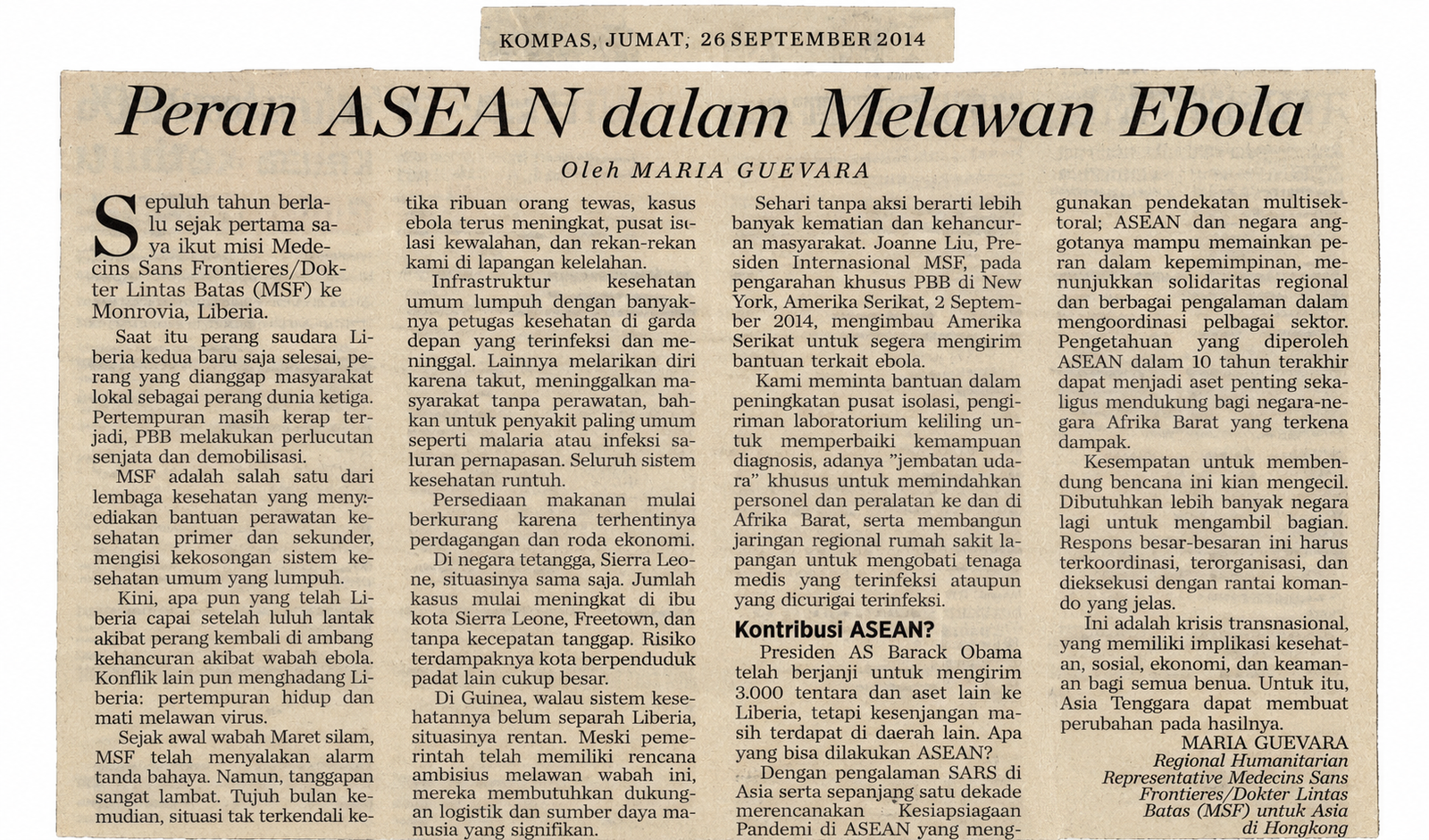
Peran ASEAN dalam Melawan Ebola [The Role of ASEAN in Fighting Ebola]
Kompas · Kompas, Jumat, 26 September 2014; rubrik Opini · 2014-09-26
Abstract
An opinion article by Maria Guevara, Regional Humanitarian Representative for Asia of Médecins Sans Frontières (Doctors Without Borders), published at the height of the Ebola epidemic in West Africa. Drawing on her experience serving in Liberia ten years earlier, the author describes the collapse of the health systems in Liberia, Sierra Leone, and Guinea, the slowness of the international response, and the urgent needs for isolation centres, mobile laboratories, an air bridge, and field hospitals for medical staff. She then calls on ASEAN, equipped with the experience of SARS and a decade of pandemic preparedness planning, to show leadership and regional solidarity in facing this transnational health crisis.
- Identifier
- KBA-KLP-2014-0024
- Type
- Kliping
- Publisher
- Kompas
- Date Issued
- 2014-09-26
- Bibliographic Citation
- Kompas, Jumat, 26 September 2014; rubrik Opini
- Creator
- Maria Guevara
- Subject
- Wabah Ebola 2014 Afrika Barat ASEAN Médecins Sans Frontières Bantuan kemanusiaan Kesehatan global Kesiapsiagaan pandemi
- LC Classification
- JZ — Hubungan internasional
- LCSH Subject
- Ebola virus disease -- Africa, West ASEAN Humanitarian assistance
- BISAC Category
- POL011000 POLITICAL SCIENCE / International Relations / General
- Language
- Indonesia
- Description
- This clipping contains an opinion article by Maria Guevara entitled "Peran ASEAN dalam Melawan Ebola" (The Role of ASEAN in Fighting Ebola) from the daily Kompas, Friday, 26 September 2014. The author is listed as Regional Humanitarian Representative for Asia of Médecins Sans Frontières (MSF), or Doctors Without Borders (Dokter Lintas Batas), based in Hong Kong. The article appeared when the Ebola virus disease epidemic in West Africa was at its most alarming phase. The clipping page shows a cut-out of the dated page header, a large italic headline stretching across four columns of text, the author's name, and one subheading in the form of a question, "Kontribusi ASEAN?" (ASEAN's Contribution?). Maria Guevara opens her piece with a personal memory. Ten years earlier she had joined her first MSF mission to Monrovia, the capital of Liberia, shortly after the end of that country's second civil war. At that time MSF filled the gap in basic and referral health services because the public health system had been paralysed by the war. The author then points out a bitter irony: Liberia's achievements after rising from the war were now once again threatened with collapse, not because of weapons, but because of a virus. This new battle, in her words, is a life-and-death struggle against disease. The opening part of the article describes the development of the epidemic since March 2014. The author stresses that MSF had sounded the alarm from the outset, but the international response was extremely slow. Seven months later the situation was out of control: thousands of people had died, the number of cases continued to rise, isolation centres were overwhelmed, and field staff were exhausted. She depicts the collapse of the health infrastructure as many frontline health workers became infected and died, while others abandoned their posts out of fear. As a result, communities lost access to services even for common illnesses such as malaria and respiratory infections. Food supplies also dwindled because trade and economic activity had come to a halt. The author notes that Sierra Leone, especially the capital Freetown, was experiencing a similar situation, while Guinea was judged to be slightly better off but still vulnerable and in need of substantial logistical support and human resources. The author also refers to the speech by MSF's International President, Joanne Liu, at a special briefing at the United Nations in New York on 2 September 2014. In that briefing MSF urged countries with large capacities to send assistance immediately. Maria Guevara details the kinds of assistance needed, among them additional isolation centres, mobile laboratories to improve diagnostic capacity, a dedicated air bridge to move personnel and equipment to and within West Africa, and a regional network of field hospitals for medical staff who were infected or suspected of being infected. The section "Kontribusi ASEAN?" forms the core of the argument. The author notes that United States President Barack Obama had pledged to send three thousand military personnel and other assets to Liberia, but gaps in assistance remained in other areas. She then asks what ASEAN could do. In her view, the experience of dealing with the SARS outbreak in 2003 and a decade of pandemic preparedness planning in the region, including a multisectoral approach, constitute important assets. ASEAN and its member states are judged capable of demonstrating leadership, regional solidarity, and experience in coordinating various sectors. The author closes by stressing that the window for containing the disaster is narrowing, that a large-scale response must be coordinated and carried out with a clear chain of command, and that this crisis is transnational, with health, social, economic, and security impacts on all continents. The historical context reinforces the significance of this clipping. The World Health Organization declared the Ebola outbreak in West Africa a Public Health Emergency of International Concern on 8 August 2014. On 18 September 2014, the UN Security Council adopted Resolution 2177, which for the first time described a disease outbreak as a threat to international peace and security. A day later the UN established a special emergency mission for the Ebola response. This article appeared only a week after these steps, and thus records the pressure from humanitarian organisations for countries outside Africa to take action. Overall, the 2014–2016 epidemic is recorded as having caused more than twenty-eight thousand cases and more than eleven thousand deaths, mainly in Guinea, Liberia, and Sierra Leone. For readers in Southeast Asia, this article is of interest because it shows how international humanitarian actors sought to involve ASEAN in global health issues beyond its own region. ASEAN has hitherto been better known for economic cooperation and regional security, while health cooperation developed mainly after the experiences of SARS and avian influenza. The author's appeal can be read as an effort to encourage ASEAN to expand its role from recipient of assistance to contributor of global solidarity. This debate later became all the more relevant when the COVID-19 pandemic struck the world in 2020 and ASEAN established various new mechanisms, including an emergency response fund and a regional centre for the study of infectious diseases. The clipping is also useful for the study of international relations and non-traditional security. The author explicitly calls the epidemic a transnational crisis that touches on security, in line with the idea of the securitisation of health widely discussed in the international relations literature. Students can use this piece to discuss the role of non-governmental organisations in humanitarian diplomacy, the capacity of regional organisations, and the tension between state sovereignty and the need for a collective response to health threats. Of course, this article is written from the advocacy standpoint of a humanitarian organisation, so its aim is to mobilise support, not to present balanced policy analysis. Readers need to compare it with official ASEAN documents and evaluation reports of the Ebola response to assess the extent to which the appeal was subsequently followed up. Nevertheless, the author's field testimony and the details of the needs she sets out make this clipping a valuable primary source on the atmosphere of the crisis at the end of September 2014. The writing of this article in Indonesian in a national daily also shows the communication strategy of an international humanitarian organisation. By writing for Indonesian readers, in the largest country in ASEAN, MSF sought to influence public opinion and policymakers in a region that had been relatively distant from the crisis in West Africa. Indonesia itself at that time tightened surveillance at its points of entry and prepared referral hospitals for suspected cases, while the dispatch of health workers to the affected areas became a subject of debate. This clipping can be a starting point for tracing the responses of the Indonesian government and other ASEAN countries to the epidemic. Physically, the clipping consists of a cut-out of a yellowish newspaper page in a wide format, with a dated page header pasted above it. The four-column text is clearly legible. The uploaded image has been straightened and sharpened for legibility. The full text of the article is not copied into this catalogue because its copyright belongs to the author and the publisher; this description is a curatorial account to help users understand its content, context, and research value. Suitable search subjects include the 2014 Ebola epidemic, West Africa, ASEAN, Médecins Sans Frontières, humanitarian assistance, global health, and pandemic preparedness. For citation purposes, the reference can be written as follows: Maria Guevara, "Peran ASEAN dalam Melawan Ebola", Kompas, 26 September 2014, Opinion section.
- Rights
- Koleksi pribadi KBA13 Academy
- Collection
- Clippings
How to cite
Maria Guevara, “Peran ASEAN dalam Melawan Ebola [The Role of ASEAN in Fighting Ebola]”, Kompas, Kompas, Jumat, 26 September 2014; rubrik Opini, 2014-09-26. KBA13 Academy Archive and Library, KBA-KLP-2014-0024.