Skandal Kebudayaan Kita [Our Cultural Scandal]
Kompas · Kompas, Sabtu, 3 Mei 2014; rubrik Opini · 2014-05-03
Abstract
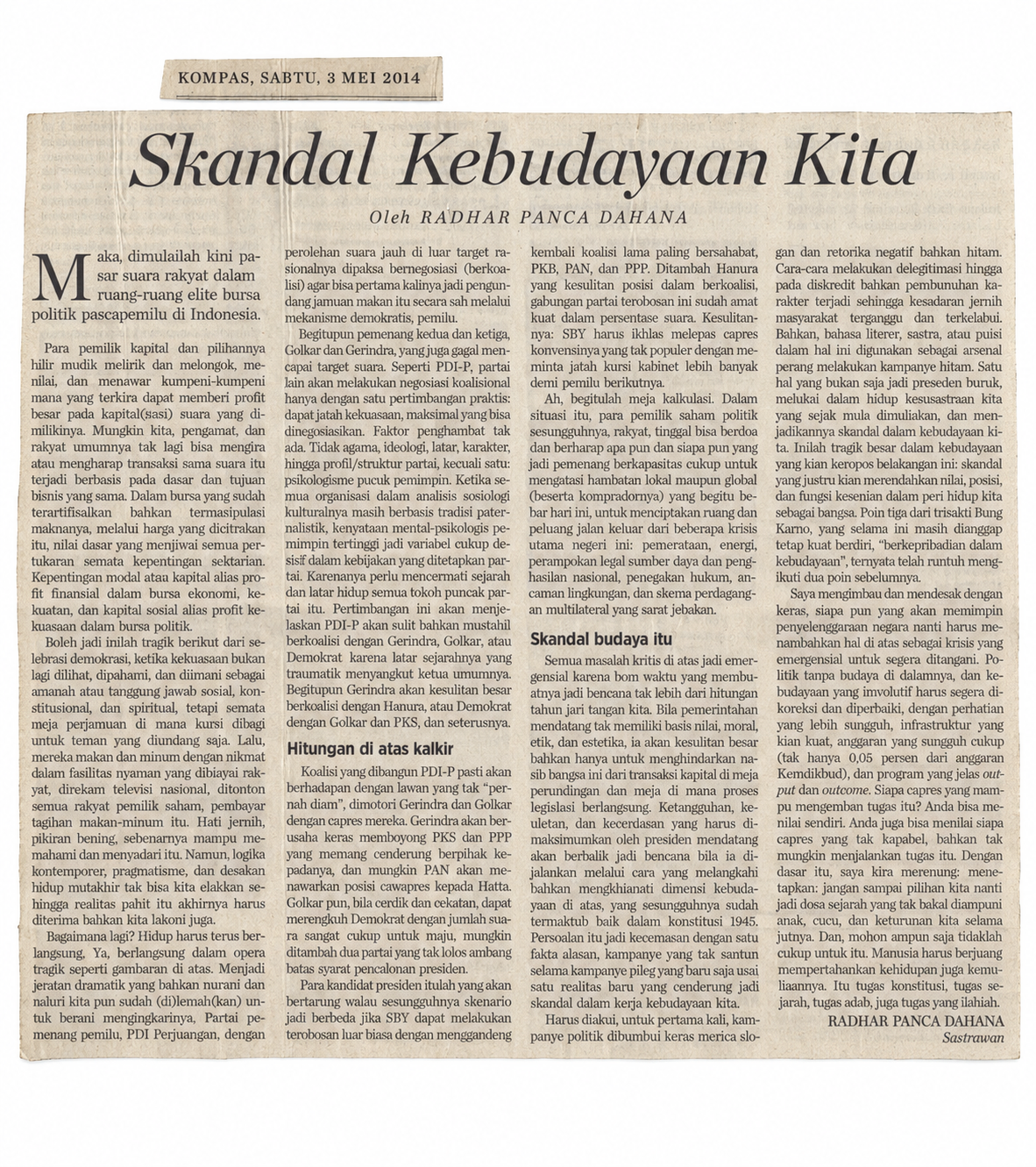
An opinion article by the writer Radhar Panca Dahana published after the 2014 legislative election. The author depicts the people's votes being traded on the elite political exchange, and then analyses the coalition calculations of parties that failed to reach their vote targets. In his view, coalitions are determined more by the psychology of party leaders than by ideology. The core of his argument is a cultural scandal: campaigns spiced with negative rhetoric, character assassination, and the use of literary language and poetry as weapons of black campaigning. He argues that the third point of the Trisakti, having a personality in culture, has collapsed, and urges the next leader to address the cultural crisis with attention, infrastructure, budget, and clear programmes.
- Identifier
- KBA-KLP-2014-0026
- Type
- Kliping
- Publisher
- Kompas
- Date Issued
- 2014-05-03
- Bibliographic Citation
- Kompas, Sabtu, 3 Mei 2014; rubrik Opini
- Creator
- Radhar Panca Dahana
- Subject
- Pemilu 2014 Koalisi partai politik Kampanye hitam Kebudayaan dan politik Sastra dan politik Trisakti Etika politik
- LC Classification
- JQ760–779 — Pemerintahan dan politik Indonesia
- LCSH Subject
- Elections -- Indonesia Political campaigns -- Indonesia Politics and culture -- Indonesia
- BISAC Category
- POL008000 POLITICAL SCIENCE / Political Process / Campaigns & Elections
- Language
- Indonesia
- Description
- This clipping contains an opinion article by Radhar Panca Dahana entitled "Skandal Kebudayaan Kita" (Our Cultural Scandal) from the daily Kompas, Saturday, 3 May 2014. The author signs his piece with the description "Sastrawan" (Writer). The article was published a few weeks after the legislative election of 9 April 2014, when quick-count results had already shown the map of party strength and the elites had begun exploring coalitions for the presidential election of July 2014. The clipping page shows a cut-out of the dated page header, a large italic headline, the author's name, four columns of text, and two subheadings, namely "Hitungan di atas kalkir" (Calculations on Tracing Paper) and "Skandal budaya itu" (That Cultural Scandal). Radhar opens his piece with a market metaphor. The people's votes, just cast in the election, are now, in his view, being traded in the elite rooms of the political exchange. The owners of capital and their chosen parties bargain over which political enterprise can yield the greatest profit from the votes they hold. He depicts the tragedy of a democracy in which power is no longer understood as a trust or as a social, constitutional, and spiritual responsibility, but as a banquet table where seats are distributed to those who are invited. Ironically, the banquet is paid for by the people and broadcast on television to the people themselves, the true shareholders of democracy. The section "Hitungan di atas kalkir" analyses post-legislative-election coalition calculations. The author notes that the winning party, PDI Perjuangan, obtained a share of the vote far below its target and therefore had to form a coalition in order to nominate a president. Golkar and Gerindra, the second- and third-placed parties, are also judged to have failed to reach their targets. According to Radhar, the determining factor of coalitions is not religion, ideology, or party structure, but the psychology of party leaders within a political culture that is still paternalistic. He anticipates difficulties for some parties in forming coalitions because of the history of personal relations between their chairpersons, and weighs the possible moves of the Partai Demokrat and President Susilo Bambang Yudhoyono. He calls all these calculations reckonings on the table, while the people can only pray that the winners will be able to overcome the nation's great crises, such as equitable distribution, energy, the plundering of national resources, law enforcement, environmental threats, and harmful multilateral trade schemes. The section "Skandal budaya itu" is the core of the argument. Radhar argues that these crises are like time bombs, and that the next government will face disaster if it lacks a foundation of values, morals, ethics, and aesthetics. He highlights the legislative election campaign, which, in his view, was for the first time spiced with negative slogans and rhetoric and even open black campaigning. Delegitimization, up to and including character assassination, is judged to have damaged the clear awareness of society. What he regrets most is the use of literary language and poetry as weapons in the black-campaign war. For Radhar, this practice is a cultural scandal because it degrades the value, position, and function of the arts in national life. He also states that the third point of Bung Karno's Trisakti, having a personality in culture, has evidently collapsed, following the other two points, namely sovereignty in politics and self-reliance in the economy. In the final section the author urges whoever becomes the next head of state to treat the cultural crisis as an urgent matter. Politics without culture and a stagnant culture, he argues, must be corrected immediately through serious attention, adequate infrastructure, a proper budget, and programmes with clear results and impact. He mocks the allocation of the culture budget, which is only a very small fraction of the budget of the Ministry of Education and Culture. Radhar closes with a call to voters not to let their choice become a historical sin, while reminding them that the human struggle encompasses constitutional duty, historical duty, civilizational duty, and divine duty. The political context of the time clarifies the meaning of the article. The official results of the General Elections Commission, announced on 9 May 2014, placed PDI Perjuangan first with about 19 percent of the vote, followed by Golkar and Gerindra. No party reached the presidential nomination threshold on its own, so coalitions became a necessity. The presidential election then pitted the pairs Joko Widodo–Jusuf Kalla and Prabowo Subianto–Hatta Rajasa against each other in one of the most polarized contests in Indonesian political history. Black campaigning, including slanderous tabloids and identity-based attacks, was a prominent feature of the period. During the legislative campaign, poems with a tone of political satire were also circulated, posted by party figures on social media, a phenomenon that appears to have been the target of Radhar's criticism. This clipping is valuable for the study of literature, culture, and politics because it shows a writer's view of the misuse of literary language in electoral politics. The piece can also be read together with other articles by Radhar in the collection, especially "Salah Tafsir Jokowi" (Misreading Jokowi), published in Kompas in October 2014. Both articles show the consistency of his thinking on the importance of the cultural and civilizational dimension in the life of the state, as well as his critique of politics reduced to pragmatic calculation. For students, this article can serve as material for discussion of campaign ethics, paternalistic political culture, and the role of culture in public policy. The reference to Bung Karno's Trisakti is also relevant because the concept was later taken up again by the Jokowi–Kalla pair in their Nawacita vision and mission, which promised development with a personality in culture. Readers can assess the extent to which that promise was later translated into policy, for example through Law Number 5 of 2017 on the Advancement of Culture. As a critical note, Radhar's rhetorical and metaphor-laden style makes some of his arguments normative and difficult to test. His coalition analysis is also speculative because it was written before the final coalition map had taken shape. Yet precisely because of this, the clipping records the uncertainty and anxiety of the public during the political transition of 2014 in a way that official documents do not. From the perspective of literary studies, the piece reflects the view that literature has a certain dignity and social function, so that using it to attack political opponents is regarded as a betrayal of artistic values. This view is debatable, since the history of Indonesian literature also includes pamphlet poetry and the literature of resistance that is openly political, for example the works of W.S. Rendra and Wiji Thukul. The difference, according to an interpretation of Radhar's argument, lies in purpose and method: the literature of resistance defends values and humanity, whereas black-campaign poetry degrades opponents in the interest of power. This debate can be interesting material for discussion in classes on literature and political communication. Physically, the clipping is a cut-out of a yellowish newspaper page with the dated page header pasted above it. The four columns of text are clearly legible. The uploaded image has been straightened and enhanced for legibility. The full text of the article has not been copied into this catalogue because the copyright belongs to the author and the publisher; this note is a curatorial description to help users understand its content, context, and research value. Suitable search subjects include the 2014 Election, political party coalitions, black campaigning, culture and politics, literature and politics, Trisakti, and political ethics. For citation purposes, the reference may be written as follows: Radhar Panca Dahana, "Skandal Kebudayaan Kita", Kompas, 3 May 2014, Opinion section.
- Rights
- Koleksi pribadi KBA13 Academy
- Collection
- Clippings
How to cite
Radhar Panca Dahana, “Skandal Kebudayaan Kita [Our Cultural Scandal]”, Kompas, Kompas, Sabtu, 3 Mei 2014; rubrik Opini, 2014-05-03. KBA13 Academy Archive and Library, KBA-KLP-2014-0026.