
Kepemimpinan Kelautan [Ocean Leadership]
By Arif Satria
Kompas · Kompas, Sabtu, 3 Mei 2014; rubrik Opini (tanggal dipastikan dari Pengantar Redaksi pada halaman yang sama) · 2014-05-03
Abstract
An opinion article by Arif Satria, Dean of the Faculty of Human Ecology at IPB (Bogor Agricultural University), written ahead of the 2014 presidential election. The author asks whether political change will bring prosperity to fishers, advance the maritime economy, and control damage to the sea. He proposes a framework of three levels of awareness about the ocean, namely individual, collective, and political, and judges that the awareness of Indonesia's policymakers has not yet reached the political level. By comparing the issue of climate change and citing the example of Abdurrahman Wahid, who established a maritime ministry, he calls for the emergence of ocean leadership: good ocean governance, the sea as a source of growth and economic justice, and the strengthening of maritime culture.
- Identifier
- KBA-KLP-2014-0027
- Type
- Kliping
- Publisher
- Kompas
- Date Issued
- 2014-05-03
- Bibliographic Citation
- Kompas, Sabtu, 3 Mei 2014; rubrik Opini (tanggal dipastikan dari Pengantar Redaksi pada halaman yang sama)
- Creator
- Arif Satria
- Subject
- Kebijakan kelautan Kepemimpinan kelautan Nelayan Perikanan Pemilu 2014 Budaya bahari Kementerian Kelautan dan Perikanan
- LC Classification
- GC1018 — Kebijakan sumber daya laut
- LCSH Subject
- Marine resources -- Government policy -- Indonesia Fisheries -- Indonesia Political leadership -- Indonesia
- BISAC Category
- POL044000 POLITICAL SCIENCE / Public Policy / Environmental Policy
- Language
- Indonesia
- Description
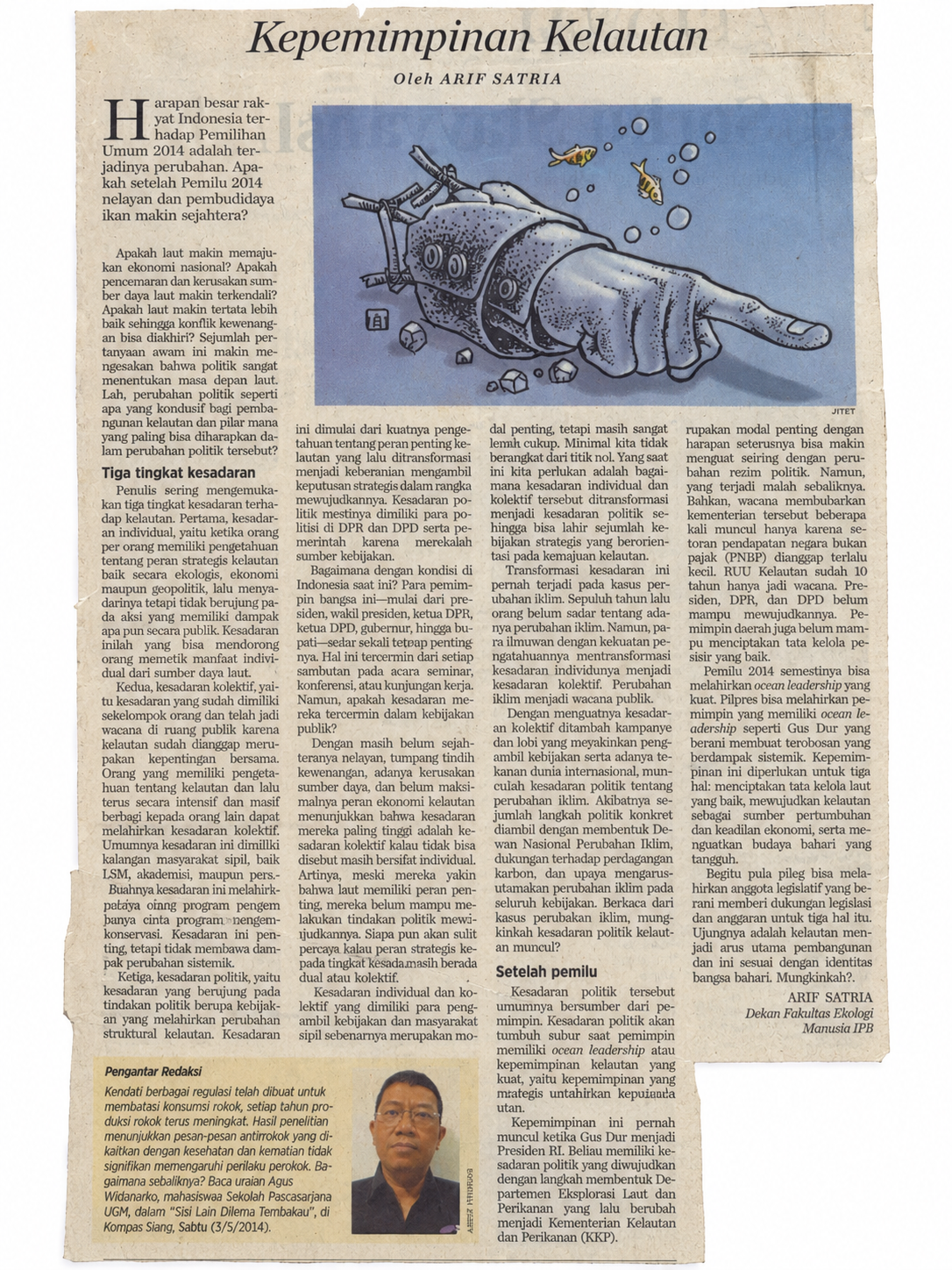
- This clipping contains an opinion article by Arif Satria entitled "Kepemimpinan Kelautan" ("Ocean Leadership") from the daily Kompas, Saturday, 3 May 2014. The author is listed as Dean of the Faculty of Human Ecology, Institut Pertanian Bogor (Bogor Agricultural University). This clipping does not include a dated page header, but the "Pengantar Redaksi" (Editor's Note) box at the bottom of the page refers to a piece in Kompas Siang, Saturday edition, 3 May 2014, so the publication date can be confirmed. The clipping page shows a large italic title, the author's name, a colour illustration by Jitet depicting a giant metal hand pointing at the seabed with fish and air bubbles, four columns of text with two subheadings, namely "Tiga tingkat kesadaran" ("Three levels of awareness") and "Setelah pemilu" ("After the election"), and an editor's note box about another piece on the tobacco dilemma. Arif Satria opens his piece with questions about hopes for change after the 2014 elections. Will fishers and fish farmers become more prosperous? Will the sea increasingly advance the national economy, will pollution and damage to marine resources be better controlled, and can conflicts of authority at sea be brought to an end? According to the author, these questions underline that politics strongly determines the future of the sea, so it is necessary to ask what kind of political change is conducive to maritime development. The section "Tiga tingkat kesadaran" sets out an analytical framework the author has often put forward. The first level is individual awareness, namely a person's knowledge of the strategic role of the ocean in ecological, economic, and geopolitical terms, which has not yet led to actions with public impact. The second level is collective awareness, when that knowledge is held by a group of people and becomes public discourse because the ocean is regarded as a common interest. This awareness generally grows among civil society, academics, and the press, and can give rise to conservation programmes, although it has not yet produced systemic change. The third level is political awareness, namely awareness that leads to policies producing structural change in the maritime field. This awareness should be held by politicians in the Dewan Perwakilan Rakyat (House of Representatives) and the Dewan Perwakilan Daerah (Regional Representative Council), as well as by the government as policymaker. The author then assesses the situation in Indonesia. Leaders, from the president to regents, are judged to be already aware of the importance of the sea, but that awareness has not yet been reflected in policy. Fishers are not yet prosperous, authorities still overlap, resource damage continues, and the economic role of the maritime sector has not been maximised. This means that the awareness of policymakers is at most collective, perhaps even still individual. The author compares this with the issue of climate change, which within a decade shifted from the individual awareness of scientists to political awareness, marked by the establishment of the Dewan Nasional Perubahan Iklim (National Council on Climate Change), support for carbon trading, and efforts to mainstream climate change in policy. From this comparison he asks whether a similar transformation might occur on the maritime issue. The section "Setelah pemilu" argues that political awareness generally originates from leaders. That awareness will flourish if leaders possess what the author calls ocean leadership. He points to President Abdurrahman Wahid as an example of a leader with maritime political awareness, realised through the establishment of the Departemen Eksplorasi Laut dan Perikanan (Department of Marine Exploration and Fisheries), which later became the Kementerian Kelautan dan Perikanan (Ministry of Marine Affairs and Fisheries). However, what happened afterwards was the opposite: talk of dissolving the ministry emerged because its contribution of non-tax state revenue was considered small, and the Ocean Bill remained mere talk for about ten years. The author hopes that the 2014 elections will produce a president with strong ocean leadership, capable of creating good ocean governance, making the sea a source of growth and economic justice, and strengthening maritime culture. He also hopes that the elected legislators will dare to provide legislative and budgetary support. The article closes with the hope that the maritime sector will become the mainstream of development in keeping with the identity of a maritime nation. The context after this article was published makes it historically very interesting. A few months later, Joko Widodo won the presidential election with the vision of the Global Maritime Fulcrum (Poros Maritim Dunia). His government established the Coordinating Ministry for Maritime Affairs in October 2014, while Law No. 32 of 2014 on Marine Affairs was finally passed in the same year, ending the long wait referred to by the author. The policies of Minister of Marine Affairs and Fisheries Susi Pudjiastuti on eradicating illegal fishing also marked a major change. This article can thus be read as part of the public discourse that paved the way for the rise of the maritime agenda in the new government. Arif Satria himself later became Rector of Institut Pertanian Bogor from 2017 and is widely known as an expert in the political ecology of marine affairs and fisheries. The three-level framework of awareness he sets out in this article reflects a political ecology approach that connects knowledge, discourse, and power in natural resource management. For researchers, this clipping is useful as an example of how academics use the momentum of elections to steer the policy agenda. This clipping is relevant to studies of maritime policy, the anthropology of coastal communities, and the politics of natural resources. For readers in Aceh, this issue is also related to the role of customary maritime institutions such as Panglima Laot (the customary sea commander), which shows that ocean governance is determined not only by the state but also by local institutions. Students can compare the idea of ocean leadership in this article with the implementation of the Global Maritime Fulcrum policy and assess its achievements and shortcomings. As a critical note, this article places greater emphasis on the role of individual leadership and discusses less the economic interests, bureaucratic structures, and inter-sectoral conflicts that also determine maritime policy. The three-level framework of awareness is also linear and therefore needs to be tested with case studies. Nevertheless, this piece gives a clear picture of the hopes of the maritime academic community ahead of the change in national leadership. This piece is also interesting to read together with other articles published in Kompas on the same day, including "Manusia Indonesia 2019" ("The Indonesian Human 2019") by Saifur Rohman and "Skandal Kebudayaan Kita" ("Our Cultural Scandal") by Radhar Panca Dahana, which are also held in this collection. All three were written in the atmosphere following the legislative elections and all question the quality of leadership that would emerge from the 2014 elections, albeit from different angles: voter ethics, culture, and the ocean. Reading the three side by side helps researchers understand the range of hopes and anxieties of Indonesian intellectuals during that period of political transition. Physically, the clipping consists of one yellowed newspaper page with an irregular cut shape at the lower right. The colour illustration is still clear, and the text is generally legible, although some lines in the first and third columns are slightly blurred. The uploaded image has been straightened and enhanced for legibility. The full text of the article is not copied into this catalogue because the copyright belongs to the author and publisher; this description is a curatorial account to help users understand its content, context, and research value. Suitable search subjects include maritime policy, ocean leadership, fishers, fisheries, the 2014 elections, maritime culture, and the Kementerian Kelautan dan Perikanan (Ministry of Marine Affairs and Fisheries). For citation purposes, the reference can be written as follows: Arif Satria, "Kepemimpinan Kelautan", Kompas, 3 May 2014, Opinion section.
- Rights
- Koleksi pribadi KBA13 Academy
- Collection
- Clippings
How to cite
Arif Satria, “Kepemimpinan Kelautan [Ocean Leadership]”, Kompas, Kompas, Sabtu, 3 Mei 2014; rubrik Opini (tanggal dipastikan dari Pengantar Redaksi pada halaman yang sama), 2014-05-03. KBA13 Academy Archive and Library, KBA-KLP-2014-0027.