Pelaksanaan Kurikulum 2013 [The Implementation of the 2013 Curriculum]
By Rosalia Wiwiek Wahyuning Ratri
Kompas · Kompas, Jumat, 26 September 2014; rubrik Opini · 2014-09-26
Abstract
An opinion article by a teacher at SMP Negeri 1 Patuk (Patuk State Junior High School 1), Gunungkidul, about the experience of implementing the 2013 Curriculum in the classroom. The author highlights the difficulty of getting students to ask questions actively as required by the scientific approach, so that classes are often silent and some teachers revert to lecturing. She sets out five causes: shame or low self-esteem, fear of being wrong, lack of understanding, a culture of obedience, and a dismissive mentality. As a way out, the author proposes a change in the social order: narrowing inequality, ending humiliating punishments, involving children in decision-making, assessing breadth of knowledge, and replacing the teaching of obedience to teachers and parents with obedience to the truth.
- Identifier
- KBA-KLP-2014-0025
- Type
- Kliping
- Publisher
- Kompas
- Date Issued
- 2014-09-26
- Bibliographic Citation
- Kompas, Jumat, 26 September 2014; rubrik Opini
- Creator
- Rosalia Wiwiek Wahyuning Ratri
- Subject
- Kurikulum 2013 Pendekatan saintifik Keaktifan siswa Budaya bertanya Pendidikan dan ketimpangan sosial Kebijakan pendidikan
- LC Classification
- LB — Teori dan praktik pendidikan
- LCSH Subject
- Education -- Curricula -- Indonesia Questioning Active learning
- BISAC Category
- EDU007000 EDUCATION / Curricula
- Language
- Indonesia
- Description
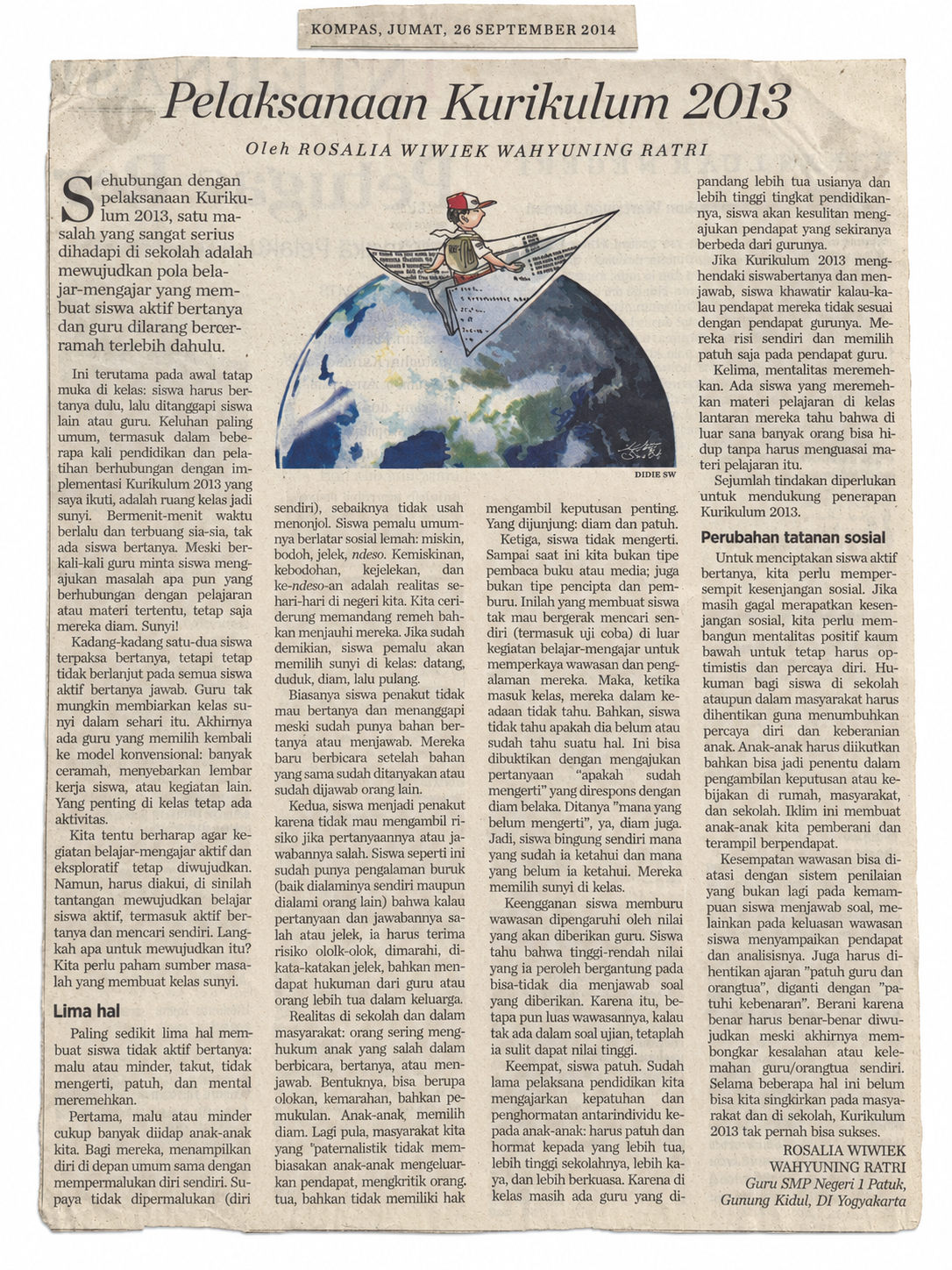
- This clipping contains an opinion article by Rosalia Wiwiek Wahyuning Ratri entitled "Pelaksanaan Kurikulum 2013" ("The Implementation of the 2013 Curriculum") from the daily Kompas, Friday, 26 September 2014. The author is listed as a teacher at SMP Negeri 1 Patuk, Gunungkidul, Daerah Istimewa Yogyakarta (Special Region of Yogyakarta). This article is special because it was written by a junior high school teacher who directly experienced the implementation of the new curriculum in the classroom, not by an official or education expert at the central level. The clipping page shows a cut-out of the dated page header, a large italic title, the author's name, four columns of text with two subheadings, namely "Lima hal" ("Five things") and "Perubahan tatanan sosial" ("Changing the social order"), and an illustration by Didie SW of a uniformed student riding a paper aeroplane above a globe. The author starts from the problem she considers most serious in the implementation of the 2013 Curriculum, namely the difficulty of realising learning activities that make students actively ask questions, while teachers are asked not to begin with lecturing. The scientific approach in that curriculum requires students to observe, question, gather information, reason, and communicate the results of their learning. However, according to the author's experience and the complaints of fellow teachers in various training sessions, classrooms in fact often fall silent. Time is wasted because students remain quiet even though the teacher repeatedly invites questions. Some teachers eventually return to old methods, such as lectures, worksheets, or other activities, as long as the class still appears active. The section "Lima hal" sets out the reasons students are reluctant to ask questions. The first cause is shame or low self-esteem. For many children, appearing in public feels the same as humiliating oneself, especially for students from weak social backgrounds who are accustomed to being looked down upon because of poverty or backwardness. The second cause is fear of taking the risk of being wrong. The author highlights bad experiences when mistaken questions or answers were met with mockery, anger, or even punishment, both at school and at home. She also touches on a paternalistic culture that does not accustom children to expressing opinions and criticising their elders. The third cause is lack of knowledge. The author considers that the nation does not yet have a culture of reading and seeking knowledge independently, so students enter the classroom without a stock of knowledge. She notes an interesting symptom: students do not even know whether or not they have understood a given topic. The reluctance to seek knowledge is also influenced by an assessment system that mainly measures the ability to answer questions, so that breadth of knowledge is not valued. The fourth cause is a culture of obedience. Education has so far instilled obedience to those who are older, more highly educated, richer, and more powerful, so students worry that their opinions differ from the teacher's. The fifth cause is a dismissive mentality, namely the view among some students that the subject matter is unimportant because many people can live without mastering it. The section "Perubahan tatanan sosial" offers a way out. The author argues that active students can only emerge if social inequality is narrowed and children from lower classes have their self-confidence nurtured. Humiliating punishments, both at school and in society, must be stopped. Children need to be involved in decision-making at home, in the community, and at school. The assessment system must also shift from accuracy in answering questions to breadth of knowledge and the ability to express opinions. The author proposes that the teaching of "obedience to teachers and parents" be replaced with "obedience to the truth", accompanied by the courage to expose the mistakes of one's own teachers or parents. She closes with the warning that as long as these matters have not been addressed, the 2013 Curriculum will never truly succeed. The policy context gives this clipping historical value. The 2013 Curriculum began to be implemented gradually in the 2013/2014 school year under Minister of Education and Culture Mohammad Nuh, and was then extended to all schools in the 2014/2015 school year. Its implementation drew much criticism, especially concerning teacher readiness, delays in textbooks, and complicated assessment. In December 2014, the new Minister of Education and Culture, Anies Baswedan, halted the implementation of the 2013 Curriculum in schools that had applied it for only one semester and returned them to the 2006 Curriculum, while retaining the pilot schools as models. The curriculum was later revised and reintroduced in stages. This article was published about two months before that decision to halt it, and thus records the voice of teachers in the field during a decisive transitional period. For education studies, this piece is interesting because it connects pedagogical problems with social and cultural structures. The author does not stop at teaching techniques, but shows that classroom silence is rooted in poverty, inequality, a culture of obedience, and authoritarian parenting patterns. This view is in line with the critical pedagogy developed by Paulo Freire, who criticised the "banking" model of education in which students merely receive knowledge from the teacher. It is also relevant to the more recent debate on the Kurikulum Merdeka (Independent Curriculum), which again emphasises student-centred learning, differentiation, and a critical learner profile. This article is also useful for teacher education. The five causes set out by the author can be used as a framework for discussion or as reflection material in courses on learning strategies, educational psychology, and the sociology of education. The experience of a school in Gunungkidul, a region known for many years as one of the poorest regencies in Yogyakarta, provides a concrete example of the relationship between socio-economic conditions and student participation in class. As a critical note, this article rests on the author's personal experience and observations, not on systematic research. Some of the causes she mentions overlap, and the solutions offered are broad and therefore require further elaboration in school policy. However, precisely because it was written from inside the classroom, this article provides a perspective rarely heard in national education policy debates. This piece is also interesting from the perspective of the anthropology of education. The classroom silence the author describes is not merely an individual problem, but a product of power relations between teacher and pupil, parent and child, and different social groups. Values such as sungkan (deferential reluctance), respect for elders, and shame have roots in Javanese culture and other cultures of the Nusantara, so curriculum policies designed uniformly from the centre need to take local cultural contexts into account. Readers can compare these observations from Gunungkidul with the experiences of schools in other regions, including Aceh, to see the similarities and differences in cultural barriers to active learning. Physically, the clipping consists of one yellowed newspaper page with a dated page header pasted above it. The colour illustration in the centre is still clear, and the text is legible. The uploaded image has been straightened and enhanced for legibility. The full text of the article is not copied into this catalogue because the copyright belongs to the author and publisher; this description is a curatorial account to help users understand its content, context, and research value. Suitable search subjects include the 2013 Curriculum, the scientific approach, student engagement, a culture of questioning, education and social inequality, and Indonesian education policy. For citation purposes, the reference can be written as follows: Rosalia Wiwiek Wahyuning Ratri, "Pelaksanaan Kurikulum 2013", Kompas, 26 September 2014, Opinion section.
- Rights
- Koleksi pribadi KBA13 Academy
- Collection
- Clippings
How to cite
Rosalia Wiwiek Wahyuning Ratri, “Pelaksanaan Kurikulum 2013 [The Implementation of the 2013 Curriculum]”, Kompas, Kompas, Jumat, 26 September 2014; rubrik Opini, 2014-09-26. KBA13 Academy Archive and Library, KBA-KLP-2014-0025.