
TIME (Asia) — The Last Star Wars (9 May 2005)
Time Inc., edisi Asia (Hong Kong) · TIME edisi Asia, 9 Mei 2005, nomor 18 (menurut kode tambahan kode batang). Artikel yang dicatat terpisah: Anthony Spaeth, "Under the Gun"; Jim Erickson, "Done Talking?"; Bill Powell, "A Journey From War To War". Foto hlm. 25 terlampir. Volume dan jumlah halaman belum diperiksa · 2005-05-09
Abstract
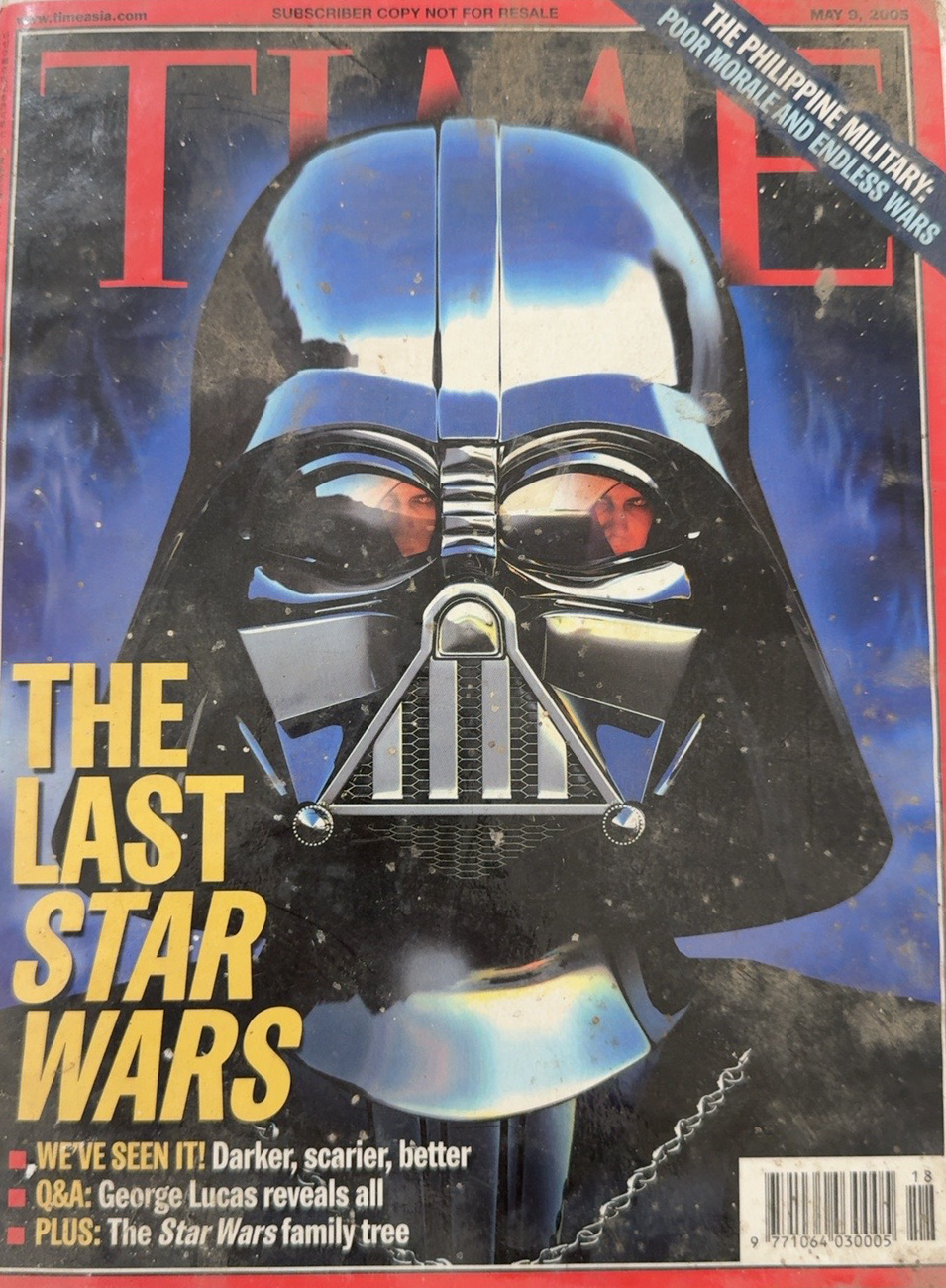
The Asia edition of the weekly news magazine TIME dated 9 May 2005, with the cover report "The Last Star Wars", published ahead of the release of Star Wars: Episode III – Revenge of the Sith on 19 May 2005. The cover shows Darth Vader's helmet with the reflection of a young man's face in its lenses, a symbol of the fall of Anakin Skywalker. This issue promises a review of the film, an interview with George Lucas, and a family tree of the Star Wars characters. A cover banner also flags a report on the Philippine military, beset by low morale and protracted war, relevant to the study of armed conflict and civil-military relations in Southeast Asia at the same time as the Aceh peace negotiations.
- Identifier
- KBA-MJL-2005-0001
- Type
- Majalah
- Publisher
- Time Inc., edisi Asia (Hong Kong)
- Date Issued
- 2005-05-09
- Bibliographic Citation
- TIME edisi Asia, 9 Mei 2005, nomor 18 (menurut kode tambahan kode batang). Artikel yang dicatat terpisah: Anthony Spaeth, "Under the Gun"; Jim Erickson, "Done Talking?"; Bill Powell, "A Journey From War To War". Foto hlm. 25 terlampir. Volume dan jumlah halaman belum diperiksa
- Subject
- Majalah berita Star Wars George Lucas Industri film Hollywood Militer Filipina Konflik bersenjata Asia Tenggara Hubungan sipil-militer Krisis nuklir Korea Utara Hubungan Taiwan–Tiongkok Perang Irak Pengungsi Vietnam
- LC Classification
- AP — Terbitan berkala umum
- LCSH Subject
- Star Wars films Lucas, George Philippines. Armed Forces Newsmagazines -- Periodicals Nuclear weapons -- Korea (North) Iraq War, 2003-2011
- BISAC Category
- PER004030 PERFORMING ARTS / Film / History & Criticism
- Language
- Inggris
- Description
- This copy is the Asia edition of the weekly news magazine TIME dated 9 May 2005. The front cover shows an image of the glossy black helmet of the character Darth Vader from the Star Wars film saga, with the reflection of a young man's face in both of its eye lenses, against a dark blue star-studded sky. The main cover title is written in large yellow letters, "The Last Star Wars", accompanied by three lines describing the contents: a review of the film, which according to the editors is darker, scarier, and better; a question-and-answer interview with George Lucas; and a family tree of the Star Wars characters. In the upper right corner is a diagonal banner bearing the title of another report, "The Philippine Military: Poor Morale and Endless Wars". The top of the cover carries the website address timeasia.com, the note "Subscriber copy not for resale", and the issue date, while the lower right corner carries a barcode with the add-on number 18 indicating the issue number. The main report of this issue is tied to the release of Star Wars: Episode III – Revenge of the Sith, the sixth film and, at the time, regarded as the conclusion of the Star Wars saga that George Lucas had pioneered since 1977. The film premiered at the Cannes Film Festival in mid-May 2005 and was released widely in cinemas on 19 May 2005, ten days after the date of this magazine issue. Episode III tells of Anakin Skywalker's fall to the dark side and his transformation into Darth Vader, so the reflection of a young man's face in Vader's helmet on the cover is a carefully chosen visual symbol of the film's main theme: the transformation of a young hero into the most iconic villain in the history of popular film. The title "The Last Star Wars" reflects the general view in 2005 that Episode III was the last Star Wars film. That view later proved mistaken after Lucasfilm was bought by The Walt Disney Company in 2012 and a new trilogy began in 2015. As a document of popular culture, this issue records one of the peaks of the Star Wars phenomenon in the early twenty-first century. The interview with George Lucas promised on the cover shows the position of the director and producer as a central figure in the Hollywood film industry, particularly in the development of digital visual effects and the film franchise business model. The family tree of the characters included as a bonus shows the magazine's effort to help readers understand the storyline of six films released out of order, namely the original trilogy of 1977–1983 and the prequel trilogy of 1999–2005. For researchers in media and cultural studies, this issue provides an example of how a mainstream news magazine treated a film as a global cultural event worthy of a cover story. The second report flagged on the cover banner, about the Philippine military, has special value for Southeast Asian studies. In the mid-2000s, the Armed Forces of the Philippines faced several fronts of conflict at once: the communist insurgency of the New People's Army, the Moro separatist movements in Mindanao, and the Abu Sayyaf armed group in Basilan and Sulu, which was linked to international terror networks. Within the military itself, dissatisfaction over corruption, soldiers' welfare, and the politicisation of the institution had culminated in the mutiny of junior officers at Oakwood, Makati, in July 2003. The banner title, highlighting low morale and endless wars, places this report within that series of anxieties. A few months after this issue was published, the political crisis of President Gloria Macapagal-Arroyo's government deepened, and in February 2006 the government declared a state of emergency after a coup plot was uncovered. For readers in Aceh and Indonesia, the report on the Philippine military is relevant for comparative study. At almost the same time, Indonesia was negotiating peace with the Gerakan Aceh Merdeka (Free Aceh Movement) in Helsinki, which culminated in the Memorandum of Understanding of 15 August 2005. Both countries were grappling with internal armed conflict, security sector reform, and civil-military relations after periods of authoritarianism. Reading TIME's report on the Philippines together with documents on the Aceh conflict can help researchers see the similarities and differences in the two countries' experiences of dealing with insurgency, separatism, and terrorism in the region. The Asia edition of TIME magazine was published from Hong Kong and had content partly different from the United States edition, especially in reports on the Asian region. This difference is visible in the cover banner about the Philippines, which probably did not appear on the cover of the American edition. The note "Subscriber copy not for resale" indicates that this copy is a subscriber's copy sent directly, not bought at a newsstand. Information of this kind is useful for reconstructing the reading habits and information networks of the collection's owner in the mid-2000s, when international news magazines were still a main source of global analysis for academic circles in Southeast Asia. From the collection perspective, this magazine complements the collection of international periodicals in this library, such as the Foreign Affairs series, with the perspective of popular news journalism. Whereas Foreign Affairs presents lengthy and academic foreign policy analysis, TIME presents world events in a more concise and visual format for a wide readership. A comparison of these two types of publication can serve as material for discussion on differences of genre in international media, how media frame events, and the relationship between popular culture and security issues within a single magazine issue. The physical condition of the copy shows age and use. The cover shows small whitish spots and stains in a number of places, especially around the image of the helmet and at the bottom, as well as slight wear at the edges. The red of the TIME logo and the blue of the background are still fairly clear. The uploaded photograph is the original photograph of the cover, not a processed cover, and is used as physical documentation of the copy. In addition to the cover photograph, this entry is accompanied by a photograph of page 25. The volume number and the total page count of the magazine still need to be completed from the colophon page. For research purposes, this issue can be used in studies of popular culture and the film industry, studies of media and international journalism, and studies of security and civil-military relations in Southeast Asia. Users who need the text of the articles are advised to refer to TIME's digital archive or the physical copy in this collection. This description is a curatorial account compiled from the cover and the historical context of the publication, not a summary of the contents of all the articles. The cover image on this copy is also interesting from a graphic design perspective. The editors did not show a scene from the film or a photograph of the cast, but a single, easily recognisable icon, namely the antagonist's helmet, so that the cover's message is conveyed almost without words. The reflection technique in the helmet's lenses combines two characters in one image and implies that the villain in fact originates from the fallen young hero. Visual strategies of this kind were common on news magazine covers in that era, when the cover was the main marketing tool at newsstands and social media did not yet play a large role. Researchers in visual communication design can use this cover as an example of the use of a popular culture icon to attract the attention of readers across countries and languages. Three articles from this issue have been recorded as separate clipping entries and linked to this magazine entry. First, the main report by Anthony Spaeth, "Under the Gun", on the low morale, outdated equipment, and protracted war faced by the Armed Forces of the Philippines, starting from the death of Lieutenant Colonel Dennis Villanueva in Jolo in February 2005. Second, the article by Jim Erickson, "Done Talking?", on the deadlock of the six-party talks on North Korea's nuclear programme. Third, the article by Bill Powell, "A Journey From War To War", about a family of ethnic Chinese Vietnamese refugees whose son, a member of the United States Marine Corps, was killed in Fallujah, Iraq. Readers can open each entry for full information and scans of the articles. The photograph on page 25 shows an elderly man holding the flag of the Republic of China inside the Chiang Kai-shek Memorial Hall in Taipei, with the statue of Chiang Kai-shek in the background. This photograph most likely accompanies a report in the same issue on relations between Taiwan and mainland China, an issue that in late April 2005 drew world attention because of the visit of Kuomintang Chairman Lien Chan to Beijing. The text of the article accompanying this photograph has not been scanned, so its connection needs to be confirmed by checking pages 24–25 of the magazine. Suitable search subjects include news magazines, TIME Asia edition, Star Wars, George Lucas, the Hollywood film industry, the Philippine military, the North Korean nuclear crisis, Taiwan–China relations, the Vietnam War and the Iraq War, and civil-military relations. For citation purposes, the reference can be written as follows: TIME (Asia edition), 9 May 2005, cover "The Last Star Wars".
- Rights
- Koleksi pribadi KBA13 Academy
- Has Part
- Collection
- Magazines
How to cite
“TIME (Asia) — The Last Star Wars (9 May 2005)”, Time Inc., edisi Asia (Hong Kong), TIME edisi Asia, 9 Mei 2005, nomor 18 (menurut kode tambahan kode batang). Artikel yang dicatat terpisah: Anthony Spaeth, "Under the Gun"; Jim Erickson, "Done Talking?"; Bill Powell, "A Journey From War To War". Foto hlm. 25 terlampir. Volume dan jumlah halaman belum diperiksa, 2005-05-09. KBA13 Academy Archive and Library, KBA-MJL-2005-0001.