
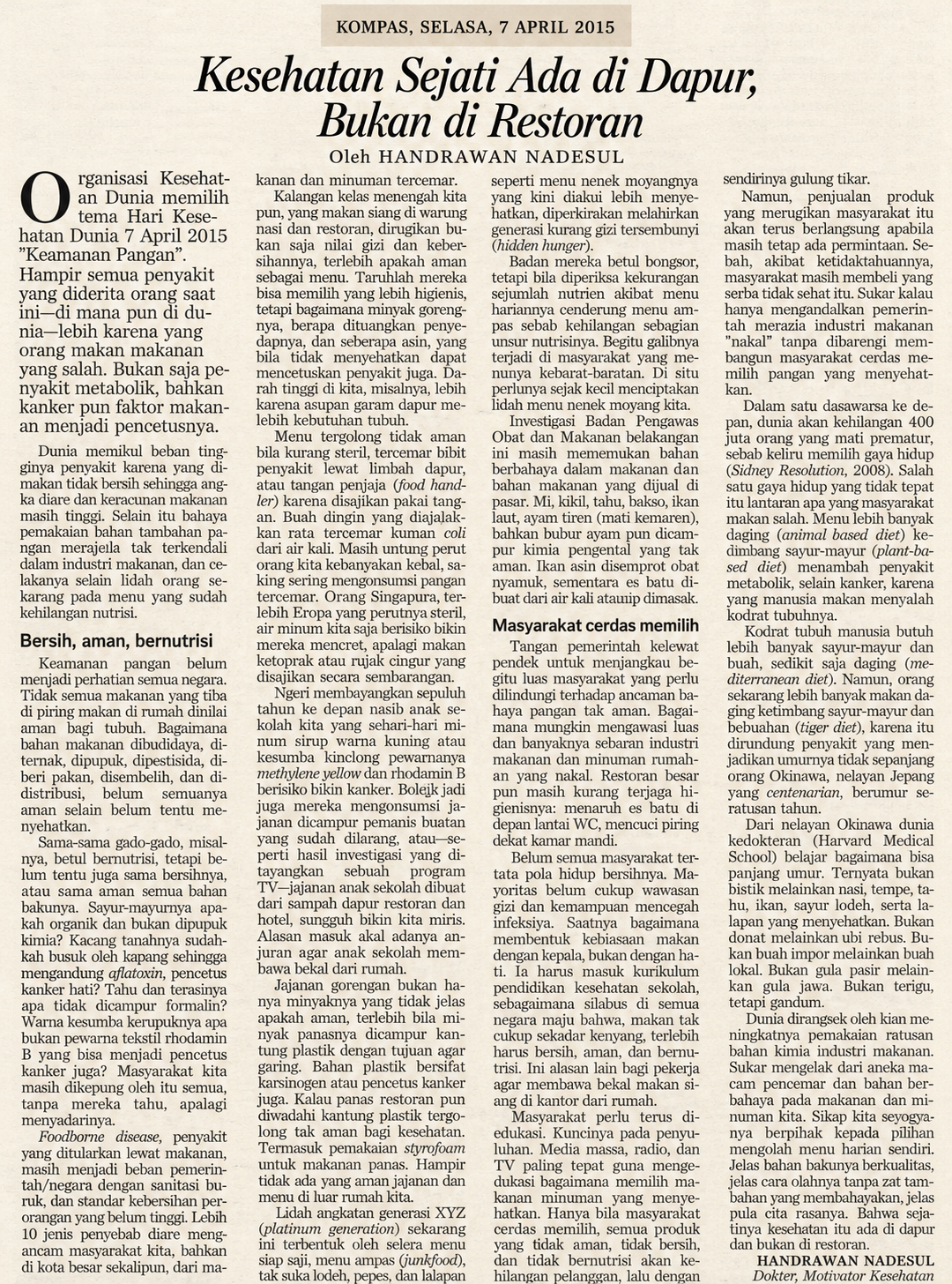
Kesehatan Sejati Ada di Dapur, Bukan di Restoran [True Health Is in the Kitchen, Not in the Restaurant]
Kompas · Kompas, Selasa, 7 April 2015; rubrik Opini · 2015-04-07
Abstract
An opinion article by the physician and health motivator Handrawan Nadesul on World Health Day 2015, whose theme was food safety. The author argues that many diseases, including metabolic diseases and cancer, are triggered by the wrong food. He highlights hazardous substances such as formalin, rhodamine B, and aflatoxin, unsafe snacks for schoolchildren, harmful oils and packaging, and the nutrient-poor diet of the younger generation. Because government oversight is limited, he stresses health education so that the public can choose wisely, recommends bringing packed meals from home, and praises the traditional menus of the Nusantara. His conclusion: true health is in the kitchen, not in the restaurant.
- Identifier
- KBA-KLP-2015-0006
- Type
- Kliping
- Publisher
- Kompas
- Date Issued
- 2015-04-07
- Bibliographic Citation
- Kompas, Selasa, 7 April 2015; rubrik Opini
- Creator
- Handrawan Nadesul
- Subject
- Keamanan pangan Hari Kesehatan Sedunia 2015 Gizi Bahan tambahan pangan berbahaya Jajanan anak sekolah Pola makan tradisional Pendidikan kesehatan
- LC Classification
- RA601 — Keamanan pangan dan kesehatan masyarakat
- LCSH Subject
- Food -- Safety measures -- Indonesia Food adulteration and inspection -- Indonesia Nutrition
- BISAC Category
- HEA017000 HEALTH & FITNESS / Nutrition
- Language
- Indonesia
- Description
- This clipping contains an opinion article by Handrawan Nadesul entitled "Kesehatan Sejati Ada di Dapur, Bukan di Restoran" (True Health Is in the Kitchen, Not in the Restaurant) from the daily Kompas, Tuesday, 7 April 2015. The author is listed as a physician and health motivator. The article was published precisely on World Health Day 2015, to which the World Health Organization gave the theme of food safety. The clipping page shows a cut-out of the dated page header, a large italic headline divided into two lines, the author's name, four columns of text, and two subheadings, namely "Bersih, aman, bernutrisi" (Clean, Safe, Nutritious) and "Masyarakat cerdas memilih" (A Public That Chooses Wisely). Handrawan Nadesul is widely known in Indonesia as a physician who has written actively on popular health for decades, in the form of newspaper columns, consultation columns, and health books for the general public. He is also known for writing poetry. His writing style is straightforward and close to the lay reader, with many examples from everyday life. This article is a typical example of that approach: public health problems are conveyed through observations of the food found in markets, food stalls, schools, and household kitchens. The author opens his article with the thesis that almost all the diseases people suffer today, anywhere in the world, are caused more by the wrong food. Not only metabolic diseases, but cancer too is largely triggered by dietary factors. The world, in his view, bears a burden of disease due to unclean food, marked by high rates of diarrhoea and food poisoning, while the use of food additives has developed without control in the food industry. Worse still, the palate of the present generation has become accustomed to menus that have lost their nutrients. The section "Bersih, aman, bernutrisi" sets out three conditions for healthy food. The author explains that food safety has not yet become a concern of all countries, and that food that appears nutritious is not necessarily clean and safe. He gives examples of vegetables that may be contaminated with pesticides, mouldy peanuts containing aflatoxin, which triggers liver cancer, tofu mixed with formalin, and textile dyes such as rhodamine B and metanil yellow misused in food and drinks for schoolchildren. The author also highlights foodborne diseases in countries with poor sanitation, the habit of vendors serving food with unprotected hands, cooking oil used repeatedly, hot fried snacks wrapped in plastic bags, and the use of styrofoam for hot food. He also warns about a younger generation accustomed to fast food and shunning traditional menus, who are thus at risk of micronutrient deficiency, or what he calls hidden hunger, even though their bodies appear large. The author refers to findings of the National Agency of Drug and Food Control (Badan Pengawas Obat dan Makanan) on hazardous substances in food sold in markets, such as noodles, kikil (cattle-hoof skin), tofu, meatballs, sea fish, and chickens that had died before being slaughtered, as well as a television investigative report on schoolchildren's snacks made from the kitchen waste of restaurants and hotels. On this basis, he recommends that schoolchildren bring packed meals from home. The section "Masyarakat cerdas memilih" argues that the government cannot possibly oversee the entire widely dispersed home-based food and beverage industry, while even large restaurants do not necessarily maintain hygiene. Therefore, the key to protection is a public that chooses wisely. Health education needs to enter the school curriculum, and the mass media, radio, and television need to educate the public on how to choose healthy food. According to the author, if the public chooses wisely, unsafe and non-nutritious products will lose their buyers and go out of business of their own accord. He also mentions an estimate that in the coming decade the world will lose hundreds of millions of lives to premature death caused by wrong lifestyles, especially diets with too much meat and too few vegetables and fruit. In the closing section the author praises traditional diets. He compares the Mediterranean diet and the diet of the people of Okinawa, Japan, known for their longevity, with traditional Nusantara menus such as rice, tempeh, tofu, fish, sayur lodeh (vegetables in coconut milk), and lalapan (raw vegetables). He recommends boiled sweet potatoes rather than doughnuts, local fruit rather than imported fruit, palm sugar (gula jawa) rather than granulated sugar, and whole wheat rather than refined flour. His conclusion is that, since it is difficult to avoid the chemicals of the food industry, the best attitude is to choose to prepare one's daily menu oneself with ingredients of clear origin and cooking methods without hazardous additives. This is where the title of the article comes from: true health is in the kitchen, not in the restaurant. This clipping is valuable for the study of public health, nutrition, and the anthropology of food. The issues raised, such as formalin, borax, rhodamine B, and the safety of schoolchildren's snacks, are problems that have been reported repeatedly in Indonesia and have become the focus of food-control programmes. In the same year, Indonesia was also preparing various nutrition policies, including the strengthening of the movement for the consumption of diverse, nutritionally balanced, and safe food. This article can be used as material for discussion on the responsibilities of the state, industry, and consumers in ensuring food safety. From an anthropological point of view, the article is interesting because it shows a discourse that links health with nostalgia for the "palate of our ancestors" and the household kitchen. Such discourse often places the burden of family health on women as managers of the kitchen, and overlooks the reality that many urban families, especially low-income workers, depend on food from stalls because of limited time and money. A critical reading of this kind can enrich classroom discussion about social class, gender, and food. As a critical note, some claims in the article are general and are not accompanied by detailed scientific references, for example the statement that almost all diseases are caused by the wrong food. The reference to the Okinawan diet also needs to be read with care because the diet of that community has changed considerably. Nevertheless, as a piece of popular health education, the article succeeds in conveying its message of prevention clearly and in an easily understood way. The article is also interesting for the study of health communication. The author uses everyday language, popular terms such as ayam tiren (chickens that died before slaughter), and examples of food that are very familiar to readers, so that the health message is easy to understand. This approach shows how physicians who write in the mass media act as translators of medical knowledge into public language, a role that is increasingly important amid a flood of health information that is not necessarily accurate. Physically, the clipping is a cut-out of a yellowish newspaper page with the dated page header pasted above it. The four columns of text are clearly legible. The uploaded image has been straightened and enhanced for legibility. The full text of the article has not been copied into this catalogue because the copyright belongs to the author and the publisher; this note is a curatorial description to help users understand its content, context, and research value. Suitable search subjects include food safety, World Health Day 2015, nutrition, hazardous food additives, schoolchildren's snacks, traditional diets, and health education. For citation purposes, the reference may be written as follows: Handrawan Nadesul, "Kesehatan Sejati Ada di Dapur, Bukan di Restoran", Kompas, 7 April 2015, Opinion section.
- Rights
- Koleksi pribadi KBA13 Academy
- Collection
- Clippings
How to cite
Handrawan Nadesul, “Kesehatan Sejati Ada di Dapur, Bukan di Restoran [True Health Is in the Kitchen, Not in the Restaurant]”, Kompas, Kompas, Selasa, 7 April 2015; rubrik Opini, 2015-04-07. KBA13 Academy Archive and Library, KBA-KLP-2015-0006.