
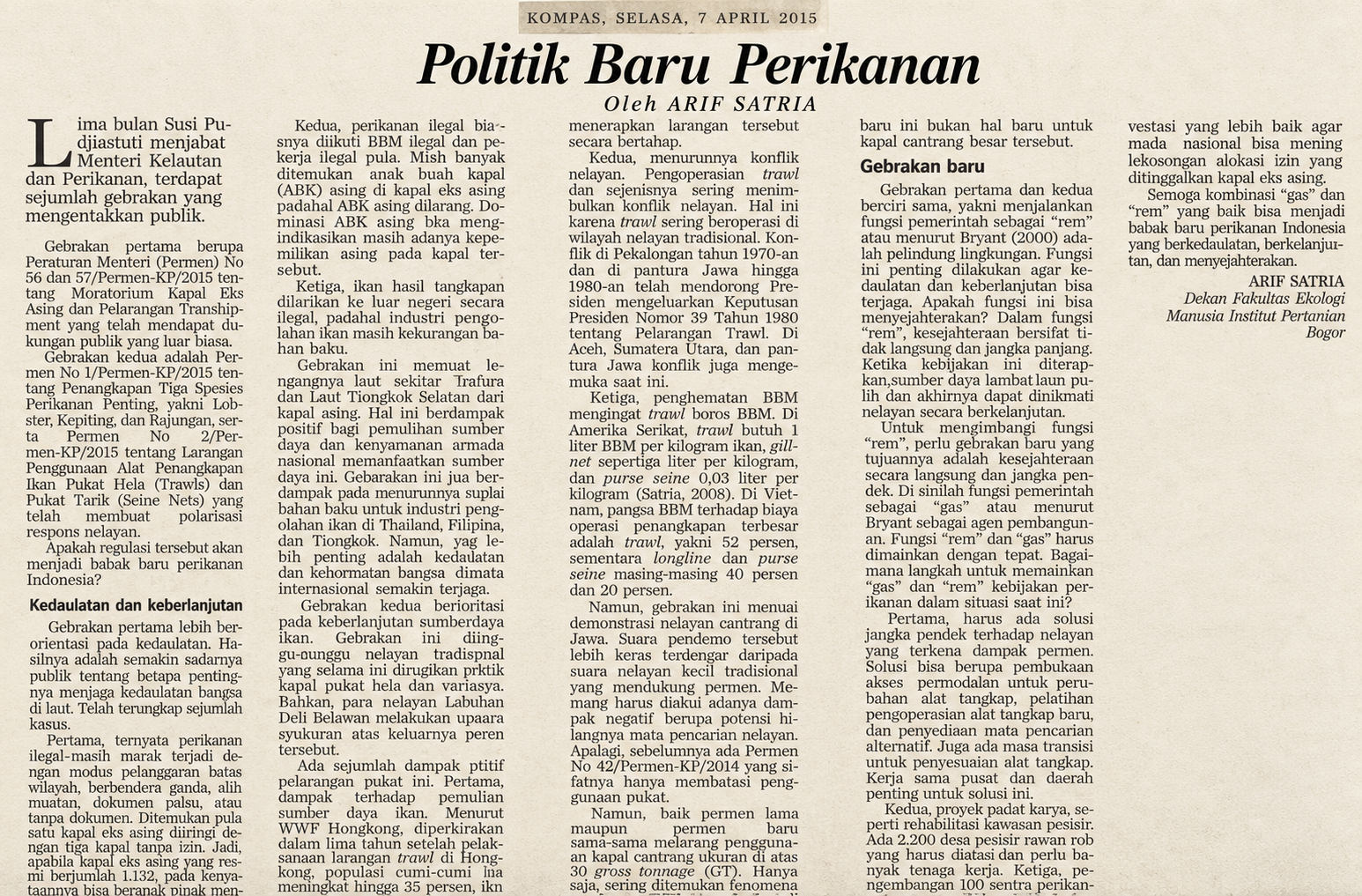
Politik Baru Perikanan [The New Politics of Fisheries]
By Arif Satria
Kompas · Kompas, Selasa, 7 April 2015; rubrik Opini (bagian bawah beberapa kolom terpotong pada pindaian) · 2015-04-07
Abstract
An opinion article by Arif Satria, Dean of the Faculty of Human Ecology at IPB, on the first five months of the policies of Minister of Marine Affairs and Fisheries Susi Pudjiastuti. The author judges the moratorium on formerly foreign-owned vessels and the ban on transshipment to be oriented towards sovereignty, while the restrictions on catching lobsters, crabs, and swimming crabs and the ban on trawls and seine nets are oriented towards sustainability. He sets out their benefits for resource recovery, reduced conflict among fishers, and fuel savings, but acknowledges the impact on cantrang (seine-net) fishers. Using a framework of "brake" and "accelerator", he proposes short-term welfare solutions: capital, training, alternative livelihoods, labour-intensive programmes, and investment in the national fleet.
- Identifier
- KBA-KLP-2015-0007
- Type
- Kliping
- Publisher
- Kompas
- Date Issued
- 2015-04-07
- Bibliographic Citation
- Kompas, Selasa, 7 April 2015; rubrik Opini (bagian bawah beberapa kolom terpotong pada pindaian)
- Creator
- Arif Satria
- Subject
- Kebijakan perikanan Susi Pudjiastuti Penangkapan ikan ilegal Larangan trawl dan cantrang Kedaulatan maritim Nelayan tradisional Poros Maritim Dunia
- LC Classification
- GC1018 — Kebijakan sumber daya laut
- LCSH Subject
- Fishery policy -- Indonesia Illegal, unreported, unregulated fishing -- Indonesia Trawls and trawling -- Law and legislation -- Indonesia
- BISAC Category
- POL044000 POLITICAL SCIENCE / Public Policy / Environmental Policy
- Language
- Indonesia
- Description
- This clipping contains Arif Satria's opinion article "Politik Baru Perikanan" (The New Politics of Fisheries) from the daily Kompas, Tuesday, 7 April 2015. The author is listed as Dean of the Faculty of Human Ecology, Institut Pertanian Bogor (Bogor Agricultural University). The article was published about five months after Susi Pudjiastuti was sworn in as Minister of Marine Affairs and Fisheries in President Joko Widodo's Working Cabinet (Kabinet Kerja). The clipping page shows a cut-out of the dated page header, a large italic title, the author's name, five columns of text, and two subheadings, namely "Kedaulatan dan keberlanjutan" (Sovereignty and sustainability) and "Gebrakan baru" (A new breakthrough). The bottom of several columns appears cut off in the scan, so that a small part of the text is illegible. Arif Satria opens his piece by noting that in her five months in office, Minister Susi had made a number of bold moves that surprised the public. The first was a ministerial regulation on a moratorium on licensing formerly foreign-owned vessels and a ban on transshipment at sea, which received extraordinary public support. The second was a ministerial regulation restricting the catching of lobsters, crabs, and swimming crabs, together with a ministerial regulation banning the use of trawls (pukat hela) and seine nets (pukat tarik). It was this second policy that produced polarised responses among fishers. The author then asks whether these regulations would mark a new chapter for Indonesian fisheries. The section "Sovereignty and sustainability" assesses the first move as a sovereignty-oriented policy. Its result was increased public awareness of the importance of sovereignty at sea. The author notes the findings that came to light: illegal fishing was still rampant, with practices such as violating territorial boundaries, double flagging, transshipment, false documents or no documents at all, and even a single vessel licence being used by several vessels. Illegal fishing was also accompanied by illegal fuel and illegal workers, including foreign crews on formerly foreign-owned vessels, indicating that foreign ownership persisted. The fish caught were shipped abroad, while the domestic processing industry lacked raw materials. According to the author, this move made the seas around the Arafura Sea and the South China Sea emptier of foreign vessels, giving fish stocks a chance to recover and the national fleet more room to operate. Its impact was also felt in the reduced supply of raw materials to the fish processing industries of neighbouring countries. The second move is assessed as oriented towards the sustainability of fish resources. The author states that the trawl ban had long been awaited by traditional fishers who were harmed by the practices of trawlers. He sets out a number of positive impacts of the ban. First, the recovery of fish resources, with the example of Hong Kong, which according to WWF experienced an increase in squid populations several years after a trawl ban. Second, reduced conflict among fishers, because trawlers often operate in the fishing grounds of traditional fishers. The author recalls the conflicts in Pekalongan in the 1970s and along the north coast of Java into the 1980s, which led to Presidential Decree No. 39 of 1980 on the Abolition of Trawl Nets, as well as similar conflicts in Aceh and North Sumatra. Third, fuel savings, since trawls are among the most fuel-intensive fishing gear compared with gillnets or purse seines, as described in the author's own research and in data from Vietnam. However, the author acknowledges that the policy prompted demonstrations by cantrang fishers in Java, whose voices were heard more loudly than those of the small traditional fishers who supported it. He affirms that there were negative impacts in the form of a potential loss of livelihoods, especially since the previous regulations had only restricted the use of such nets. He also notes that both the old and the new rules prohibited cantrang vessels above a certain size, but in the field manipulation of vessel sizes was often found, so that the ban on large vessels was not actually anything new. The section "A new breakthrough" contains the core of the author's proposal. Referring to Bryant (2000), Arif Satria describes the two moves as performing the government's function as a "brake", namely as protector of the environment and guardian of sovereignty. This function is important, but the welfare it produces is long-term and indirect. It therefore needs to be balanced by the "accelerator" function, namely the government as an agent of development that delivers short-term welfare. He proposes several steps: short-term solutions for affected fishers, such as access to capital to replace fishing gear, training, alternative livelihoods, and a transition period; labour-intensive projects such as the rehabilitation of coastal areas prone to tidal flooding (rob); the development of fisheries centres; and a better investment climate so that the national fleet can fill the licensing vacuum left by formerly foreign-owned vessels. He closes with the hope that the combination of "accelerator" and "brake" would become a new chapter for Indonesian fisheries that is sovereign, sustainable, and brings prosperity. This clipping has high value for the history of policy. Susi Pudjiastuti's policies, especially the sinking of poaching vessels and the cantrang ban, became among the most popular and at the same time most controversial policies of Jokowi's first term. The cantrang ban was postponed several times because of protests by fishers, and in the following term, under a different minister, the regulation was revised and cantrang was again permitted under certain arrangements. This article shows that from the outset a fisheries policy expert had warned of the need to balance resource protection with the welfare of fishers. The clipping can also be read together with another article by Arif Satria in the collection, "Kepemimpinan Kelautan" (Maritime Leadership), published in Kompas in May 2014, before Jokowi was elected. In that earlier article the author hoped for the emergence of a president with strong maritime leadership. This 2015 article can be seen as an early evaluation of that hope, at a time when the vision of the Global Maritime Fulcrum (Poros Maritim Dunia) was beginning to be translated into concrete policy. Reading the two side by side helps researchers understand the development of the thinking of an academic who later became Rector of IPB. For readers in Aceh, the article is relevant because it mentions trawl conflicts in Aceh and because Acehnese fishers have a customary maritime institution, the Panglima Laot, which has long regulated the use of fishing gear and settled disputes at sea. Central policies on fishing gear and foreign vessels interact with these customary rules, so this clipping can serve as material for the study of legal pluralism in fisheries management. The article also shows how an academic uses a theoretical framework to assess public policy constructively. The concept of "accelerator" and "brake", borrowed from the literature of political ecology, helps readers understand that conservation policy and development policy need not be set against each other. Physically, the clipping is a cut-out of a yellowish newspaper page with a dated page header at the top. The five columns of text are clearly legible, but the very bottom of several columns is cut off. The uploaded image has been straightened and enhanced for legibility. The full text of the article is not reproduced in this catalogue because its copyright belongs to the author and the publisher; this note is a curatorial description to help users understand its content, context, and research value. Suitable search subjects include fisheries policy, Susi Pudjiastuti, illegal fishing, the ban on trawls and cantrang, maritime sovereignty, traditional fishers, and the Global Maritime Fulcrum. For citation purposes, the reference can be written as follows: Arif Satria, "Politik Baru Perikanan", Kompas, 7 April 2015, Opinion section.
- Rights
- Koleksi pribadi KBA13 Academy
- Collection
- Clippings
How to cite
Arif Satria, “Politik Baru Perikanan [The New Politics of Fisheries]”, Kompas, Kompas, Selasa, 7 April 2015; rubrik Opini (bagian bawah beberapa kolom terpotong pada pindaian), 2015-04-07. KBA13 Academy Archive and Library, KBA-KLP-2015-0007.