
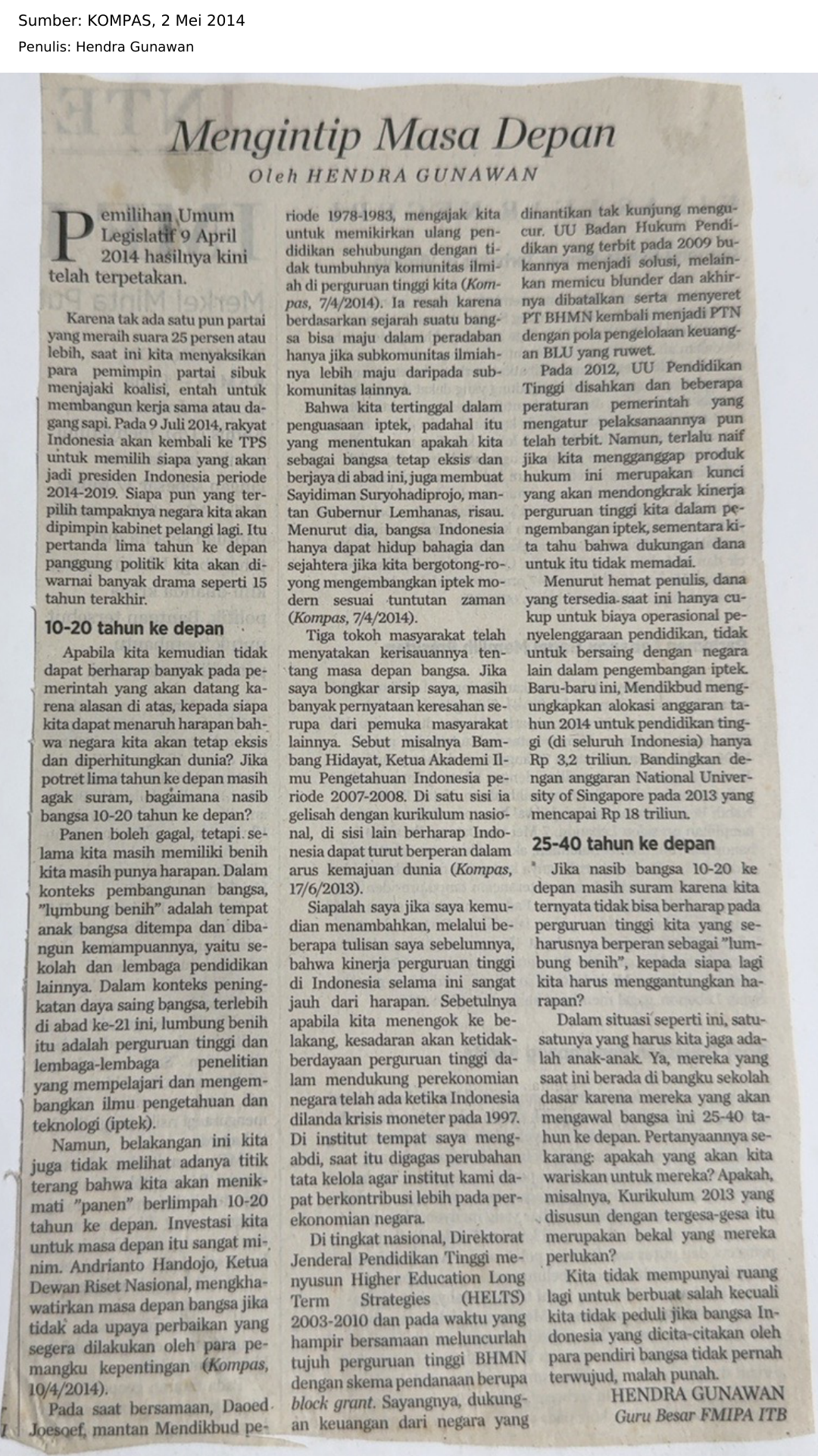
Mengintip Masa Depan [Peering into the Future]
Kompas · Kompas, Jumat, 2 Mei 2014; rubrik Opini · 2014-05-02
Abstract
An opinion article by Hendra Gunawan, Professor at the Faculty of Mathematics and Natural Sciences (FMIPA), ITB, published on National Education Day 2014. Starting from the atmosphere of coalition-building after the legislative election, the author asks about the fate of the nation ten to forty years ahead. He calls universities and research institutions the nation's "seed barns" (lumbung benih), but judges the investment in them to be very small. He gathers the concerns of a number of public figures, traces higher education policy from HELTS 2003–2010, BHMN, and the BHP Law to the 2012 Higher Education Law, and compares the national higher education budget with that of the National University of Singapore. He closes with a call to safeguard primary school children as the determinants of the nation's future.
- Identifier
- KBA-KLP-2014-0028
- Type
- Kliping
- Publisher
- Kompas
- Date Issued
- 2014-05-02
- Bibliographic Citation
- Kompas, Jumat, 2 Mei 2014; rubrik Opini
- Creator
- Hendra Gunawan
- Subject
- Pendidikan tinggi Indonesia Kebijakan riset Ilmu pengetahuan dan teknologi Perguruan tinggi badan hukum Pendanaan pendidikan Kurikulum 2013 Pemilu 2014
- LC Classification
- LB2300–2430 — Pendidikan tinggi
- LCSH Subject
- Education, Higher -- Indonesia Science and state -- Indonesia Education, Higher -- Finance -- Indonesia
- BISAC Category
- EDU015000 EDUCATION / Schools / Levels / Higher
- Language
- Indonesia
- Description
- This clipping contains an opinion article by Hendra Gunawan entitled "Mengintip Masa Depan" (Peering into the Future) from the daily Kompas, Friday, 2 May 2014. The author is listed as a Professor at the Faculty of Mathematics and Natural Sciences, Institut Teknologi Bandung. The scan is accompanied by a note of the source and the author's name at the top. The clipping page shows a large italic headline, the author's name, three columns of text, and two subheadings, namely "10-20 tahun ke depan" (10-20 years ahead) and "25-40 tahun ke depan" (25-40 years ahead). The article appeared on National Education Day, so its theme of the future of education and science felt especially timely. Hendra Gunawan opens his piece with the political atmosphere after the legislative election of 9 April 2014. Because no single party won 25 percent of the vote, party leaders were busy exploring coalitions ahead of the presidential election of 9 July 2014. Whoever was elected, according to the author, would most likely lead a rainbow cabinet, so that for the next five years the political stage would be filled with drama as in the previous fifteen years. From this observation the author turns to a more far-reaching question: if not much can be expected from the government over the next five years, what will be the fate of the nation ten to twenty years ahead, and even twenty-five to forty years ahead. The section "10-20 years ahead" uses an agricultural metaphor. A harvest may fail, but as long as we still have seed, there is still hope. In nation-building, the "seed barns" are schools and educational institutions, and in the competition of the twenty-first century, those seed barns are the universities and research institutions that develop science and technology. However, the author sees no sign that Indonesia will enjoy an abundant harvest in the coming one or two decades, because investment in the future is very small. The author gathers the concerns of a number of public figures reported by Kompas at the time. The Chairman of the National Research Council, Andrianto Handojo, worried about the nation's future if there were no immediate improvement. Former Minister of Education and Culture Daoed Joesoef called for rethinking education because of the failure of scientific communities to grow in universities, in the conviction that a nation advances only if its scientific subcommunity is more advanced than other subcommunities. Former Governor of Lemhanas (the National Resilience Institute) Sayidiman Suryohadiprojo was troubled that Indonesia lagged behind in the mastery of science and technology. The author also mentions the concerns of Bambang Hidayat, former Chairman of the Indonesian Academy of Sciences, about the national curriculum and Indonesia's role in global progress. The author then sets out the history of higher education policy. In his view, awareness of the weakness of universities in supporting the economy had emerged since the 1997 monetary crisis. At the national level, the Directorate General of Higher Education drew up the Higher Education Long Term Strategies 2003–2010, and almost simultaneously seven universities became State-Owned Legal Entities (Badan Hukum Milik Negara) with a block grant funding scheme. Unfortunately, financial support from the state never materialized. The 2009 Law on Educational Legal Entities (Badan Hukum Pendidikan) instead provoked chaos, was eventually annulled, and caused universities with legal-entity status to revert to being state universities under a complicated public service agency (badan layanan umum) model. The 2012 Higher Education Law and its implementing regulations, according to the author, likewise cannot be expected to be the key to improving performance because financial support is inadequate. He compares the 2014 higher education budget allocation cited by the Minister of Education and Culture, about Rp 3.2 trillion, with the 2013 budget of the National University of Singapore, which reached about Rp 18 trillion. The section "25-40 years ahead" concludes that if universities cannot be relied on as seed barns, the only thing that must be safeguarded is the children now in primary school, because it is they who will steward the nation twenty-five to forty years ahead. The author asks what will be bequeathed to them, and whether the hastily drafted 2013 Curriculum is the provision they need. He closes with the warning that this nation no longer has any room to make mistakes. The value of this clipping lies in its critical summary of Indonesian higher education policy during the decade after reformasi. The issues the author raises, namely university autonomy, legal-entity status, research funding, and scientific competitiveness, remain subjects of debate to this day. After this article was published, the Jokowi government moved higher education affairs to the Ministry of Research, Technology, and Higher Education in 2014, then returned them to the Ministry of Education and Culture in 2019, while the National Research and Innovation Agency (BRIN) was established to unify research institutions. These repeated institutional changes can be read as a continuation of the concerns the author expressed. This article is also interesting because it was written by a mathematician, not an education policy expert. The perspective of a basic scientist shows how the academic community directly feels the impact of budget and governance policies on scientific culture. For students and lecturers, this clipping can be used as material for discussion on the research ecosystem, campus autonomy, and the relationship between electoral politics and long-term planning. For religious higher education institutions such as UIN, the problems raised are also relevant, because public service agency status, research funding, and the building of scientific communities are shared challenges. This article can be read together with other clippings in the collection published in the same week, such as "Manusia Indonesia 2019" (The Indonesian Human 2019) and "Skandal Kebudayaan Kita" (Our Cultural Scandal), which also reflect on the nation's future after the 2014 legislative election. As a critical note, the comparison of the national higher education budget with the budget of a single university in Singapore is rhetorical and not entirely equivalent, because of differences in financing structures and budget coverage. Nevertheless, the comparison is effective in illustrating the gap in research investment between Indonesia and its neighbour. The idea of the "seed barn" used by the author also deserves note as a policy metaphor. This metaphor positions education and research as long-term investments whose results can be harvested only after a generation, so that they often lose out to short-term programmes that are more politically attractive. In this way the author connects the five-year political cycle with the need for scientific planning over a much longer horizon. Physically, the clipping is a yellowish cut-out newspaper page photographed against a white background, with a note of the source and the author's name at the top of the image. The three-column text is clearly legible although the left edge is slightly folded. The full text of the article is not reproduced in this catalogue because its copyright belongs to the author and the publisher; this note is a curatorial description to help users understand its content, context, and research value. Appropriate search subjects include Indonesian higher education, research policy, science and technology, legal-entity universities, education funding, the 2013 Curriculum, and the 2014 General Election. For citation purposes, the reference can be written as follows: Hendra Gunawan, "Mengintip Masa Depan", Kompas, 2 May 2014, Opinion section.
- Rights
- Koleksi pribadi KBA13 Academy
- Collection
- Clippings
How to cite
Hendra Gunawan, “Mengintip Masa Depan [Peering into the Future]”, Kompas, Kompas, Jumat, 2 Mei 2014; rubrik Opini, 2014-05-02. KBA13 Academy Archive and Library, KBA-KLP-2014-0028.