
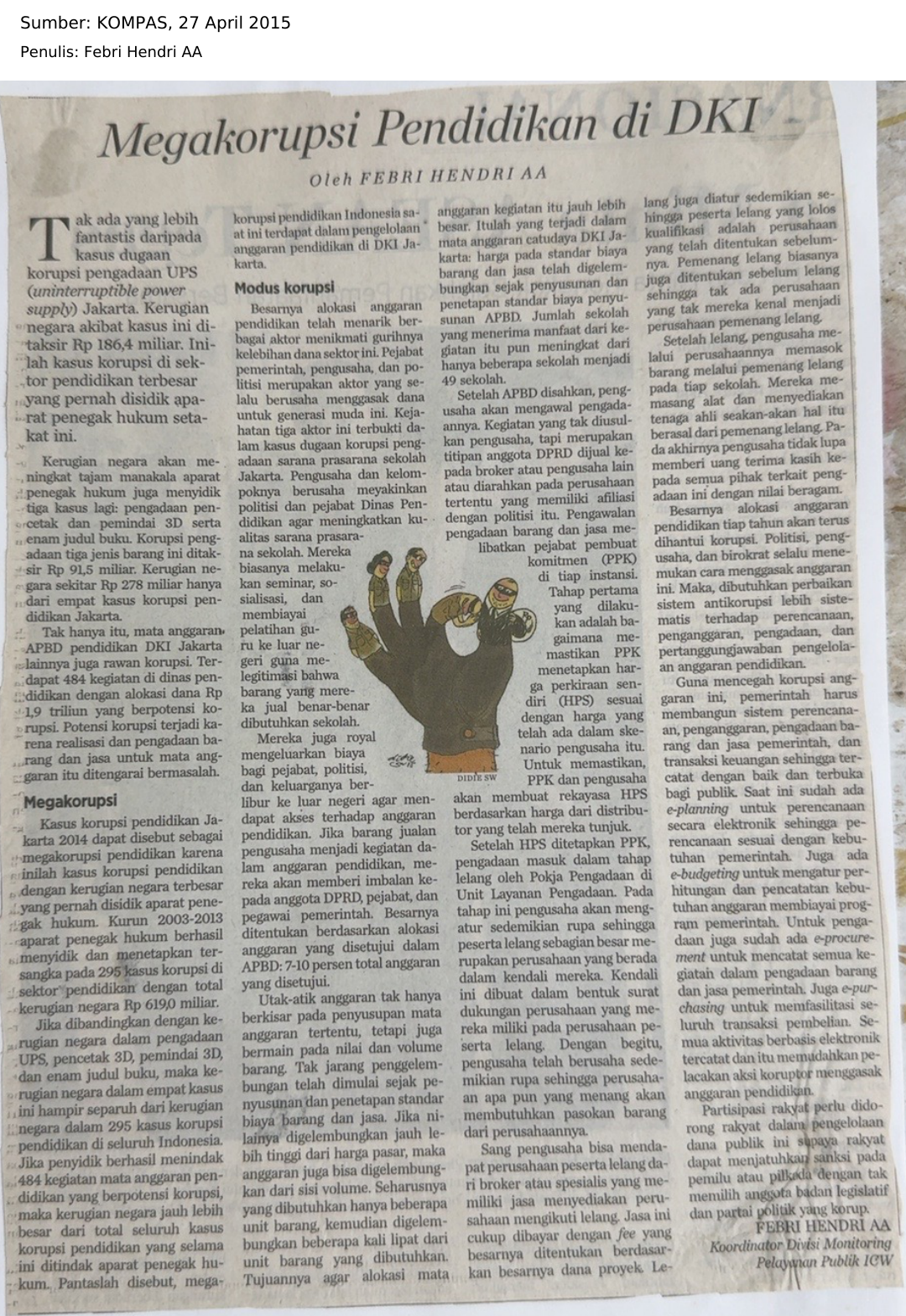
Megakorupsi Pendidikan di DKI [Education Mega-Corruption in Jakarta]
Kompas · Kompas, Senin, 27 April 2015; rubrik Opini · 2015-04-27
Abstract
An opinion article by Febri Hendri AA of Indonesia Corruption Watch on the alleged corruption case involving the procurement of UPS units and other goods for schools in DKI Jakarta, which he calls education mega-corruption because its losses almost equal half the losses of hundreds of national education corruption cases over a decade. The author sets out the modus operandi involving officials, businesspeople, and politicians: lobbying to have goods included in the budget, percentage-based kickbacks, inflation of prices and volumes, "entrusted" (titipan) activities, manipulation of the owner's estimated price (harga perkiraan sendiri), and rigging of tender participants. He recommends an electronic anti-corruption system from planning through procurement and public participation to punish corrupt politicians through elections.
- Identifier
- KBA-KLP-2015-0008
- Type
- Kliping
- Publisher
- Kompas
- Date Issued
- 2015-04-27
- Bibliographic Citation
- Kompas, Senin, 27 April 2015; rubrik Opini
- Creator
- Febri Hendri AA
- Subject
- Korupsi pendidikan Kasus UPS DKI Jakarta Pengadaan barang dan jasa Anggaran pendidikan DPRD DKI Jakarta Indonesia Corruption Watch Penganggaran elektronik
- LC Classification
- JQ760–779 — Pemerintahan dan politik Indonesia
- LCSH Subject
- Political corruption -- Indonesia -- Jakarta Government purchasing -- Corrupt practices -- Indonesia Education -- Indonesia -- Finance
- BISAC Category
- POL064000 POLITICAL SCIENCE / Corruption & Misconduct
- Language
- Indonesia
- Description
- This clipping contains Febri Hendri AA's opinion article "Megakorupsi Pendidikan di DKI" (Education Mega-Corruption in Jakarta) from the daily Kompas, Monday, 27 April 2015. The author is listed as Coordinator of the Public Service Monitoring Division of Indonesia Corruption Watch (ICW). The scan includes a note of the source and the author's name at the top of the image. The clipping page shows a large italic title, the author's name, four columns of text, two subheadings, namely "Megakorupsi" (Mega-corruption) and "Modus korupsi" (Modus operandi of corruption), and an illustration by Didie SW of a black-gloved hand with figures in dark glasses riding on each finger, symbolising the perpetrators who together gnaw away at the budget. Febri Hendri opens his article by calling the alleged corruption case in the procurement of uninterruptible power supply (UPS) units for Jakarta schools the most fantastic case of all. State losses in this case were estimated at around Rp 186 billion, and according to the author it was the largest corruption case in the education sector ever investigated by law enforcement. The losses would grow even larger because the authorities were also investigating three other cases, namely the procurement of three-dimensional printers and scanners and the procurement of six book titles. The author also mentions hundreds of other activities in the DKI Jakarta education office, with allocations of trillions of rupiah, that were potentially subject to corruption because their realisation and the procurement of goods and services were suspected of being problematic. The section "Mega-corruption" places the Jakarta case in national perspective. The author cites ICW monitoring data showing that during 2003–2013 law enforcement agencies investigated and named suspects in hundreds of education corruption cases throughout Indonesia, with total state losses of hundreds of billions of rupiah. The losses from the four Jakarta cases alone, he says, amount to almost half the losses of all those cases. If investigators succeeded in tracing the hundreds of activities potentially involving corruption, state losses could far exceed the total losses of all education corruption cases ever prosecuted. For this reason, the author calls the case education mega-corruption. The section "Modus operandi of corruption" is the core of the analysis. The author explains that the large allocation of the education budget has attracted various actors to enjoy the sector's surplus funds. He identifies three main actors: government officials, businesspeople, and politicians. The modus operandi begins at the budget planning stage. Businesspeople or their groups try to convince politicians and education office officials that certain goods are needed by schools, for example through seminars, socialisation events, or teacher training trips abroad. They also pay for the travel of officials, politicians, and their families in order to gain access to the budget. If the goods they sell are included in the budget, the businesspeople give kickbacks to council members, officials, and government employees, the size of which is determined as a percentage of the approved budget. The author explains that budget manipulation concerns not only the drafting of budget lines, but also the value and volume of goods. Unit prices can be inflated from the stage of drawing up cost standards, and the quantity of goods can be enlarged far beyond what is needed. After the budget is approved, the businesspeople oversee the procurement. Activities that were not proposed by schools but were "entrusted" by council members are sold to intermediaries or steered to particular companies. The next stage is to ensure that the commitment-making official sets the owner's estimated price in line with the businesspeople's scenario, and to arrange the tender participants so that most of them are companies under their control, so that whoever wins will need supplies of goods from them. After the tender, the winning company supplies the goods to the schools, and the businesspeople distribute money to all the parties involved. The author closes with recommendations. He argues that education budget allocations will continue to be haunted by corruption because politicians, businesspeople, and bureaucrats always find ways to plunder the budget. A systematic anti-corruption system is therefore needed in planning, budgeting, procurement, and accountability. He mentions existing electronic tools such as e-planning, e-budgeting, e-procurement, and e-purchasing, which allow all activities to be recorded and make tracing easier. In addition, public participation needs to be encouraged so that citizens can impose sanctions through general elections by not voting for corrupt council members and political parties. The context of this clipping is very important. The UPS case emerged in early 2015 amid a dispute between DKI Jakarta Governor Basuki Tjahaja Purnama and the DKI Regional House of Representatives (DPRD) over the regional budget. The governor alleged the existence of "phantom" budget lines in the draft budget, including the procurement of UPS units for schools at unreasonable prices, and introduced an electronic budgeting system to prevent the insertion of budget items. The dispute led to investigations by the police and the prosecutor's office. In the subsequent legal process, a number of education office officials and DPRD members were found guilty by the courts. This article records the early stage of the case from the perspective of a corruption watchdog. For anti-corruption studies, this clipping is valuable because it describes in detail the chain of corruption in the procurement of goods and services, from planning to the sharing of profits. This account is consistent with many findings of the Corruption Eradication Commission (KPK) and academic studies of budget corruption at the regional level after decentralisation. Students of law, public administration, and political science can use the article as case-study material on the relationship among regional legislatures, the bureaucracy, and businesspeople in the use of public budgets. The clipping is also relevant to education studies. The constitutional obligation to allocate at least twenty percent of the budget to education gives the sector large funds, but at the same time makes it an easy target for corruption. The question of how a large education budget can genuinely improve quality, rather than enrich particular parties, remains a central problem of Indonesian education policy. The article can be read together with other clippings in the collection on the 2013 Curriculum and higher education to obtain a fuller picture of the challenges facing national education in the mid-2010s. For readers in Aceh, the issue is also relevant because Aceh manages large special autonomy funds and education budgets, and several procurement cases in the regional education sector have come under scrutiny. The modus operandi described by the author can serve as a reference for budget oversight in other regions. As a critical note, the article was written by an activist of an anti-corruption organisation with an advocacy purpose. The figures for potential losses and the description of the modus operandi are presented in general terms and had not all been tested in court at the time the article was published. Readers need to compare it with court rulings and official reports to assess the legal facts that were eventually proven. Physically, the clipping is a cut-out of a yellowish newspaper page photographed against a white background and accompanied by a note of the source and the author's name at the top of the image. The four columns of text are legible, although a small part of the left edge is slightly blurred. The full text of the article is not reproduced in this catalogue because its copyright belongs to the author and the publisher; this note is a curatorial description to help users understand its content, context, and research value. Suitable search subjects include education corruption, the DKI Jakarta UPS case, procurement of goods and services, the education budget, the DKI Jakarta DPRD, Indonesia Corruption Watch, and electronic budgeting. For citation purposes, the reference can be written as follows: Febri Hendri AA, "Megakorupsi Pendidikan di DKI", Kompas, 27 April 2015, Opinion section.
- Rights
- Koleksi pribadi KBA13 Academy
- Collection
- Clippings
How to cite
Febri Hendri AA, “Megakorupsi Pendidikan di DKI [Education Mega-Corruption in Jakarta]”, Kompas, Kompas, Senin, 27 April 2015; rubrik Opini, 2015-04-27. KBA13 Academy Archive and Library, KBA-KLP-2015-0008.