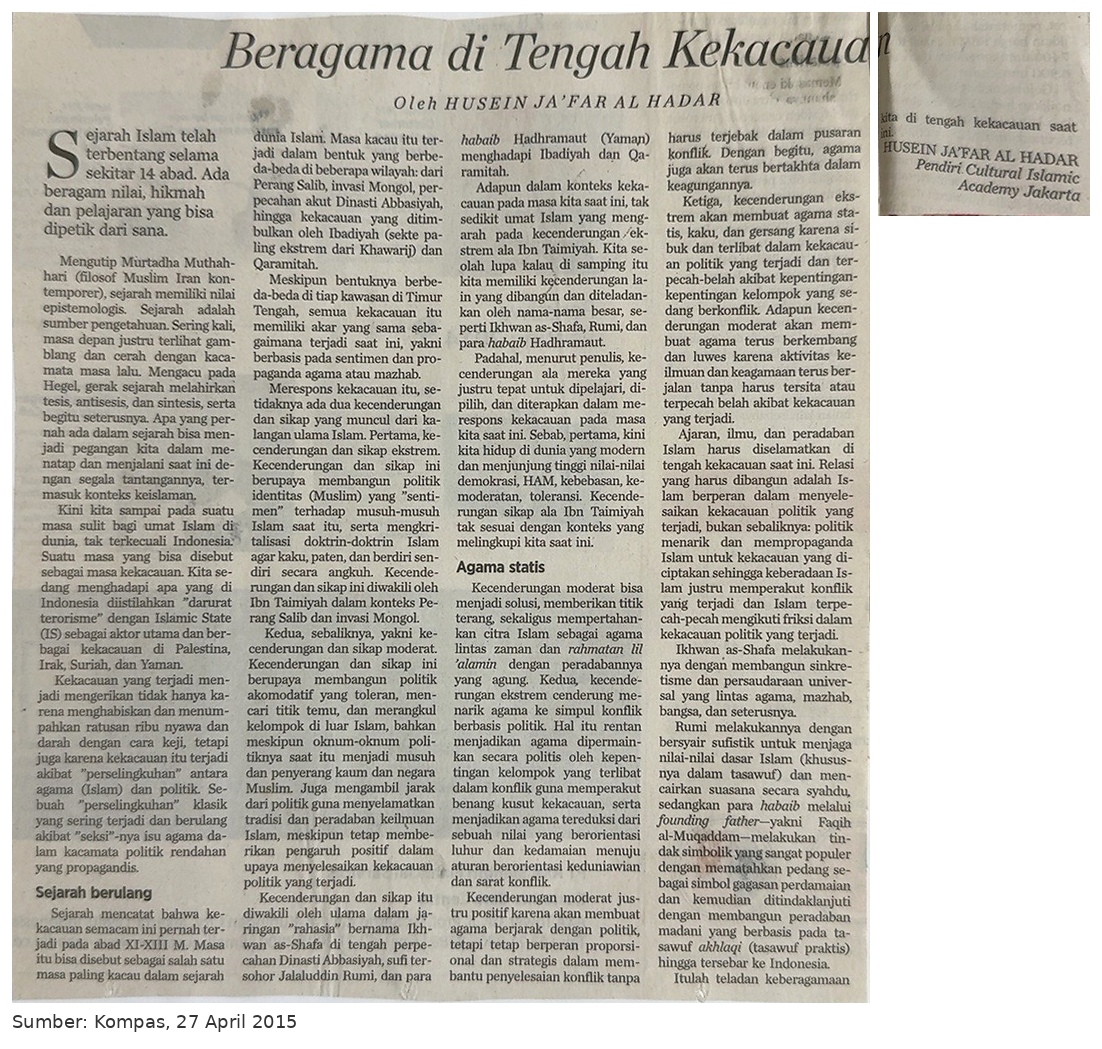
Beragama di Tengah Kekacauan [Being Religious amid Chaos]
Kompas · Kompas, Senin, 27 April 2015; rubrik Opini · 2015-04-27
Abstract
An opinion article by Husein Ja'far Al Hadar, founder of the Cultural Islamic Academy Jakarta, on religious attitudes amid the chaos of the present-day Islamic world, marked by the terrorism of the Islamic State and conflicts in the Middle East. Referring to Murtadha Muthahhari on the epistemological value of history, the author compares the present with the eleventh to thirteenth centuries, which were marked by the Crusades, the Mongol invasion, and the fragmentation of the Abbasids. He distinguishes two tendencies in the responses of the ulama: the extreme, which he associates with Ibn Taimiyah, and the moderate, represented by the Ikhwan as-Shafa, Jalaluddin Rumi, and the habibs of Hadhramaut. He recommends the moderate tendency so that religion is not toyed with by politics, does not become static, and remains a mercy for the universe.
- Identifier
- KBA-KLP-2015-0009
- Type
- Kliping
- Publisher
- Kompas
- Date Issued
- 2015-04-27
- Bibliographic Citation
- Kompas, Senin, 27 April 2015; rubrik Opini
- Creator
- Husein Ja'far Al Hadar
- Subject
- Moderasi beragama Ekstremisme Negara Islam (ISIS) Sejarah Islam abad pertengahan Tasawuf Jalaluddin Rumi Ikhwan as-Shafa Habib Hadhramaut
- LC Classification
- BP173.7 — Islam dan politik
- LCSH Subject
- Islamic fundamentalism Islam -- 21st century Moderation -- Religious aspects -- Islam Sufism
- BISAC Category
- REL084000 RELIGION / Religion, Politics & State
- Language
- Indonesia
- Description
- This clipping contains an opinion article by Husein Ja'far Al Hadar entitled "Beragama di Tengah Kekacauan" (Being Religious amid Chaos) from the daily Kompas, Monday, 27 April 2015. The author is listed as the founder of the Cultural Islamic Academy Jakarta. The scan is assembled from two parts: the main page containing the title, the author's name, and four columns of text with two subheadings, namely "Sejarah berulang" (History Repeats Itself) and "Agama statis" (Static Religion), and a small cut-out on the right side containing the closing sentences and the author's identification. The source information is given at the bottom of the image. The last letter of the title on the main page is cut off, but it can be read in full from the supplementary cut-out. Husein Ja'far Al Hadar, born in 1988 in Bondowoso, East Java, later became widely known as a young preacher and writer active on social media, with an approach to Islam that is friendly, humorous, and close to the younger generation. At the time this article was written, he was only about twenty-six years old and was actively writing Islamic columns in various national media. The article shows the seeds of ideas that would later characterize his preaching: an emphasis on tasawuf (Sufism), moderation, and the example of the habibs of Hadhramaut who spread Islam peacefully to the Nusantara. The author opens his piece with the statement that the history of Islam, spanning some fourteen centuries, holds a variety of values, wisdom, and lessons. He quotes the contemporary Iranian Muslim thinker Murtadha Muthahhari to the effect that history has epistemological value, or can be a source of knowledge, and refers to Hegel's dialectic of thesis, antithesis, and synthesis. With this equipment he asserts that historical experience can serve as a guide in facing present challenges, including in the Islamic context. The present, according to the author, is a difficult time for Muslims throughout the world, Indonesia included. He calls it a time of chaos, marked by what in Indonesia is called a terrorism emergency, with the group Negara Islam or Islamic State as the main actor, as well as various conflicts in Palestine, Iraq, Syria, and Yemen. This chaos is terrifying not only because it has consumed hundreds of thousands of lives in brutal ways, but also because it was born of an "illicit affair" between religion and politics. The author considers that this kind of relationship is classic and has often recurred, because religious issues are seen as attractive through the lens of base, propagandistic politics. The section "Sejarah berulang" compares the present with the eleventh to thirteenth centuries CE, which the author calls one of the most chaotic periods in the history of the Islamic world. That chaos appeared in various forms in various regions: the Crusades, the Mongol invasion, the fragmentation of the Abbasid dynasty, and the chaos caused by groups he calls extreme, namely the Ibadiyah and the Qaramithah (Qarmatians). Although their forms differed, all these upheavals, in his view, shared the same root as the chaos of the present, namely religious or sectarian sentiment and propaganda. The author then identifies two tendencies in the attitudes of the ulama in responding to that chaos. The first tendency is the extreme attitude, in the form of a Muslim identity politics hostile to the enemies of Islam and the crystallization of doctrine so that it becomes rigid and stands arrogantly on its own. This tendency, in the author's reading, is represented by Ibn Taimiyah in the context of the Crusades and the Mongol invasion. The second tendency is the moderate attitude, in the form of an accommodative politics that is tolerant, seeks common ground, and embraces groups outside Islam, while keeping a distance from politics in order to preserve the tradition and intellectual civilization of Islam. This tendency is represented by the network of the Ikhwan as-Shafa amid the fragmentation of the Abbasids, the great Sufi Jalaluddin Rumi, and the habibs of Hadhramaut. The author regrets that in today's chaos not a few Muslims lean towards the extreme tendency, as if they had forgotten that there is another tendency built and exemplified by great figures. In his view, the moderate tendency is in fact the more appropriate one to study and apply, because Muslims now live in a modern world that upholds the values of democracy, human rights, freedom, moderation, and tolerance. The section "Agama statis" sets out the reasons for this choice. First, the moderate tendency can be a solution and can preserve the image of Islam as a religion that brings mercy to the universe. Second, the extreme tendency drags religion into the knot of political conflict so that religion is toyed with by group interests, whereas the moderate tendency keeps religion at a distance from politics while still allowing it to play a proportional and strategic role. Third, the extreme tendency makes religion static, rigid, and barren, whereas the moderate tendency allows religion to keep developing because intellectual and religious activity is not consumed by chaos. In the final section the author presents concrete examples. The Ikhwan as-Shafa built a syncretism and a universal brotherhood across religions, schools of thought, and nations. Rumi preserved the basic values of Islam through Sufi poetry and soothed the atmosphere with deep serenity. The habibs, through their pioneering figure al-Faqih al-Muqaddam, according to the author's account performed a famous symbolic act, namely breaking a sword as a symbol of the idea of peace, and then built a civil (madani) civilization based on ethical Sufism (tasawuf akhlaki) that later spread as far as Indonesia. The author closes with a call for such examples of religiosity to be taken as a guide amid the chaos of the present. The context of the article is important. In 2014–2015, the emergence of the Islamic State in Iraq and Syria caused great concern in Indonesia, including over citizens departing to join it and the potential for attacks at home. The government declared the group's ideology banned, and mainstream Islamic organizations such as Nahdlatul Ulama and Muhammadiyah actively campaigned for moderate Islam. In the same year Nahdlatul Ulama took up the theme of Islam Nusantara at its congress (muktamar). This article is part of that public discourse, providing historical and Sufi arguments for religious moderation. For Islamic studies, this clipping is interesting and at the same time invites critical discussion. The author's reading of Ibn Taimiyah as a representative of the extreme tendency is a contested interpretation; many scholars stress that Ibn Taimiyah's thought is complex and is read in various ways by different groups. The classification of the Ibadiyah as an extreme group also needs scrutiny, because present-day Ibadi communities, for example in Oman, are in fact known as moderate. Readers can use this article as an example of how Islamic history is used in public argument to support an agenda of moderation, and also as material for testing its historical accuracy. For students of Islam in the Malay World and the Indian Ocean, the reference to the habibs of Hadhramaut and ethical Sufism links this article with studies of the Hadhrami diaspora networks and their role in the spread of Islam in Southeast Asia. The article can also be read together with works on the Alawiyyin in the Nusantara to understand how that tradition is re-presented in contemporary religious discourse. Physically, the clipping is a cut-out of a yellowish newspaper page, accompanied by a small cut-out containing the conclusion of the article placed on the right side. The text is clearly legible. The uploaded image has been assembled and enhanced for legibility. The full text of the article has not been copied into this catalogue because the copyright belongs to the author and the publisher; this note is a curatorial description to help users understand its content, context, and research value. Suitable search subjects include religious moderation, extremism, the Islamic State, medieval Islamic history, tasawuf, Jalaluddin Rumi, the Ikhwan as-Shafa, the habibs of Hadhramaut, and Islam and politics. For citation purposes, the reference may be written as follows: Husein Ja'far Al Hadar, "Beragama di Tengah Kekacauan", Kompas, 27 April 2015, Opinion section.
- Rights
- Koleksi pribadi KBA13 Academy
- Collection
- Clippings
How to cite
Husein Ja'far Al Hadar, “Beragama di Tengah Kekacauan [Being Religious amid Chaos]”, Kompas, Kompas, Senin, 27 April 2015; rubrik Opini, 2015-04-27. KBA13 Academy Archive and Library, KBA-KLP-2015-0009.