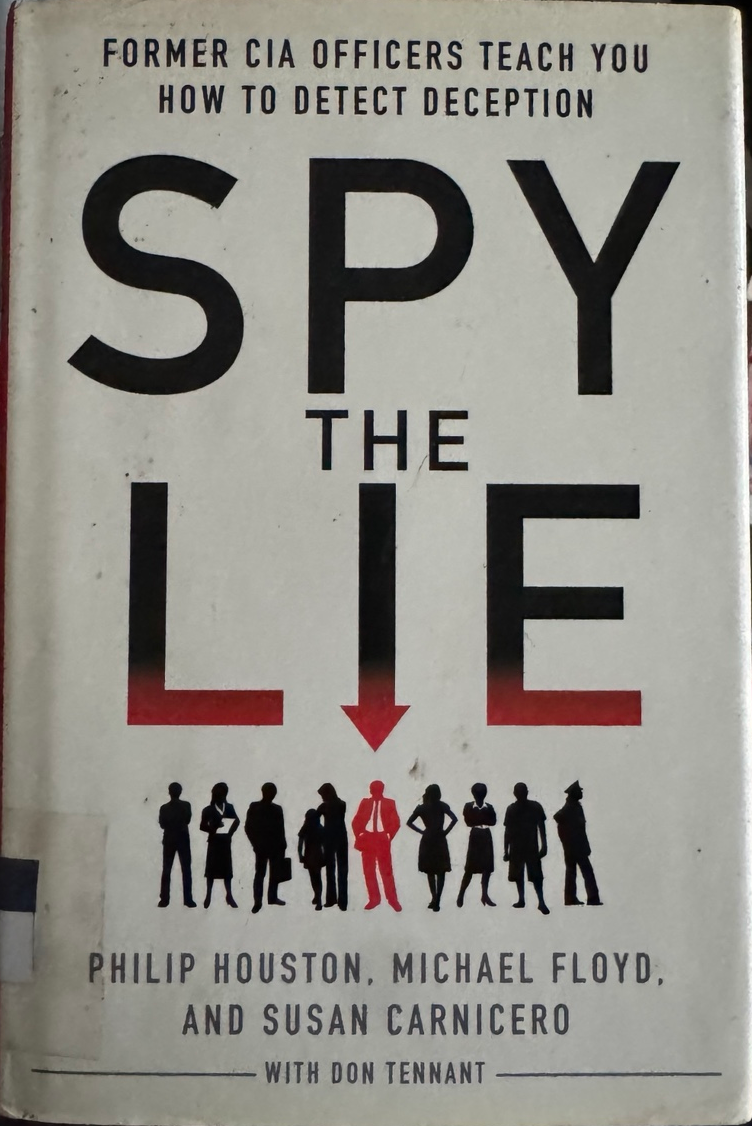
St. Martin's Press, New York · Tahun, cetakan, jumlah halaman, dan ISBN eksemplar belum diperiksa. Rujukan pembanding: New York: St. Martin's Press, 2012 (sampul keras), ISBN 978-1-250-00585-4; edisi sampul lunak St. Martin's Griffin, 2013, xiii + 258 hlm., ISBN 978-1-250-02962-1 (belum diverifikasi pada halaman hak cipta eksemplar) · Tanpa tahun
Abstract
A popular book on lie detection written by three former CIA officers, Philip Houston, Michael Floyd, and Susan Carnicero, together with the journalist Don Tennant. The book sets out the method Houston developed for counterterrorism and criminal investigations, and then shows its application in job interviews, legal testimony, business, and personal relationships. The authors emphasize observing behaviour that appears immediately after a question is asked and looking for clusters of verbal and nonverbal indicators, such as evasive answers, repeating the question, qualifying words, invoking religion to persuade, and hand movements to the face. The book is relevant to intelligence, legal, and psychological studies, although its method has been criticized as insufficiently supported by scientific research.
Identifier
KBA-BKU-TT-0018
Type
Buku
Publisher
St. Martin's Press, New York
Date Issued
Tanpa tahun
Bibliographic Citation
Tahun, cetakan, jumlah halaman, dan ISBN eksemplar belum diperiksa. Rujukan pembanding: New York: St. Martin's Press, 2012 (sampul keras), ISBN 978-1-250-00585-4; edisi sampul lunak St. Martin's Griffin, 2013, xiii + 258 hlm., ISBN 978-1-250-02962-1 (belum diverifikasi pada halaman hak cipta eksemplar)
DeceptionTruthfulness and falsehoodLie detectors and detectionInterviewing
BISAC Category
SEL040000 SELF-HELP / Communication & Social Skills
Language
Inggris
Description
Spy the Lie: Former CIA Officers Teach You How to Detect Deception by Philip Houston, Michael Floyd, and Susan Carnicero, written together with the journalist Don Tennant, is a popular book on how to detect lies, developed from the authors' experience as officers of the United States Central Intelligence Agency (CIA). The cover of this copy is ivory white with a large title in black letters. The word LIE is made distinctive: the letter I is replaced by a red arrow pointing downward, while the lower parts of the letters L and E change from black to red. Below it is a row of silhouettes of nine people from various professions, such as businesspeople, working women, families, and uniformed officers, with one figure in the middle coloured red as the marker of the person who is lying. The subtitle at the top states that former CIA officers will teach the reader how to detect deception, and the names of the four authors appear at the bottom. This copy is a hardcover with a dust jacket and has a library label on the left side of the spine.
The three principal authors have long backgrounds in security and intelligence. Philip Houston served in the CIA for about twenty-five years as an investigator, interviewer, and polygraph examiner, and he is known as the developer of the deception-detection methodology that forms the core of this book. Michael Floyd has experience as a polygraph examiner and security consultant within United States intelligence and security agencies. Susan Carnicero served as a security officer and interviewer in the CIA with expertise in personnel screening and criminal interviewing. After leaving government service, the three founded a consulting firm that provides training in deception detection and interview techniques to government agencies and private companies. Don Tennant, a technology journalist, helped shape their experience into a flowing read for a general audience.
According to the publisher's information and library catalogues, the book sets out the method Houston developed for counterterrorism and criminal investigations, and then shows how to apply it in everyday situations, such as job interviews, legal testimony, business dealings, and personal relationships. The book discusses verbal and nonverbal cues worth watching for, including hand movements to the face, grooming gestures, invoking religion to persuade, repeating the question, and using qualifying or hedging words in answers.
The book's approach is known for rejecting the popular notion that a lie can be guessed from a single sign, such as avoiding eye contact. The authors emphasize the importance of attending to behaviour that appears immediately after a question is asked, and of looking for clusters of several indicators at once, not a single isolated cue. They also caution observers not to be swayed by a general impression of a person's honesty, because skilled liars often appear convincing. Within this framework, answers that do not answer the question, vague denials, statements that try too hard to convince, and nonverbal behaviour that is out of step with speech become clues that need further testing, not final proof.
The book is also known for using many examples from real cases, both from the authors' experience in intelligence and security interviews and from interviews with public figures broadcast in the media. These examples are used to show how certain verbal and nonverbal patterns appear when someone is avoiding the truth. Its narrative, anecdote-rich style has made the book one of the best-known popular books on the subject of lie detection, and it was later followed by a sequel from the same team of authors on techniques for eliciting information in interviews.
Available publisher data indicate that the hardcover edition was published by St. Martin's Press, New York, in 2012, with ISBN 978-1-250-00585-4. The paperback edition was published by St. Martin's Griffin in 2013, at xiii plus 258 pages, with ISBN 978-1-250-02962-1. Because this copy is a hardcover, it most likely belongs to the 2012 edition, but the printing year and ISBN of the photographed copy still need to be checked against the copyright page.
In this library collection, the book is closely related to the study of intelligence and security. Interview techniques and deception detection are an important part of human intelligence practice, personnel security screening, and counterterrorism investigation. For researchers studying the history and organizational culture of United States intelligence agencies, this book provides a picture of how practical knowledge developed inside secret agencies was later popularized and commercialized after its practitioners retired. The phenomenon of former intelligence officers writing books and opening consulting services is also part of the study of the relationship between the security state and the market.
The book is also relevant to the fields of law, psychology, and communication. Law students can use it to understand the dynamics of examining witnesses and suspects, while psychology and communication students can compare it with the scientific literature on nonverbal communication and cognition in lying. In the Indonesian context, this topic intersects with the practices of investigation, examination in court, and employee selection, including the use of lie detectors in a number of major criminal cases.
As a critical note, a number of reviewers and psychology researchers judge that the method in this book is oversimplified and insufficiently supported by rigorous scientific evidence. Academic research on deception detection generally shows that the human ability to distinguish honesty from lies is only slightly above random guessing, and that many behavioural cues regarded as signs of lying turn out to be weak or inconsistent. Approaches based on cognitive interviewing and strategic use of evidence tend to be better supported by research than the reading of body language. Readers need to treat the method in this book as a practical guide to be critically examined, not a definitive measuring tool, especially where decisions with serious consequences for other people are concerned.
Moreover, applying such techniques across cultures requires caution. Cues regarded as suspicious in American culture, such as avoiding eye contact or invoking the name of God, may have very different meanings in other cultures, including in Indonesia, where references to religion and an attitude of deference (sungkan) are a natural part of everyday communication. Anthropological considerations of this kind are important so that deception-detection methods do not turn into instruments of prejudice.
From the standpoint of book and publishing history, Spy the Lie also reflects the proliferation of the genre of popular books by former intelligence officers after the events of 11 September 2001. The sharp rise in public interest in the world of intelligence encouraged major publishers to issue memoirs, practical guides, and analyses by people who had worked in secret agencies. Before publication, manuscripts of this kind usually have to go through a review process by the author's former agency to ensure that no classified information is leaked. This book can therefore be read alongside other works on the CIA in this collection to see the range of voices of former insiders, from those defending the agency to those critical of it.
This note is a curatorial introduction based on the cover, publisher information, and library catalogues, not a summary of the entire contents of the book. Appropriate search subjects include deception detection, nonverbal communication, interview techniques, intelligence, the CIA, the psychology of lying, and investigation. For citation purposes, references should state the authors' names, the full title, the publisher, the year, and the pages read directly in the copy.
Philip Houston, Michael Floyd, Susan Carnicero, Don Tennant (penulis pendamping), “Spy the Lie: Former CIA Officers Teach You How to Detect Deception”, St. Martin's Press, New York, Tahun, cetakan, jumlah halaman, dan ISBN eksemplar belum diperiksa. Rujukan pembanding: New York: St. Martin's Press, 2012 (sampul keras), ISBN 978-1-250-00585-4; edisi sampul lunak St. Martin's Griffin, 2013, xiii + 258 hlm., ISBN 978-1-250-02962-1 (belum diverifikasi pada halaman hak cipta eksemplar). KBA13 Academy Archive and Library, KBA-BKU-TT-0018.