
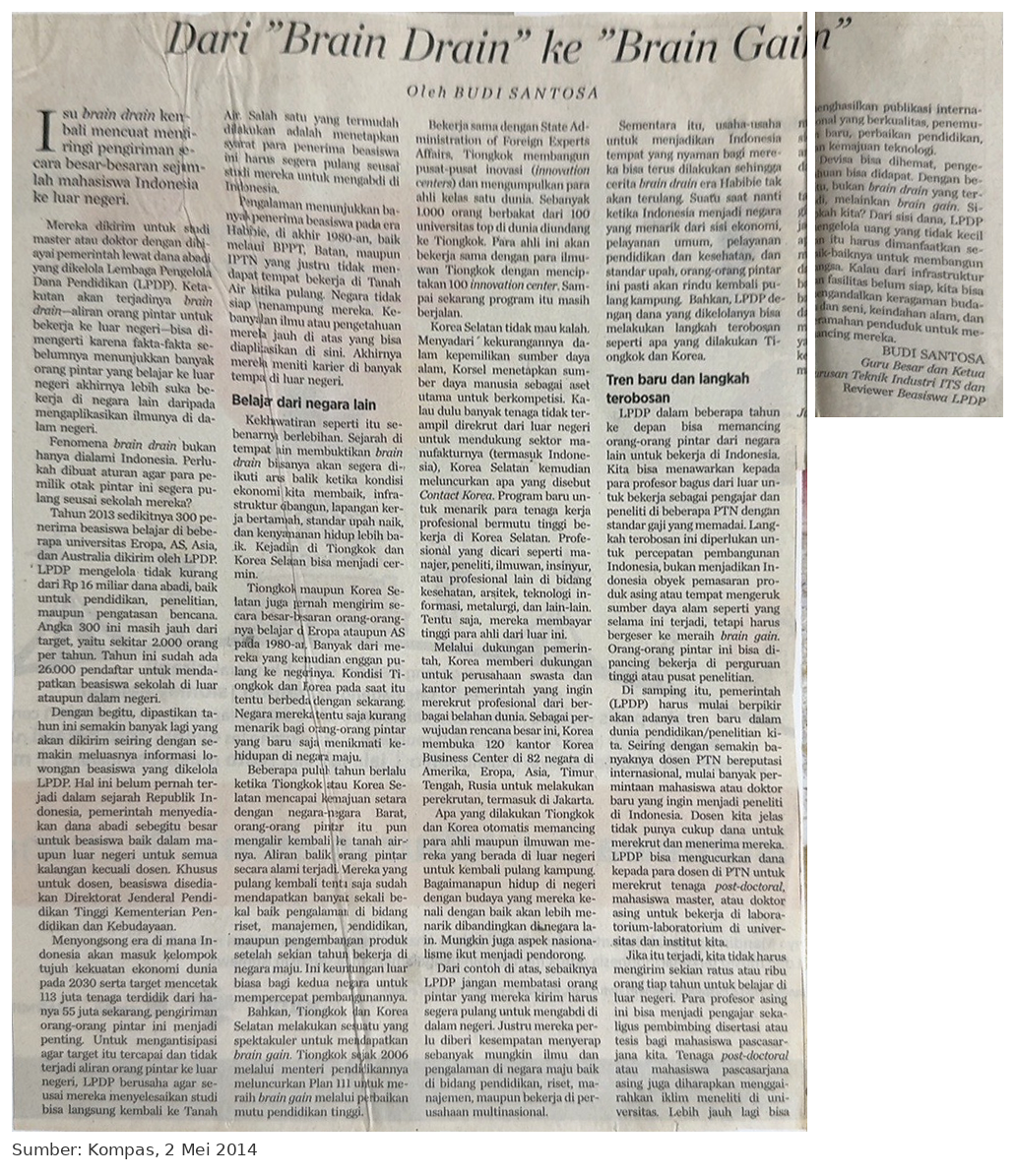
Dari "Brain Drain" ke "Brain Gain" [From "Brain Drain" to "Brain Gain"]
By Budi Santosa
Kompas · Kompas, Jumat, 2 Mei 2014; rubrik Opini · 2014-05-02
Abstract
An opinion article by Budi Santosa, professor of Industrial Engineering at ITS and a reviewer for LPDP scholarships, on concerns about brain drain amid the large-scale dispatch of Indonesian students abroad through LPDP scholarships. Recalling the experience of the Habibie era, when many overseas graduates could not be absorbed, the author considers these concerns exaggerated and draws lessons from China and South Korea, which attracted their talent back after their economies improved and through active programmes such as Plan 111 and Contact Korea. He proposes that LPDP not oblige alumni to return immediately, that Indonesia's attractiveness continue to be improved, and that foreign professors, postdoctoral researchers, and students be funded to work at Indonesian campuses in order to achieve brain gain.
- Identifier
- KBA-KLP-2014-0029
- Type
- Kliping
- Publisher
- Kompas
- Date Issued
- 2014-05-02
- Bibliographic Citation
- Kompas, Jumat, 2 Mei 2014; rubrik Opini
- Creator
- Budi Santosa
- Subject
- Brain drain Brain gain LPDP Beasiswa luar negeri Diaspora ilmuwan Pendidikan tinggi Tiongkok Korea Selatan
- LC Classification
- LB2300–2430 — Pendidikan tinggi
- LCSH Subject
- Brain drain -- Indonesia Scholarships -- Indonesia Educational exchanges -- Indonesia
- BISAC Category
- EDU015000 EDUCATION / Schools / Levels / Higher
- Language
- Indonesia
- Description
- This clipping contains an opinion article by Budi Santosa entitled "Dari 'Brain Drain' ke 'Brain Gain'" (From "Brain Drain" to "Brain Gain") from the daily Kompas, Friday, 2 May 2014. The author is listed as a professor and Head of the Department of Industrial Engineering at the Institut Teknologi Sepuluh Nopember (ITS) Surabaya and a scholarship reviewer for the Lembaga Pengelola Dana Pendidikan (LPDP, Indonesia Endowment Fund for Education). The scan is assembled from two parts: the main page containing the title, the author's name, and four columns of text with two subheadings, namely "Belajar dari negara lain" (Learning from Other Countries) and "Tren baru dan langkah terobosan" (New Trends and Breakthrough Measures), and a small cut-out on the right side containing the closing paragraph and the author's identification. The source information is given at the bottom of the image. The article was published on National Education Day, together with the article by Hendra Gunawan, "Mengintip Masa Depan" (Peeking into the Future), which is also kept in this collection. Budi Santosa opens his piece by noting that the issue of brain drain, namely the outflow of talented people to work abroad, has resurfaced alongside the large-scale dispatch of Indonesian students for master's and doctoral studies abroad at government expense through the endowment fund managed by LPDP. According to the author, this concern is understandable because the facts show that many talented people who study abroad end up preferring to work in other countries rather than applying their knowledge at home. This phenomenon is not experienced by Indonesia alone, and therefore proposals have emerged that scholarship recipients be required to return immediately after completing their studies. The author then sets out the scale of the LPDP programme in its early period. In 2013 at least three hundred scholarship recipients were studying at various universities in Europe, the United States, Asia, and Australia, a figure still far from the target of about two thousand people per year, while the number of applicants had reached tens of thousands. He considers that for the first time in the history of the Republic of Indonesia the government had provided an endowment fund of that size for domestic and overseas scholarships for all groups, except lecturers, who obtain scholarships through the Directorate General of Higher Education. In view of the projection that Indonesia would join the group of the world's seven largest economies by 2030, with a much greater need for educated workers, sending talented people abroad becomes very important. To prevent the outflow of talented people abroad, LPDP stipulated that scholarship recipients must return immediately and serve in Indonesia. The author recalls past experience. In the era of B.J. Habibie in the late 1980s, many scholarship recipients sent through the Agency for the Assessment and Application of Technology (BPPT), the National Nuclear Energy Agency (BATAN), and the Nusantara Aircraft Industry (IPTN) in fact found no place to work when they returned. The state was not prepared to absorb them, and much of the knowledge they had acquired was far above the needs that could be applied at home. In the end they pursued careers in other countries. The section "Belajar dari negara lain" argues that the concern about brain drain is actually exaggerated. History, according to the author, shows that brain drain is usually followed by a reverse flow when the economic conditions of the country of origin improve, infrastructure is built, employment grows, and wage standards and living comfort rise. He takes China and South Korea as mirrors. Both countries once sent large numbers of students to Europe and the United States in the 1980s, and many of them were reluctant to return. Several decades later, when both countries had achieved progress on a par with Western countries, these talented people returned, bringing valuable experience in research, management, education, and product development. The author also notes that both countries took active steps to attract talent back. Since 2006 China has launched a programme known as Plan 111 to achieve brain gain through improving the quality of higher education, working with the agency responsible for foreign experts, building innovation centres, and inviting hundreds of experts from the world's best universities to work alongside Chinese scientists. South Korea, aware of its lack of natural resources, made human resources its main asset and launched the Contact Korea programme to attract high-quality professional workers, supported by a network of Korea Business Center offices in dozens of countries. The author adds that nationalism and a longing for one's own culture also helped drive this reverse flow. The section "Tren baru dan langkah terobosan" contains policy proposals. The author suggests that LPDP should not require the talented people it sends to return immediately, but should give them the opportunity to absorb as much knowledge and experience as possible in advanced countries, whether in education, research, management, or employment in multinational companies. Meanwhile, efforts to make Indonesia a comfortable place for them must continue, so that later, when Indonesia becomes an attractive country in terms of the economy, public services, education, health, and wages, they will surely long to return. LPDP is also urged to take breakthrough measures like China and Korea, for example offering positions to good foreign professors and researchers to work at state universities with adequate salaries, and funding foreign postdoctoral researchers and master's or doctoral students to work in the laboratories of Indonesian universities and institutes. In this way, Indonesia need not always send hundreds or thousands of people abroad, because foreign professors and researchers can serve as teachers as well as dissertation supervisors at home. The author closes by stating that what needs to be developed is not the brain drain that is occurring, but brain gain, supported by the optimal use of LPDP funds and by Indonesia's cultural and natural wealth and the hospitality of its people. The value of this clipping lies in its role as an early document of the debate about LPDP. The institution was established in 2012 and began awarding scholarships in 2013, and then grew into the largest scholarship programme in Indonesian history with tens of thousands of recipients. The debate about the obligation of alumni to return and serve has continued to this day, including controversies over alumni who choose to remain working abroad and government policies to enforce the service obligation. This article shows that from the outset there were voices from within the LPDP circle itself advocating a more flexible and long-term-oriented approach. The clipping is also relevant to studies of diaspora and development. The idea that an educated diaspora can be an asset through the circulation of knowledge, rather than merely a loss, is in line with the concept of brain circulation in the literature on international migration. The experiences of China and South Korea cited by the author are indeed often held up as examples of success in attracting talent back. The Indonesian government later also launched various schemes to engage the scientific diaspora, for example a visiting diaspora professor programme and citizenship policies for the diaspora, although their results remain a matter of debate. From the standpoint of higher-education policy, the author's proposal to bring in foreign professors and researchers is related to efforts to internationalize campuses and increase scientific publications. In the following years, the government did issue policies that made it easier to recruit foreign lecturers and launched world-class professor programmes, so this article can be read as part of the discourse that pushed in that direction. As a critical note, the analogy with China and South Korea needs to be read with care. Both countries have industrial capacity, research budgets, and state policies very different from Indonesia's, so the reverse flow of talent does not occur automatically simply because time passes. In addition, the proposal not to require alumni to return immediately raises questions about accountability in the use of public funds. Readers can weigh this argument together with Hendra Gunawan's article of the same day, which highlights the state's small investment in higher education and research. Physically, the clipping is a cut-out of a yellowish newspaper page with fold marks in several places, accompanied by a small cut-out containing the conclusion of the article. The text is clearly legible, although a few lines near the folds and the edge of the left column are slightly blurred. The full text of the article has not been copied into this catalogue because the copyright belongs to the author and the publisher; this note is a curatorial description to help users understand its content, context, and research value. Suitable search subjects include brain drain, brain gain, LPDP, overseas scholarships, the scientific diaspora, higher education, human resources policy, China, and South Korea. For citation purposes, the reference may be written as follows: Budi Santosa, "Dari 'Brain Drain' ke 'Brain Gain'", Kompas, 2 May 2014, Opinion section.
- Rights
- Koleksi pribadi KBA13 Academy
- Collection
- Clippings
How to cite
Budi Santosa, “Dari "Brain Drain" ke "Brain Gain" [From "Brain Drain" to "Brain Gain"]”, Kompas, Kompas, Jumat, 2 Mei 2014; rubrik Opini, 2014-05-02. KBA13 Academy Archive and Library, KBA-KLP-2014-0029.