Paramadina, Jakarta · Tahun, cetakan, jumlah halaman, dan ISBN eksemplar belum diperiksa. Rujukan pembanding: Jakarta: Paramadina bekerja sama dengan Jurnal Ulumul Qur'an, 1996, sekitar 762 hlm., ISBN belum ditemukan (belum diverifikasi pada halaman hak cipta eksemplar) · Tanpa tahun
Abstract
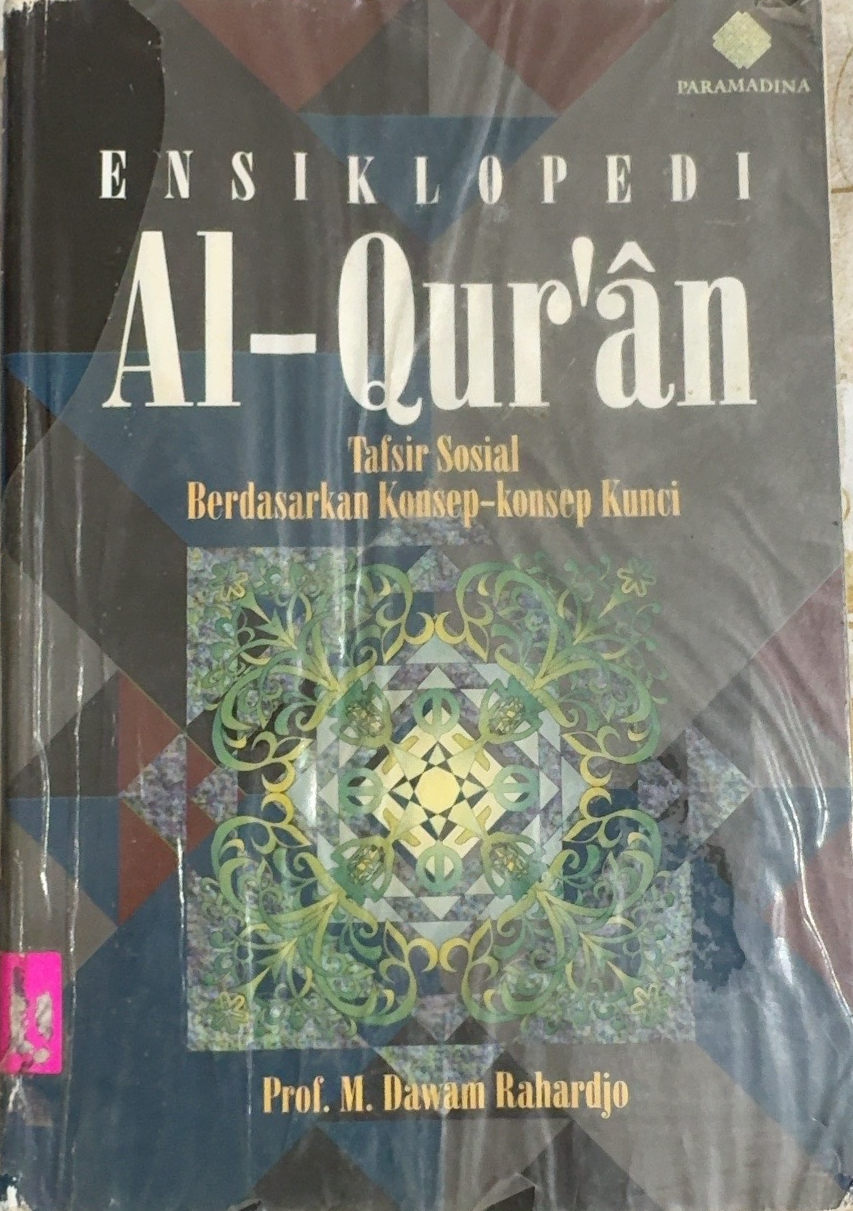
This work by the economist and Muslim intellectual M. Dawam Rahardjo is a thematic exegesis organized around the key concepts of the Qur'an, rather than the order of its surahs and verses. Originating in the encyclopedia column of the Jurnal Ulumul Qur'an, this book published by Paramadina discusses some twenty-seven concepts, including fitrah, hanif, din, takwa, amanah, rahmah, riba, and amar ma'ruf nahi munkar. Each entry traces the use of the term across various verses, refers to classical and modern exegetes, and then relates it to present-day social, economic, and political problems. This social-exegesis approach arose from the movement for the renewal of Islamic thought in Indonesia and has been widely studied in Islamic religious higher education institutions. The cover of the copy has a dark geometric background with a green-and-yellow arabesque panel; it is wrapped in protective plastic, bears a pink library label on the spine, and shows wear at the edges.
- Identifier
-
KBA-BKU-TT-0019
- Type
-
Buku
- Publisher
-
Paramadina, Jakarta
- Date Issued
-
Tanpa tahun
- Bibliographic Citation
-
Tahun, cetakan, jumlah halaman, dan ISBN eksemplar belum diperiksa. Rujukan pembanding: Jakarta: Paramadina bekerja sama dengan Jurnal Ulumul Qur'an, 1996, sekitar 762 hlm., ISBN belum ditemukan (belum diverifikasi pada halaman hak cipta eksemplar)
- Creator
-
M. Dawam Rahardjo
- LC Classification
-
BP130–137 — Al-Qur'an dan tafsir
- LCSH Subject
-
Koran -- Criticism, interpretation, etc.
Koran -- Encyclopedias
Islam -- Social aspects -- Indonesia
- BISAC Category
-
REL041000 RELIGION / Islam / Koran & Sacred Writings
- Language
-
Indonesia
- Description
-
Ensiklopedi Al-Qur'an: Tafsir Sosial Berdasarkan Konsep-konsep Kunci (Encyclopedia of the Qur'an: A Social Exegesis Based on Key Concepts) by M. Dawam Rahardjo is one of the most influential works of thematic exegesis to emerge from the milieu of Indonesian Muslim intellectuals in the 1990s. The book was published by Paramadina, the institute of Islamic studies founded by Nurcholish Madjid and colleagues in Jakarta. The cover of this copy shows a dark background with a geometric pattern of triangular and diamond-shaped fields in grey, dark blue, and maroon, resembling patchwork or tiles. The word "ENSIKLOPEDI" is written in widely spaced capitals, followed by the word "Al-Qur'ân" in very large white serif letters with a circumflex over the letter a. The subtitle "Tafsir Sosial Berdasarkan Konsep-konsep Kunci" is written in golden-yellow letters. The middle of the cover is filled with a square panel with an arabesque motif, consisting of green and yellow tendrils and leaves surrounding a geometric star pattern with a pale yellow centre. The Paramadina logo and name are located in the upper right corner, while the author's name is printed as "Prof. M. Dawam Rahardjo" at the bottom.
M. Dawam Rahardjo was born in Surakarta on 20 April 1942 and died in Jakarta in 2018. He studied economics at Universitas Gadjah Mada and took part in a student exchange programme in the United States while in secondary school. Dawam was known as an economist, an NGO activist, and a Muslim intellectual. He was long active in the Lembaga Penelitian, Pendidikan, dan Penerangan Ekonomi dan Sosial (LP3ES, Institute for Social and Economic Research, Education and Information), led the magazine Prisma, founded the Lembaga Studi Agama dan Filsafat (LSAF, Institute for the Study of Religion and Philosophy), and was a driving force behind the Jurnal Ulumul Qur'an. He was also professor of development economics at Universitas Muhammadiyah Malang, rector of Universitas 45 Bekasi, and active in the Ikatan Cendekiawan Muslim se-Indonesia (ICMI, Indonesian Association of Muslim Intellectuals) and Muhammadiyah. In the final years of his life, he was known as a defender of religious freedom and the rights of religious minority groups, a stance that often placed him at the centre of controversy.
The book originates from a series of Dawam's writings in the Qur'an encyclopedia column of the Jurnal Ulumul Qur'an from the late 1980s. These writings were later collected and edited into a single thick volume. Unlike classical exegesis, which follows the order of surahs and verses, this book is organized around key concepts of the Qur'an. A number of studies mention some twenty-seven concepts discussed, including fitrah, hanif, Ibrahim, din, Islam, takwa, 'abd, amanah, rahmah, riba, and amar ma'ruf nahi munkar. Each entry is developed by tracing the use of the term across various verses, referring to the interpretations of classical and modern exegetes, and then relating it to the social, economic, and political problems of modern society.
The approach Dawam uses can be called thematic social exegesis. He does not stop at linguistic or legal explanation, but asks about the social meaning of Qur'anic concepts. The concept of amanah, for example, is connected with human responsibility as khalifah (vicegerent) and with the ethics of power, while the discussion of riba is linked to modern economic debates about bank interest. Several researchers note that Dawam tends to read riba contextually, so that he does not automatically equate it with all forms of bank interest, a position that differs from the mainstream of the Islamic economics movement. In building his exegesis, Dawam refers to exegetes such as Hamka and thinkers such as Fazlur Rahman, but also borrows ideas from the Western social sciences, including sociology and psychology, so that the book displays a dialogue between the sacred text and the modern sciences.
In the context of Indonesian intellectual history, this book arose from the movement for the renewal of Islamic thought that developed from the 1970s together with Nurcholish Madjid, Djohan Effendi, Ahmad Wahib, and young members of the Himpunan Mahasiswa Islam (HMI, Islamic Students' Association). The Jurnal Ulumul Qur'an in the late 1980s and the 1990s became one of the most important spaces for debate on Islam, modernity, and Indonesian identity. Ensiklopedi Al-Qur'an can be read as an effort to ground the Qur'an in problems of development, social justice, and public ethics, in keeping with Dawam's concerns as a development economist. The work is also often compared with Wawasan Al-Qur'an (Insights of the Qur'an) by M. Quraish Shihab, published in the same period and also using a thematic approach, though in a style closer to the exegetical tradition.
Bibliographic data available in various academic references indicate that the first edition of this book was published in Jakarta by Paramadina, in cooperation with the Jurnal Ulumul Qur'an, in 1996, with approximately 762 pages according to a number of reviews. Other references record a subsequent edition or printing in 2002, also by Paramadina. The ISBN of the first edition could not be confirmed from the catalogues examined. The printing, year, page count, and ISBN of the photographed copy still need to be checked against the copyright page.
For Islamic studies in Indonesia, this book is valuable in several respects. First, it is an early example of an Indonesian-language thematic exegesis written by a social scientist rather than by an exegete in the traditional sense, thus showing the expansion of interpretive authority among Muslim intellectuals. Second, the book has been the subject of many undergraduate theses, master's theses, and journal articles in Islamic religious higher education institutions examining its method, character, and hermeneutics. Third, for the study of Islamic law and economics, the discussion of riba, zakat, and social justice provides comparative material between social exegesis and fiqh thought. For universities in Aceh, where Islamic sharia is formally implemented, this book can be used to discuss the tension between normative-legal and social-contextual approaches to understanding the Qur'an. Teachers can use one or two entries, for example on amanah or justice, as material for class discussion to train students to compare thematic exegesis with tahlili (analytical, verse-by-verse) exegesis, while also assessing how Qur'anic concepts are translated into the language of public policy and social ethics. For the anthropology of religion, the book is also an important document of how the educated Muslim middle class in Indonesia during the New Order era read scripture in the language of the social sciences.
As a critical note, some scholars judge that Dawam's social exegesis is at times driven more by the framework of modern social science than by rigorous linguistic analysis and the principles of exegesis. The choice of concepts discussed also reflects the author's personal interests, so the book cannot be considered a complete encyclopedia in the sense of a comprehensive reference. The use of the word "encyclopedia" is better understood as a form of presentation based on concept entries. Nevertheless, Dawam's boldness in bringing the sacred text into encounter with problems of development and social justice keeps this book relevant and widely cited, both by scholars of exegesis and by those interested in Islamic social thought in Indonesia.
In terms of collection documentation, this copy is wrapped in protective plastic that appears wrinkled and reflects light in places. The edges of the cover show wear, and the spine on the left side appears dark and worn. A pink library label is attached to the spine at the lower left. This note is a curatorial introduction based on the cover and catalogue information, not a summary of the entire contents of the book.
Appropriate search subjects include Qur'anic exegesis, thematic exegesis, social exegesis, key concepts of the Qur'an, Indonesian Islamic thought, M. Dawam Rahardjo, Paramadina, and the Jurnal Ulumul Qur'an. For citation purposes, references should state the author's name, the full title, the publisher, the year, and the pages read directly in the copy.
- Rights
-
Koleksi pribadi KBA13 Academy