Gramedia, Jakarta · Tahun, cetakan, jumlah halaman, dan ISBN eksemplar belum diperiksa. Rujukan pembanding: Jakarta: Gramedia, 1987, ISBN 979-403-091-0; cetakan ulang Gramedia Pustaka Utama, misalnya cet. 4, 1994, 424 hlm., dan cet. 7, 2003, xv + 424 hlm. (belum diverifikasi pada halaman hak cipta eksemplar) · Tanpa tahun
Abstract
This classic Indonesian-language work of political philosophy sets out the normative foundations of the modern state. Franz Magnis-Suseno, a long-time lecturer at the Sekolah Tinggi Filsafat Driyarkara (Driyarkara School of Philosophy), starts from the question of the legitimacy of power and distinguishes its sociological, legal, and ethical dimensions. He critically weighs religious, elitist, and democratic claims to legitimacy, and arrives at the conclusion that the modern state can be ethically justified only if it guarantees human rights, is subject to law, and is run democratically. The discussion also covers the functions of law and the state, the rule-of-law state (negara hukum), democracy, and social justice. First published in 1987 under the New Order, the book provided a philosophical language for questioning the moral basis of power and became important reading for the generation approaching reformasi. The work remains relevant for the study of law and society, the philosophy of law, and comparison with Islamic political thought.
- Identifier
-
KBA-BKU-TT-0020
- Type
-
Buku
- Publisher
-
Gramedia, Jakarta
- Date Issued
-
Tanpa tahun
- Bibliographic Citation
-
Tahun, cetakan, jumlah halaman, dan ISBN eksemplar belum diperiksa. Rujukan pembanding: Jakarta: Gramedia, 1987, ISBN 979-403-091-0; cetakan ulang Gramedia Pustaka Utama, misalnya cet. 4, 1994, 424 hlm., dan cet. 7, 2003, xv + 424 hlm. (belum diverifikasi pada halaman hak cipta eksemplar)
- Creator
-
Franz Magnis-Suseno
- LC Classification
-
JC — Teori politik
- LCSH Subject
-
Political ethics
Political science -- Philosophy
State, The
Legitimacy of governments
- BISAC Category
-
PHI019000 PHILOSOPHY / Political
- Language
-
Indonesia
- Description
-
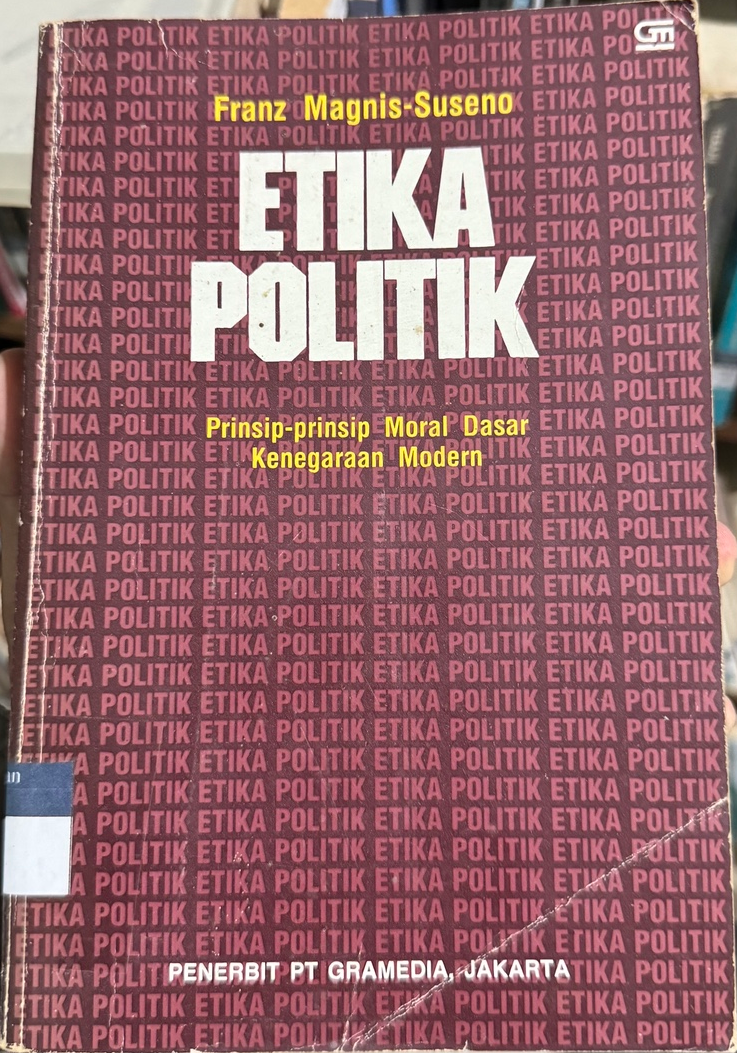
Etika Politik: Prinsip-prinsip Moral Dasar Kenegaraan Modern (Political Ethics: The Basic Moral Principles of the Modern State) by Franz Magnis-Suseno is one of the most widely read and cited Indonesian-language books of political philosophy in Indonesian universities since the late 1980s. The cover of this copy is dark maroon with a background consisting of the words ETIKA POLITIK repeated in pink capitals that fill the entire cover, creating a distinctive textured pattern. Over this pattern the author's name is printed in yellow letters, the title ETIKA POLITIK in large, bold white stencil-style typography, and then the subtitle in yellow. The Gramedia logo appears in the upper right corner, while at the bottom is written PENERBIT PT GRAMEDIA, JAKARTA. The publisher's name in this form, rather than Gramedia Pustaka Utama, suggests that this copy probably comes from an early printing, but this supposition must still be confirmed on the copyright page.
Franz Magnis-Suseno was born in 1936 in Silesia, a region now part of Poland, and came to Indonesia as a member of the Society of Jesus in 1961. He studied philosophy and theology, and then obtained a doctorate in philosophy from the University of Munich with a dissertation on the thought of the young Karl Marx. From the late 1960s he helped build the Sekolah Tinggi Filsafat Driyarkara in Jakarta and taught there for decades, later becoming an Indonesian citizen in 1977. His works are very numerous and varied, including Etika Jawa (Javanese Ethics), Etika Dasar (Basic Ethics), Filsafat sebagai Ilmu Kritis (Philosophy as a Critical Science), Pemikiran Karl Marx (The Thought of Karl Marx), and studies of twentieth-century ethical thinkers. He is also known as a public intellectual who writes actively in the mass media, takes part in interreligious dialogue, and speaks out on issues of democracy, human rights, and social justice.
The book is composed as a systematic introduction to the normative foundations of the modern state. Its point of departure is the question of the legitimacy of power: on what basis a political power has the right to govern and to demand the obedience of citizens. Magnis-Suseno distinguishes several dimensions of legitimacy, namely sociological legitimacy, which concerns acceptance by society; legal legitimacy, which concerns conformity with law; and ethical legitimacy, which assesses power according to moral norms. He also discusses various forms of claims to legitimacy in history, for example religious legitimacy, which grounds power in the divine will; elitist legitimacy, which grounds power in the superiority of a particular group; and democratic legitimacy, which grounds power in popular sovereignty. Through critical analysis, the book arrives at the conclusion that the modern state can be ethically justified only if it guarantees basic rights, is subject to law, and is run democratically.
The book then discusses the relationship between human beings as social creatures and the institutions that regulate common life, the position of law and the functions of the state, the foundations of human rights, the principle of the rule-of-law state, democracy, and social justice. The discussion of human rights and social justice occupies an important place, because the author holds that the state must not merely maintain order but is also obliged to create the conditions that allow all citizens to live decently. Its style of exposition is typical of a philosophy textbook: concepts are explained step by step, counterarguments are considered, and conclusions are drawn carefully. The book is also equipped with a bibliography and an index that make it easy to use as a course reference.
The context of the book's publication is decisive for its meaning. In 1987, Indonesia was under the New Order government, which emphasized stability, economic development, and a single interpretation of Pancasila through the P4 indoctrination programme (penataran P4). The space to discuss the legitimacy of power, human rights, and democracy openly was very limited. In that situation, Magnis-Suseno's book offered a philosophical language that enabled readers to question the moral basis of power without becoming trapped in political slogans. He discusses the modern state in general, not any particular regime, but the attentive reader could grasp its relevance to the Indonesian situation. That is why the book became important reading for the generation of students and activists who later took part in the reformasi movement of 1998.
Intellectually, the book combines the European tradition of political philosophy, from Aristotle and Thomas Aquinas to Hobbes, Locke, Rousseau, Kant, Hegel, and Marx, with attention to the concrete problems of Indonesian society. The influence of Catholic ethics on human dignity and the common good can be felt, but its arguments are formulated in a rational language open to readers of various religious backgrounds. This approach has made the book acceptable in state universities, religious higher education institutions, and other educational institutions.
For the study of law and society, the philosophy of law, and political science in Indonesia, this book remains a basic reference. Students of faculties of sharia and law can use it to understand the concepts of the rule-of-law state, legitimacy, and human rights before comparing them with the ideas of siyasah syar'iyyah, maqasid al-syari'ah, and classical and modern Islamic political theory. For readers in Aceh, the question of religious legitimacy and democratic legitimacy is highly relevant, given the implementation of Islamic sharia within the framework of special autonomy inside the unitary state of the Republic of Indonesia. Magnis-Suseno's analysis of the dangers of religious legitimacy that is not democratically controlled can provide valuable material for critical discussion, while of course taking into account the differences in perspective between secular political philosophy and Islamic political thought.
From the standpoint of political anthropology, this book can also be read alongside Magnis-Suseno's other work, Etika Jawa, which discusses the moral outlook of Javanese society on harmony, respect, and power. Comparing the two books reveals the tension between a traditional concept of power that emphasizes harmony and the concept of the modern state that demands accountability, a tension that still colours Indonesian political culture today.
As a critical note, some readers judge that the framework of this book relies heavily on the Western philosophical tradition, so that political thought from the Islamic, Chinese, Indian, or Nusantara traditions receives little space. Moreover, because it was written in the late 1980s, important later developments, such as debates on deliberative democracy, multiculturalism, global justice, and identity politics, are not covered in the early edition. Nevertheless, the clarity of its arguments and the balance of its stance make the book still worth using as a gateway into political philosophy, especially when supplemented with more recent readings.
Comparative publication data from various library catalogues in Indonesia show that the book was first published in Jakarta by Gramedia in 1987 with ISBN 979-403-091-0, and then reprinted many times by Gramedia Pustaka Utama, for example the fourth printing in 1994 and the seventh printing in 2003, with a physical description of xv plus 424 pages, 21 centimetres in size. The page count of the first printing could not be confirmed from the sources examined. The year, printing, and ISBN of the photographed copy still need to be checked against the copyright page.
The physical condition of the copy shows a much-used paperback. Cracks and a diagonal fold are visible at the lower right of the cover, with wear and small areas of peeling on the left edge near the spine, and the corners are beginning to blunt. At the lower left is a blue-and-white library label with remnants of truncated writing, indicating that this book was once part of an institutional library collection. The colour of the cover is still fairly good although its surface looks dull. This note is a curatorial introduction based on the cover and catalogue information, not a summary of the entire contents of the book.
Appropriate search subjects include political ethics, political philosophy, the legitimacy of power, the rule-of-law state, human rights, democracy, social justice, and Indonesian political thought. For citation purposes, references should state the author's name, the full title with subtitle, the publisher, the year, the printing, and the pages read directly in the copy.
- Rights
-
Koleksi pribadi KBA13 Academy
How to cite
Franz Magnis-Suseno, “Etika Politik: Prinsip-prinsip Moral Dasar Kenegaraan Modern [Political Ethics: The Basic Moral Principles of the Modern State]”, Gramedia, Jakarta, Tahun, cetakan, jumlah halaman, dan ISBN eksemplar belum diperiksa. Rujukan pembanding: Jakarta: Gramedia, 1987, ISBN 979-403-091-0; cetakan ulang Gramedia Pustaka Utama, misalnya cet. 4, 1994, 424 hlm., dan cet. 7, 2003, xv + 424 hlm. (belum diverifikasi pada halaman hak cipta eksemplar). KBA13 Academy Archive and Library, KBA-BKU-TT-0020.