Fenomena Partai Keadilan: Transformasi 20 Tahun Gerakan Tarbiyah di Indonesia [The Justice Party Phenomenon: The 20-Year Transformation of the Tarbiyah Movement in Indonesia]
Teraju, Jakarta · Tahun, cetakan, jumlah halaman, dan ISBN eksemplar belum diperiksa. Rujukan pembanding: Jakarta: Teraju, 2002, v + 389 hlm., 20,5 cm; sebagian katalog mencatat tahun 2003; ISBN tidak tercantum pada katalog yang diperiksa (belum diverifikasi pada halaman hak cipta eksemplar) · Tanpa tahun
Abstract
A study by Ali Said Damanik, with an introduction by political scientist Bahtiar Effendy, on the birth of the Partai Keadilan (Justice Party) as the result of a transformation of roughly two decades of the tarbiyah movement in Indonesia. The book traces the growth of da'wah networks based on halaqah (study circles) and campus da'wah institutions since the late 1970s, the influence of the thought of the Ikhwanul Muslimin (Muslim Brotherhood), patterns of cadre formation during the New Order, and the movement's decision to enter the party arena after the fall of the regime in 1998 and its participation in the 1999 elections. Published at a stage when the Partai Keadilan was preparing to become the Partai Keadilan Sejahtera (Prosperous Justice Party), this book records the formative stage of that da'wah party, including its image as a clean and disciplined cadre party and its efforts to bring Islamic ideals together with electoral democracy. This work is relevant to studies of Islamic politics, urban middle-class religious movements, the anthropology of religion, and comparative Islamic movements in the Malay World.
Identifier
KBA-BKU-TT-0021
Type
Buku
Publisher
Teraju, Jakarta
Date Issued
Tanpa tahun
Bibliographic Citation
Tahun, cetakan, jumlah halaman, dan ISBN eksemplar belum diperiksa. Rujukan pembanding: Jakarta: Teraju, 2002, v + 389 hlm., 20,5 cm; sebagian katalog mencatat tahun 2003; ISBN tidak tercantum pada katalog yang diperiksa (belum diverifikasi pada halaman hak cipta eksemplar)
Partai Keadilan (Indonesia)Islam and politics -- IndonesiaPolitical parties -- IndonesiaIslamic renewal -- Indonesia
BISAC Category
POL015000 POLITICAL SCIENCE / Political Process / Political Parties
Language
Indonesia
Description
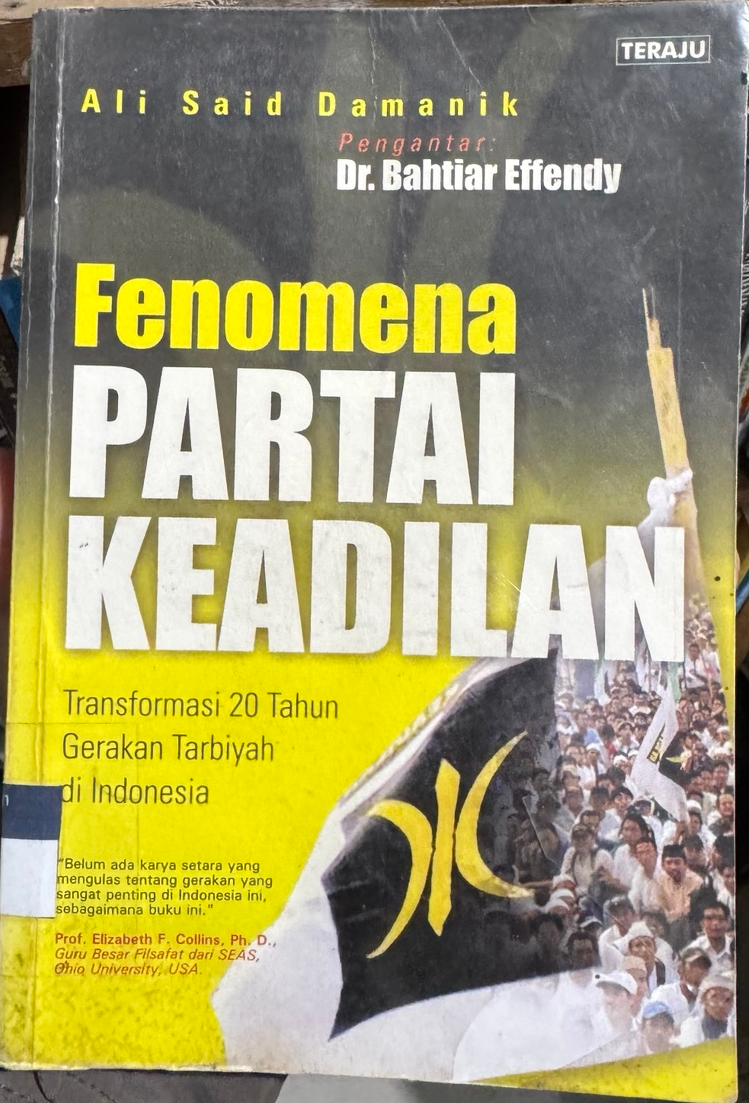
Fenomena Partai Keadilan: Transformasi 20 Tahun Gerakan Tarbiyah di Indonesia by Ali Said Damanik is one of the early Indonesian-language studies of the birth of the Partai Keadilan (Justice Party), a da'wah party born during the Reformasi era which later transformed into the Partai Keadilan Sejahtera (PKS, Prosperous Justice Party). The book carries a foreword by political scientist Bahtiar Effendy and was published by Teraju, a publishing imprint that in the early 2000s actively published books on Islamic thought and movements. The cover of this copy is dominated by greyish black at the top and bright yellow at the bottom. The author's name is printed in widely spaced yellow letters at the upper left, followed by a note on the introduction by Dr. Bahtiar Effendy in bold white letters. The word "Fenomena" is printed in yellow, while "Partai Keadilan" appears in very large white capitals. The dark grey subtitle sits on the yellow field. At the lower right is a photograph of a crowd at a rally or campaign, many of them dressed in white, with a black flag bearing the party emblem of two yellow crescent moons flanking an upright stalk of rice. The Teraju logo is printed in the upper right corner, and at the lower left is a quotation of praise from Elizabeth F. Collins of Ohio University, United States, who judges that there is as yet no comparable work on this movement.
Ali Said Damanik is known as the author of this book and, according to several reviews, wrote it on the basis of academic research on the tarbiyah movement and the party that emerged from it. Publicly available biographical information about the author is relatively limited, so his educational and institutional background should be checked directly against the biography at the back of the copy. The presence of Bahtiar Effendy as author of the introduction gives the book a distinctive academic weight. Bahtiar Effendy (1958–2019) was a professor of political science at UIN Syarif Hidayatullah Jakarta, a graduate of Ohio State University, and the author of a well-known study of the relationship between Islam and the state in Indonesia. His view of the transformation of Islamic politics from a legal-formal approach towards a substantive approach became one of the important frameworks for reading the emergence of Islamic parties after 1998, including the Partai Keadilan.
The subject of this book is the roughly two-decade journey of the tarbiyah movement, a da'wah network based on small-group formation that grew on Indonesian campuses from the late 1970s and early 1980s. This movement developed through halaqah or usrah (study circles), campus da'wah institutions, and university mosques, with intellectual references heavily influenced by the Ikhwanul Muslimin (Muslim Brotherhood) in Egypt. During the New Order, when the space for Islamic politics was restricted and Pancasila was imposed as the sole ideological basis (asas tunggal), the movement operated in a relatively closed pattern and emphasised the formation of individuals, families, and communities. The fall of the New Order in 1998 opened the opportunity for this network to emerge into the public sphere in the form of a political party. The Partai Keadilan was declared in 1998 and took part in the 1999 elections, obtaining a vote share that was relatively small nationally but fairly solid in a number of large cities and campus areas. This book reads that process as a transformation, namely a shift from a cultural da'wah movement into a formal political organisation that continued to claim a da'wah identity.
In its exposition, the book traces the origins of the movement, patterns of recruitment and cadre formation, the structure of mentoring, its core ideas about Islam and politics, and the internal debates when the movement decided to enter the party arena. The author also discusses how the party presented itself as a clean, disciplined, and morally oriented cadre party, different from the image of the old parties. Another interesting aspect is how the party bridged the ideal of applying Islamic values with the reality of a system of electoral democracy, including its stance on Pancasila, pluralism, and the issue of sharia. Chapter details and the structure of the argument should be checked against the copy's table of contents, because this description was compiled on the basis of the cover, catalogue data, and general knowledge about the book.
The publication context of this book is important. The book appeared when the Partai Keadilan was at a crossroads. Its vote share in the 1999 elections did not meet the electoral threshold, so its leaders founded a new party, the Partai Keadilan Sejahtera, which then became the vehicle for the continuation of the movement and achieved a significant increase in votes in the 2004 elections. This book thus records an often-forgotten early phase, before the PKS became one of the important Islamic political forces and before the various controversies of later periods. For researchers, records from this early phase are valuable for comparing the founding ideals with the party's later development.
Catalogue data that can serve as a comparison show that this book was published in Jakarta by Teraju in 2002, with a physical description of v and 389 pages and a height of 20.5 centimetres, as recorded in the catalogue of the Politeknik Tempo Library. The catalogue of the Universitas Muhammadiyah Surakarta Library records the Teraju publication with the year 2003, which may refer to a reprint. No ISBN number is listed in the catalogues examined. The printing, year, page count, and ISBN of the photographed copy still need to be checked against the copyright page.
For the study of Islam and politics in Indonesia, this book is relevant for understanding the wave of Islamisation of the educated middle class since the 1980s, which took place through campuses, mosques, and da'wah networks. The book can be read alongside other works on the PKS and the tarbiyah movement, for example Yon Machmudi's study of the Jemaah Tarbiyah and the Partai Keadilan Sejahtera, Burhanuddin Muhtadi's study of the PKS dilemma, and Mathias Diederich's writing on the da'wah and politics of the Partai Keadilan in the journal Archipel. From the perspective of the anthropology of religion, the tarbiyah movement is interesting as an example of the formation of a moral community through disciplined mentoring, small-group rituals, the regulation of lifestyle, and close-knit social networks. Patterns of this kind show how religion becomes a source of identity, solidarity, and political mobilisation among urban youth.
For readers in Aceh and Southeast Asia, this book also provides comparative material. The tarbiyah movement has networks on campuses in Aceh, and the party that emerged from it has taken part in local politics in Aceh, including after the 2005 peace, when the party landscape in the province changed with the presence of local parties. At the regional level, the influence of the Ikhwanul Muslimin is also evident in movements in Malaysia, for example through student networks and da'wah organisations, so this book is useful for comparative studies of Islamic politics in the Malay World.
As a critical note, it is natural for a study written when the party under discussion was still very young to have limits of analytical distance. Readers should pay attention to the extent to which the author uses internal movement sources, interviews with cadres, and party documents, and how those sources are tested against views from outside. Some assessments of the party's character as a clean and cadre-based party also need to be compared with developments after 2004, when the party faced the dynamics of power, coalitions, and cases that affected its image. However, limitations of this kind are precisely what make this book valuable as a document of its time, because it shows how the movement was understood and presented in its formative phase.
In terms of collection documentation, this copy shows signs of use in the form of creases and scratches on the cover, especially at the top and along the right edge. On the left side of the spine is a blue and white library label. This description is a curatorial introduction based on the cover and catalogue information, not a summary of the entire contents of the book.
Suitable search subjects include the Partai Keadilan, the Partai Keadilan Sejahtera, the tarbiyah movement, the Ikhwanul Muslimin in Indonesia, campus da'wah, Islamic political parties, post-Reformasi Islamic politics, and the 1999 elections. For citation purposes, references should name the author, the full title, the publisher, the year, and the pages read directly in the copy.
Ali Said Damanik, Bahtiar Effendy (pengantar), “Fenomena Partai Keadilan: Transformasi 20 Tahun Gerakan Tarbiyah di Indonesia [The Justice Party Phenomenon: The 20-Year Transformation of the Tarbiyah Movement in Indonesia]”, Teraju, Jakarta, Tahun, cetakan, jumlah halaman, dan ISBN eksemplar belum diperiksa. Rujukan pembanding: Jakarta: Teraju, 2002, v + 389 hlm., 20,5 cm; sebagian katalog mencatat tahun 2003; ISBN tidak tercantum pada katalog yang diperiksa (belum diverifikasi pada halaman hak cipta eksemplar). KBA13 Academy Archive and Library, KBA-BKU-TT-0021.