Garba Budaya · Tahun, cetakan, jumlah halaman, dan ISBN eksemplar belum diperiksa. Rujukan pembanding: Garba Budaya bersama Friends of Aceh, 2003; katalog National Library of Australia mencatat anak judul "atawa mati ketawa cara Aceh"; jumlah halaman dan ISBN belum ditemukan (belum diverifikasi pada halaman hak cipta eksemplar) · Tanpa tahun
Abstract
A collection of humour and anecdotes about the Aceh conflict, edited by Tri Agus S. Siswowiharjo and published by Garba Budaya, according to an academic reference together with Friends of Aceh in 2003. The title puns on the abbreviation of Gerakan Aceh Merdeka (Free Aceh Movement), turning it into Geerr, an imitation of the sound of laughter, while the subtitle recorded in some catalogues echoes the political humour book Mati Ketawa Cara Rusia (Dying of Laughter, Russian Style). Published at the time of the collapse of the Cessation of Hostilities Agreement and the imposition of martial law in Aceh, the book can be read as a record of how residents processed their experience of raids, suspicion, and being caught between armed parties through jokes. The work is relevant to the study of humour as everyday resistance, Acehnese folklore and verbal arts, the pragmatics of wartime humour, and post-conflict collective memory, with the caveat that humour about conflict is sensitive and is best read together with the testimonies of victims and studies of the Aceh conflict from various perspectives.
- Identifier
-
KBA-BKU-TT-0022
- Type
-
Buku
- Publisher
-
Garba Budaya
- Date Issued
-
Tanpa tahun
- Bibliographic Citation
-
Tahun, cetakan, jumlah halaman, dan ISBN eksemplar belum diperiksa. Rujukan pembanding: Garba Budaya bersama Friends of Aceh, 2003; katalog National Library of Australia mencatat anak judul "atawa mati ketawa cara Aceh"; jumlah halaman dan ISBN belum ditemukan (belum diverifikasi pada halaman hak cipta eksemplar)
- LC Classification
-
DS646.15.A2 — Sejarah Aceh
- LCSH Subject
-
Indonesian wit and humor
Aceh (Indonesia) -- Politics and government -- Humor
Gerakan Aceh Merdeka -- Humor
- BISAC Category
-
HUM006000 HUMOR / Topic / Politics
- Language
-
Indonesia
- Description
-
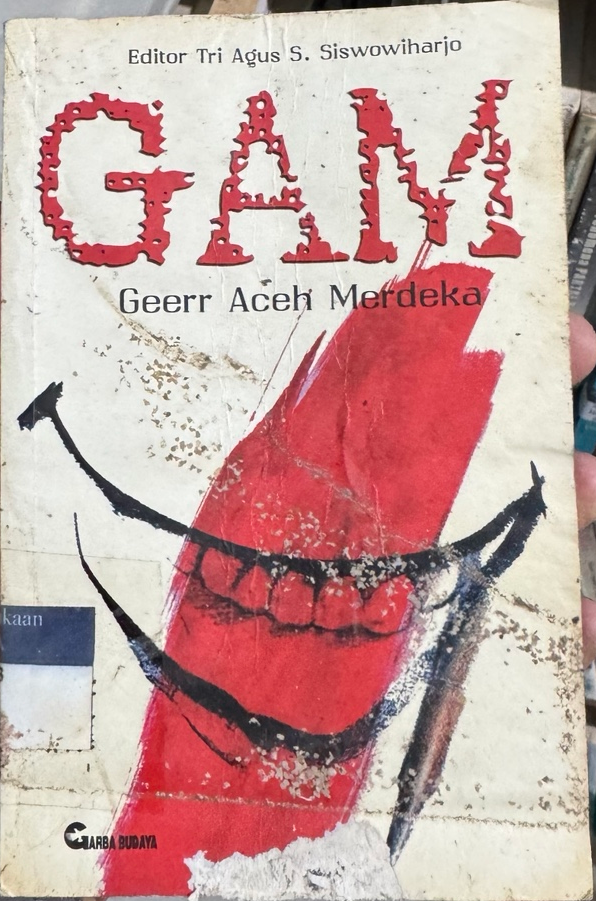
GAM: Geerr Aceh Merdeka is a collection of humour and anecdotes about the Aceh conflict, edited by Tri Agus S. Siswowiharjo and published by Garba Budaya. The catalogue of the National Library of Australia records this title with the added subtitle atawa mati ketawa cara Aceh (or, dying of laughter, Aceh style), a phrase that deliberately echoes the political humour book Mati Ketawa Cara Rusia (Dying of Laughter, Russian Style), which was very popular in Indonesia in the 1980s. A scholarly article on humour interaction during wartime in Aceh, published in the SiELE journal of Universitas Syiah Kuala, cites this book as a 2003 publication of Garba Budaya together with Friends of Aceh, with a subtitle recorded somewhat differently. The differences in the subtitle across these sources show the need for a direct examination of the title page of the copy. The cover of this copy has a dull white background with a speckled texture like peeling paint. The editor's name is printed small at the top. The letters GAM appear large in red with irregularly perforated edges, as if eroded or pierced by bullets, and below them Geerr Aceh Merdeka is written in black letters. The middle and lower part of the cover is dominated by a broad slanting red brushstroke, overlaid with a black drawing of a wide grinning mouth with a row of teeth, resembling a broad caricatured smile. The Garba Budaya logo is printed at the lower left.
The title of the book plays on the abbreviation GAM, which in everyday conversation refers to the Gerakan Aceh Merdeka (Free Aceh Movement), the armed resistance organization founded by Hasan Tiro in 1976. By replacing the word Gerakan (Movement) with Geerr, an imitation of the sound of roaring laughter in Indonesian slang, the editor turns an abbreviation that was highly sensitive at the time into a gateway to the world of humour. This wordplay is itself already a statement, because in the early 2000s mentioning the name GAM could arouse suspicion, while laughing about the conflict was a way of distancing oneself from everyday tension.
Tri Agus S. Siswowiharjo is known as an activist, writer, and columnist whose writing has appeared in various media, including humour and satire columns in online media. He is also recorded as a lecturer at the Sekolah Tinggi Pembangunan Masyarakat Desa APMD (APMD College of Village Community Development) in Yogyakarta. Garba Budaya, the publisher of this book, is known for publishing works on human rights, democratization, and conflict, including on Timor-Leste. The involvement of Friends of Aceh, as mentioned in the journal reference, indicates that the book emerged from a network of civil-society solidarity concerned with Aceh during the conflict. The institutional details of the editor and the publishing partners should be checked on the title page and in the foreword of the copy.
The contents of the book, in keeping with its subtitle, consist of humour, jokes, and anecdotes that circulated among or were collected from the experiences of the people of Aceh during the conflict. Humour in conflict situations usually targets things that cannot be discussed openly: raids on the highway, identity card checks, the suspicion of security forces towards residents, the confusion of residents caught between armed parties, aid bureaucracy, and the cleverness of the Acehnese in outwitting others through language and accent. These jokes can mock anyone, whether state security forces, combatants, civilian officials, or the residents themselves. The forms and targets of the humour in this book, including the origin of each anecdote and whether some were contributed by particular contributors, need to be read directly in the copy, because this note was not compiled on the basis of a reading of the full text.
The historical context of the book is very important. In 2003, Aceh was in the most critical period of its long conflict. After the end of its status as a Military Operations Area (Daerah Operasi Militer) in 1998, hopes for a peaceful settlement had grown through the Humanitarian Pause in 2000 and the Cessation of Hostilities Agreement signed in Geneva in December 2002. The agreement collapsed in May 2003, when the government imposed martial law in Aceh and launched a major military operation. In a situation of restricted information and fear, humour was one of the spaces of expression that still remained. The book thus records a side of life in conflict that is rarely documented in political and military reports, namely the way residents survived inwardly through laughter.
For anthropology and folklore studies, the book is relevant to the theme of humour as a form of everyday resistance, as discussed in James C. Scott's work on the weapons of the weak and hidden transcripts. Jokes allow criticism to be expressed in veiled form, reduce tension, build solidarity, and affirm dignity in the face of power. The Acehnese tradition of humour itself has cultural roots, for example in verbal arts and performances such as PM Toh, peugah haba (storytelling), and comic tales circulating in coffee shops. This book can be compared with other collections of political humour in Indonesia, such as Mati Ketawa Cara Rusia, published by Grafiti Pers with an introduction by Abdurrahman Wahid, which shows how humour is used to talk about authoritarian power. Pragmatic linguistic research on wartime humour in Aceh, such as the article in the SiELE journal that cites this book, shows that collections of this kind have become a source of academic data.
For Aceh studies, the book is useful as a complement to the literature on the conflict, which is generally dominated by political, security, and human-rights analyses. The collective memory of the people of Aceh about the conflict contains not only violence and trauma but also survival strategies, ingenuity, and dark humour. Within the framework of post-conflict memory studies, documents of this kind help in understanding how society processes bitter experiences and how these narratives changed after the Helsinki peace of 2005. For students and researchers in Aceh, the book can also serve as material for tracing how Acehnese, Indonesian, and military terms were mixed in everyday conversation during the conflict, while also showing the skill of the community in punning official terms into objects of laughter that carry criticism. Thus, this small book can be placed on the same shelf as the social documentation of the conflict, not merely as light reading.
As a critical note, humour about conflict always lies in sensitive territory. Jokes can refresh, but they also have the potential to diminish the suffering of victims, reinforce stereotypes about the Acehnese, or take the side of one of the warring parties. Readers need to pay attention to who is telling the story, to whom the humour is addressed, and in what situation it circulated. Readers also need to be aware that a book edited outside Aceh by a solidarity network has a particular point of view, so it should be read alongside the testimonies of residents, reports of human-rights organizations, and academic studies of the Aceh conflict from various perspectives, including the perspective of the state and that of former combatants.
In terms of collection documentation, this copy shows fairly heavy wear. The surface of the cover appears dull with stains and speckles, part of the cover layer at the bottom has peeled off, and the edges are worn. On the spine on the left side there is a blue and white library label with remnants of truncated writing. This note is a curatorial introduction based on the cover and catalogue information, not a summary of the entire content of the book.
Suitable search subjects include political humour, anecdotes of the Aceh conflict, the Gerakan Aceh Merdeka, martial law in Aceh 2003, humour as resistance, Acehnese folklore, and the collective memory of conflict. For citation purposes, references should give the editor's name, the full title together with the subtitle as printed on the title page, the publisher, the year, and the pages read directly in the copy.
- Rights
-
Koleksi pribadi KBA13 Academy
- Contributor
-
Tri Agus S. Siswowiharjo (penyunting)