Madani Press, Jakarta · Tahun, cetakan, jumlah halaman, dan ISBN eksemplar belum diperiksa. Rujukan pembanding: Jakarta: Madani Press, 1999, edisi 1, xii + 329 hlm., ilus., 24 cm, tanpa ISBN tercatat; sebagian katalog mencatat tahun 2000 (belum diverifikasi pada halaman hak cipta eksemplar) · Tanpa tahun
- Identifier
-
KBA-BKU-TT-0023
- Type
-
Buku
- Publisher
-
Madani Press, Jakarta
- Date Issued
-
Tanpa tahun
- Bibliographic Citation
-
Tahun, cetakan, jumlah halaman, dan ISBN eksemplar belum diperiksa. Rujukan pembanding: Jakarta: Madani Press, 1999, edisi 1, xii + 329 hlm., ilus., 24 cm, tanpa ISBN tercatat; sebagian katalog mencatat tahun 2000 (belum diverifikasi pada halaman hak cipta eksemplar)
- Creator
-
Al Chaidar
- LC Classification
-
DS646.15.A2 — Sejarah Aceh
- LCSH Subject
-
Gerakan Aceh Merdeka
Aceh (Indonesia) -- History -- Autonomy and independence movements
Islam and politics -- Indonesia -- Aceh
Darul Islam (Indonesia)
- BISAC Category
-
HIS048000 HISTORY / Asia / Southeast Asia
- Language
-
Indonesia
- Description
-
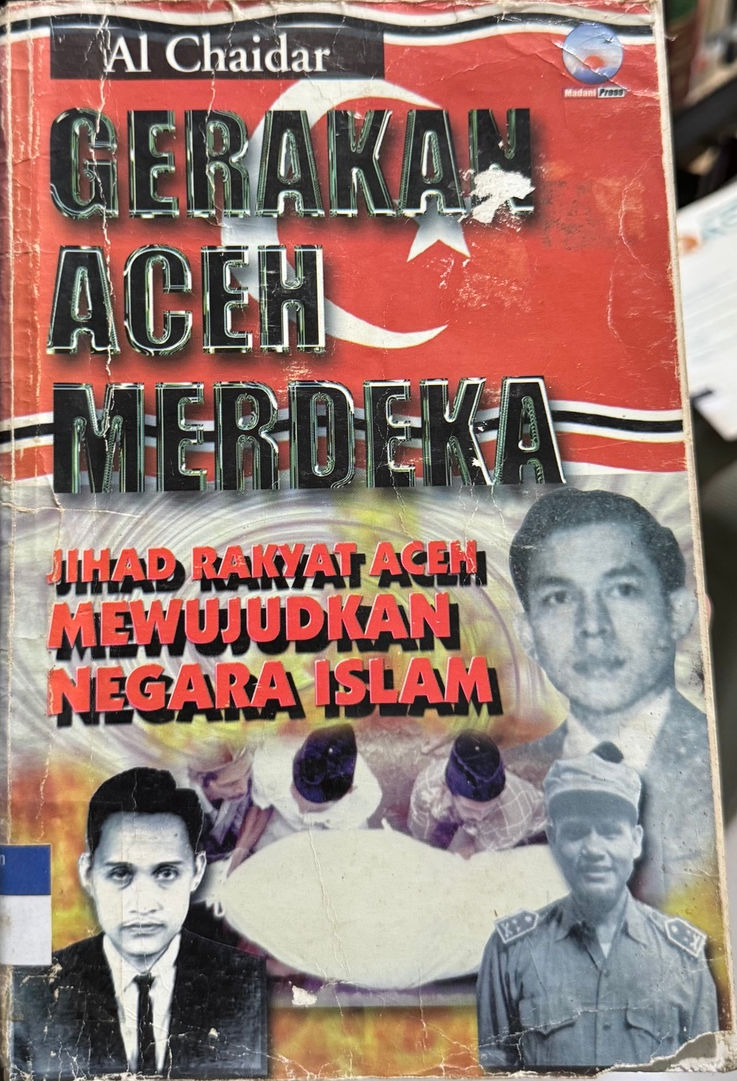
Gerakan Aceh Merdeka: Jihad Rakyat Aceh Mewujudkan Negara Islam by Al Chaidar is one of the Indonesian-language books on the Acehnese resistance published in the early Reformasi period, when open discussion of Aceh had only just become possible after the lifting of the status of Military Operations Area (Daerah Operasi Militer) in 1998. The book was published by Madani Press in Jakarta. The cover of this copy is designed in a striking style. The upper part shows a red background with a white crescent and star and black and white stripes, resembling the Crescent and Star (Bulan Bintang) flag used by the Free Aceh Movement. The name Al Chaidar is printed in white in a black box at the upper left, while the Madani Press logo in the form of a small globe is at the upper right. The title Gerakan Aceh Merdeka is printed in large capital letters in a black metallic style with silvery edges. The subtitle is printed in bold red letters with a black shadow. The lower part of the cover contains a collage of several black-and-white photographs: a man in a suit at the upper right, a man in a suit and tie at the lower left, an older man in uniform with a cap and rank insignia at the lower right, and in the middle a blurred photograph of several men wearing peci (caps) near a white surface. According to the collection manager's notes, the photographs of figures on the cover include Teungku Muhammad Daud Beureueh and Hasan Tiro. However, the front cover carries no captions, so matching faces with names of figures needs to be confirmed through the back cover, the picture caption page, or the contents of the book, and is not set out here without adequate grounds.
Al Chaidar, born in 1969 according to library catalogues, is known as a writer and observer of political Islamic movements, Darul Islam, and terrorism in Indonesia. He studied at Universitas Indonesia and later taught at Universitas Malikussaleh, Lhokseumawe. In the late 1990s he published a number of books on Darul Islam and the political thought of S.M. Kartosoewirjo, and co-authored a book on violence in Aceh during the period of military operations. His closeness to the study of Darul Islam influenced the way he read the history of Acehnese resistance, as is clearly apparent in the subtitle of this book. In subsequent years he often appeared in the media as a commentator on radicalism and terror networks, so his position as a writer close to the object of his study needs to be borne in mind by readers.
The main argument of the book, as formulated in its subtitle, is that the struggle of the Acehnese people can be understood as a jihad to establish an Islamic state. Within this framework, the author connects the various phases of Acehnese resistance, from the war against the Dutch, Aceh's involvement in the independence revolution, the Darul Islam rebellion under Daud Beureueh in 1953, which joined Kartosoewirjo's Negara Islam Indonesia (Islamic State of Indonesia), up to the birth of the Free Aceh Movement proclaimed by Hasan Tiro in 1976. The author tends to place the Islamic element as the common thread uniting these phases. The arrangement of chapters, the sources used, and the documents appended need to be examined directly in the copy, because this description has been compiled on the basis of the cover, catalogue data, and general knowledge about the book.
The context of the book's publication is very important to understand. In 1998 and 1999, after the fall of Soeharto, various reports of human rights violations during the period of the Military Operations Area began to come to light, demands for a referendum grew stronger, and the Free Aceh Movement once again expanded its influence. The Indonesian book market at that time was flooded with publications about Aceh, from journalistic reports and victims' testimonies to political analyses. Al Chaidar's book belongs to this wave and offers a reading that emphasises the religious dimension of the conflict. Its publication coincided with the period when the central government began to formulate special autonomy and the implementation of Islamic sharia in Aceh as one of its political responses, so the debate about the place of Islam in the demands of the Acehnese people became a heated issue.
Catalogue data that can be used for comparison indicate that the book was published in Jakarta by Madani Press in 1999 as a first edition, of xii and 329 pages with illustrations, 24 centimetres in size, as recorded in the catalogue of the Universitas Terbuka Library, without an ISBN. The catalogue of the Universiti Malaysia Terengganu Library records a Madani Press publication with the year 2000 and call number DS646.15.A8 A4 2000, with the subjects history of Aceh and autonomy and independence movements. This difference in year may indicate a reprint. The printing, year, number of pages, and ISBN data of the photographed copy still need to be checked against the copyright page.
For Aceh studies and Islamic studies in Southeast Asia, this book is relevant as a document of the way some Indonesian Islamist circles read the Aceh conflict in the late 1990s. It can be compared with later academic studies, for example Edward Aspinall's Islam and Nation: Separatist Rebellion in Aceh, Indonesia, which argues that the ideology of the Free Aceh Movement was essentially ethno-nationalist and different from the Islamic state project of Darul Islam, although Islam remained an important part of Acehnese identity. Nazaruddin Sjamsuddin's study of the Daud Beureueh rebellion, Tim Kell's works on the roots of the Aceh conflict, and Kirsten Schulze's writings on GAM also provide necessary points of comparison. From the standpoint of political anthropology, this debate shows that Acehnese identity is composed of layers of history, religion, and ethnicity that are interpreted differently by interested parties.
As a critical note, the framework of jihad to establish an Islamic state is the author's interpretation and is not entirely in line with the official formulations of the Free Aceh Movement itself. In his documents, Hasan Tiro placed greater emphasis on Aceh's historical claim to sovereignty, Acehnese-Sumatran nationalism, and the rejection of what he called Javanese colonialism, rather than the establishment of an Islamic state in the Darul Islam sense. A connection between Hasan Tiro and the Darul Islam movement in the 1950s did exist, but the ideological continuity between the two remains debated. Readers also need to be aware that this book was written in the midst of an ongoing conflict, so its use of sources, accuracy of data, and tendencies of judgement need to be tested against other sources, including archives, testimonies from various parties, and studies written after the Helsinki peace of 2005. Read critically, the book remains valuable as a source on the ideological debates surrounding Aceh and as part of the history of the historiography of the conflict itself.
For university teaching, particularly in courses on the history of Islam in the Malay World, political anthropology, and conflict studies, this book can be used as an example of a secondary source with a clear ideological position. Students can be invited to compare the way this book strings events together with the way academic studies weigh evidence, so that they are trained to distinguish between narratives of struggle, ideological interpretation, and balanced historical analysis.
In terms of collection documentation, this copy shows heavy wear. The cover is full of folds, cracks, and scratches, part of the surface layer has peeled off around the title, and the edges are torn and rounded. On the left side of the spine there is a blue and white library label. This description is a curatorial introduction based on the cover and catalogue information, not a summary of the entire contents of the book.
Suitable search subjects include the Free Aceh Movement (Gerakan Aceh Merdeka), the Aceh conflict, Darul Islam in Aceh, Daud Beureueh, Hasan Tiro, Islam and nationalism, jihad and Islamic politics, and the history of Aceh in the twentieth century. For citation purposes, references should state the author's name, the full title, the publisher, the year, and the pages read directly in the copy.
- Rights
-
Koleksi pribadi KBA13 Academy
How to cite
Al Chaidar, “Gerakan Aceh Merdeka: Jihad Rakyat Aceh Mewujudkan Negara Islam [The Free Aceh Movement: The Jihad of the Acehnese People to Establish an Islamic State]”, Madani Press, Jakarta, Tahun, cetakan, jumlah halaman, dan ISBN eksemplar belum diperiksa. Rujukan pembanding: Jakarta: Madani Press, 1999, edisi 1, xii + 329 hlm., ilus., 24 cm, tanpa ISBN tercatat; sebagian katalog mencatat tahun 2000 (belum diverifikasi pada halaman hak cipta eksemplar). KBA13 Academy Archive and Library, KBA-BKU-TT-0023.