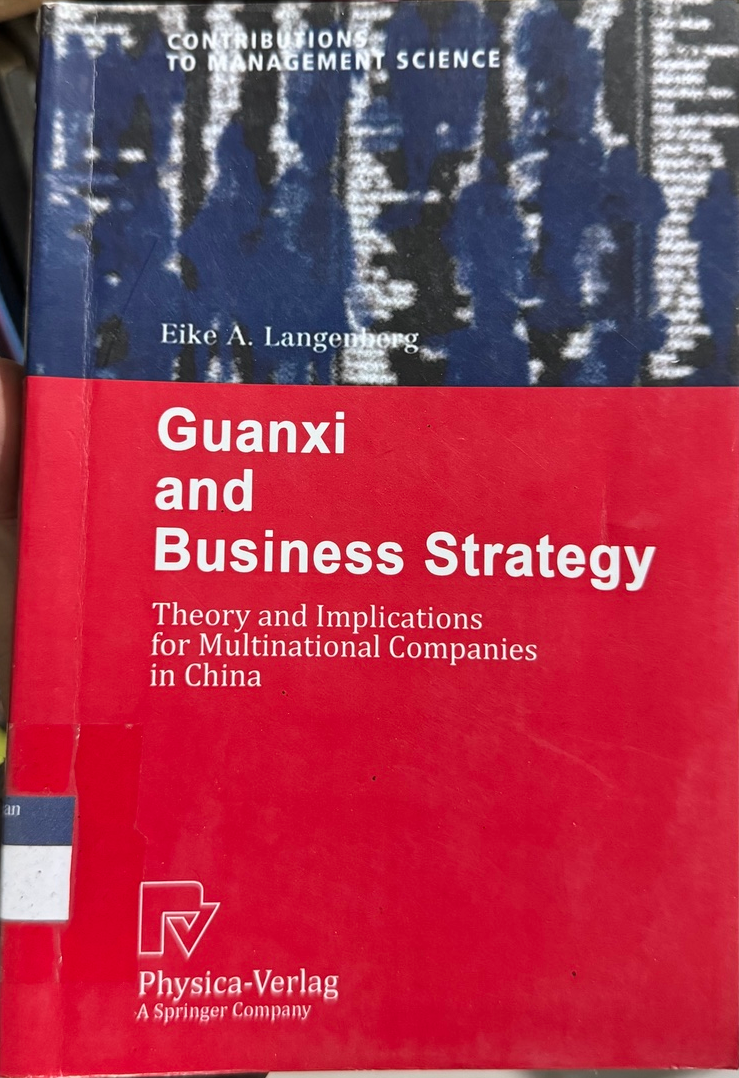
Physica-Verlag, Heidelberg · Tahun, cetakan, jumlah halaman, dan ISBN eksemplar belum diperiksa. Rujukan pembanding: Heidelberg: Physica-Verlag, 2007, xix + 226 hlm., ISBN 978-3-7908-1955-7 (seri Contributions to Management Science) (belum diverifikasi pada halaman hak cipta eksemplar) · Tanpa tahun
Abstract
This monograph in the Contributions to Management Science series discusses guanxi, the network of personal relationships in Chinese society, and its implications for the strategy of multinational companies. Eike A. Langenberg, a practitioner affiliated with Siemens Ltd. China, rejects explanations that link guanxi solely to the legacy of Confucianism. Using the tools of the new economic sociology, he explains the persistence of guanxi as a response to institutional conditions, such as weak legal certainty and the large role of the bureaucracy. The book sets out the guanxi system, formulates relationship-based business strategies with suppliers, customers, competitors, and government officials, and then weighs these strategies from legal and ethical standpoints, since their risks border on corruption. The concluding section also reminds readers of the boundary between good relationships and corrupt practices. The work is relevant to economic anthropology, social capital, Chinese business networks in Southeast Asia, and the reading of Chinese investment in Indonesia.
- Identifier
-
KBA-BKU-TT-0024
- Type
-
Buku
- Publisher
-
Physica-Verlag, Heidelberg
- Date Issued
-
Tanpa tahun
- Bibliographic Citation
-
Tahun, cetakan, jumlah halaman, dan ISBN eksemplar belum diperiksa. Rujukan pembanding: Heidelberg: Physica-Verlag, 2007, xix + 226 hlm., ISBN 978-3-7908-1955-7 (seri Contributions to Management Science) (belum diverifikasi pada halaman hak cipta eksemplar)
- Creator
-
Eike A. Langenberg
- LC Classification
-
HD — Ekonomi industri, pertanian, dan tenaga kerja
- LCSH Subject
-
Business networks -- China
International business enterprises -- China -- Management
Strategic planning -- China
Interpersonal relations -- China
- BISAC Category
-
BUS063000 BUSINESS & ECONOMICS / Strategic Planning
- Language
-
Inggris
- Description
-
Guanxi and Business Strategy: Theory and Implications for Multinational Companies in China by Eike A. Langenberg is an English-language monograph on the role of networks of personal relationships, called guanxi in Chinese, in the business strategy of multinational companies in China. The cover of this copy is divided into two contrasting colour fields. The upper third is an abstract image in dark blue, black, and white tones resembling rows of characters or code arranged in vertical columns, with the series name CONTRIBUTIONS TO MANAGEMENT SCIENCE in the upper left corner and the author's name at the bottom of that blue field. The lower two thirds are bright red, carrying the main title in bold white letters and the subtitle in black serif letters. The Physica-Verlag logo in the form of a stylized letter P, together with the words A Springer Company, is printed at the lower left. A design of this kind is characteristic of the Physica-Verlag monograph series in the 2000s.
Eike A. Langenberg is a business practitioner who, according to the publisher's page, was affiliated with Siemens Ltd. China at the time the book was published. This background is important, because the book was written by someone who combines an academic theoretical framework with direct experience in the environment of multinational corporations in China. The Contributions to Management Science series itself contains many doctoral research results from German and European universities, so it is quite likely that this book also derives from a dissertation, although this still needs to be confirmed in the preface or the opening pages of the copy.
The main argument of this book starts from the question of why guanxi has persisted, and even become more important, amid China's transition to a market economy. The usual explanation links guanxi to the legacy of Confucianism, namely cultural values concerning family, loyalty, and reciprocal relationships. Langenberg is not satisfied with such a cultural explanation. He uses the analytical tools of the new economic sociology, a school that emphasizes that economic action is always embedded in social networks, to explain guanxi as a rational response to particular institutional conditions, for example weak legal certainty, the large role of the bureaucracy in the allocation of resources, and high uncertainty in transactions. In this way guanxi is understood not as a remnant of traditional culture, but as a social mechanism continually reproduced by contemporary economic and political structures.
On the basis of this framework, the book offers an analysis of how companies can make use of guanxi relationships with suppliers, customers, competitors, and government officials to achieve sustainable competitive advantage. According to the publisher's table of contents, the book consists of an introduction, a long exposition of the guanxi system, a discussion of guanxi-based business strategies, and then a discussion section. The section on the guanxi system is the longest, showing that the author pays great attention to conceptual foundations before turning to practical implications. In the discussion section, the author weighs these strategies from legal and ethical standpoints, because guanxi practices can border on bribery, conflicts of interest, and violations of anti-corruption rules, including the rules of the home countries of multinational companies.
The context of the book's publication also deserves attention. In the mid-2000s, after China joined the World Trade Organization in 2001, foreign investment flows into the country rose sharply. Many European and American companies needed an understanding of China's business environment, which differed from their home markets. The literature on guanxi grew rapidly in the fields of international management, marketing, and sociology, with important references such as Mayfair Mei-hui Yang's work on the gift economy and personal relationships, and the studies of Thomas Gold, Doug Guthrie, and David Wank on whether guanxi would fade with institutional modernization. Langenberg's book can be read as an effort to bridge that academic debate with the practical needs of managers.
For studies in Indonesia and Southeast Asia, the book has a wider relevance than its title suggests. The concept of personal relationship networks in business applies not only in China, but also in the overseas Chinese communities of Indonesia, Malaysia, Singapore, and Thailand, which have long been studied by historians and anthropologists. Moreover, similar practices are known in Indonesia by terms such as koneksi (connections), orang dalam (insiders), or relasi (relations), which are often related to access to business permits, government projects, and political protection. In economic anthropology, the book can be used as material for discussion on the embeddedness of the economy in social relations, the gift economy, trust, and social capital, as well as for comparison with concepts such as patron-client relations that are widely used to read Southeast Asian societies.
For readers in Aceh, its relevance can be found in the growing involvement of Chinese investment in Indonesia, including through infrastructure and industrial projects within the framework of the Belt and Road Initiative. Understanding the logic of networks in Chinese business helps policymakers, academics, and local entrepreneurs assess the opportunities and risks of economic cooperation. From the standpoint of Islamic studies and business ethics, the book's discussion of the boundary between good relationships and corrupt practices can also be compared with the principles of muamalah concerning honesty, the prohibition of risywah (bribery), and justice in transactions.
As a critical note, an approach that positions guanxi as a source of competitive advantage risks normalizing practices that in certain contexts come close to nepotism and corruption, even though the author consciously includes legal and ethical considerations. Moreover, because it was written in 2007, the book does not yet reflect the major changes that followed, especially the massive anti-corruption campaign in China since 2012, which changed the way officials and businesspeople interact, and the digitalization of the economy, which shifted some functions of personal networks to online platforms. Readers should also bear in mind that the book's perspective is mainly that of foreign multinational companies, so the experiences of small Chinese entrepreneurs and workers are not its main focus.
Nevertheless, the book remains useful as an example of the application of economic sociology theory to problems of strategic management. For postgraduate students, it shows how a cultural phenomenon can be analysed structurally without neglecting its normative dimension. For lecturers in economic and industrial anthropology, several parts of the book can serve as readings for discussing the relationship between formal institutions, informal networks, and corporate strategy.
Comparative publication data from library catalogues, including the catalogue of Joyner Library at East Carolina University and the Springer page, state that the book was published in Heidelberg by Physica-Verlag in 2007 in the Contributions to Management Science series, at xix plus 226 pages with illustrations, 24 centimetres in size. The ISBN of its paperback edition is recorded as 978-3-7908-1955-7, while its electronic version uses ISBN 978-3-7908-1956-4. The Library of Congress call number recorded in that catalogue is HD6957.C6 L36 2007. The year, printing, and ISBN of the photographed copy still need to be checked against the copyright page.
The physical condition of the copy shows a paperback that has been used, with a slightly curved spine, edges beginning to wear, and some small spots and scratches on the red field. At the lower left is a blue-and-white library label with remnants of partly truncated writing, indicating that this book was once part of an institutional library collection. This note is a curatorial introduction based on the cover and catalogue information, not a summary of the entire contents of the book.
Appropriate search subjects include guanxi, Chinese business networks, multinational corporate strategy, international management, economic sociology, social capital, business ethics, and foreign investment in China. For citation purposes, references should state the author's name, the full title with subtitle, the series, the publisher, the year, and the pages read directly in the copy.
- Rights
-
Koleksi pribadi KBA13 Academy