Cambridge University Press, Cambridge · Tahun, cetakan, jumlah halaman, dan ISBN eksemplar belum diperiksa. Rujukan pembanding: Cambridge: Cambridge University Press, 1995, vi + 328 hlm., ISBN 0-521-46565-6 (sampul keras) (belum diverifikasi pada halaman hak cipta eksemplar) · Tanpa tahun
- Identifier
-
KBA-BKU-TT-0025
- Type
-
Buku
- Publisher
-
Cambridge University Press, Cambridge
- Date Issued
-
Tanpa tahun
- Bibliographic Citation
-
Tahun, cetakan, jumlah halaman, dan ISBN eksemplar belum diperiksa. Rujukan pembanding: Cambridge: Cambridge University Press, 1995, vi + 328 hlm., ISBN 0-521-46565-6 (sampul keras) (belum diverifikasi pada halaman hak cipta eksemplar)
- Creator
-
Anthony Milner
- LC Classification
-
DS591–599 — Sejarah Malaysia dan Semenanjung Melayu
- LCSH Subject
-
Nationalism -- Malaysia -- Malaya -- History
Malaya -- Politics and government
Malays (Asian people) -- Politics and government
Islam and politics -- Malaysia -- Malaya
- BISAC Category
-
HIS048000 HISTORY / Asia / Southeast Asia
- Language
-
Inggris
- Description
-
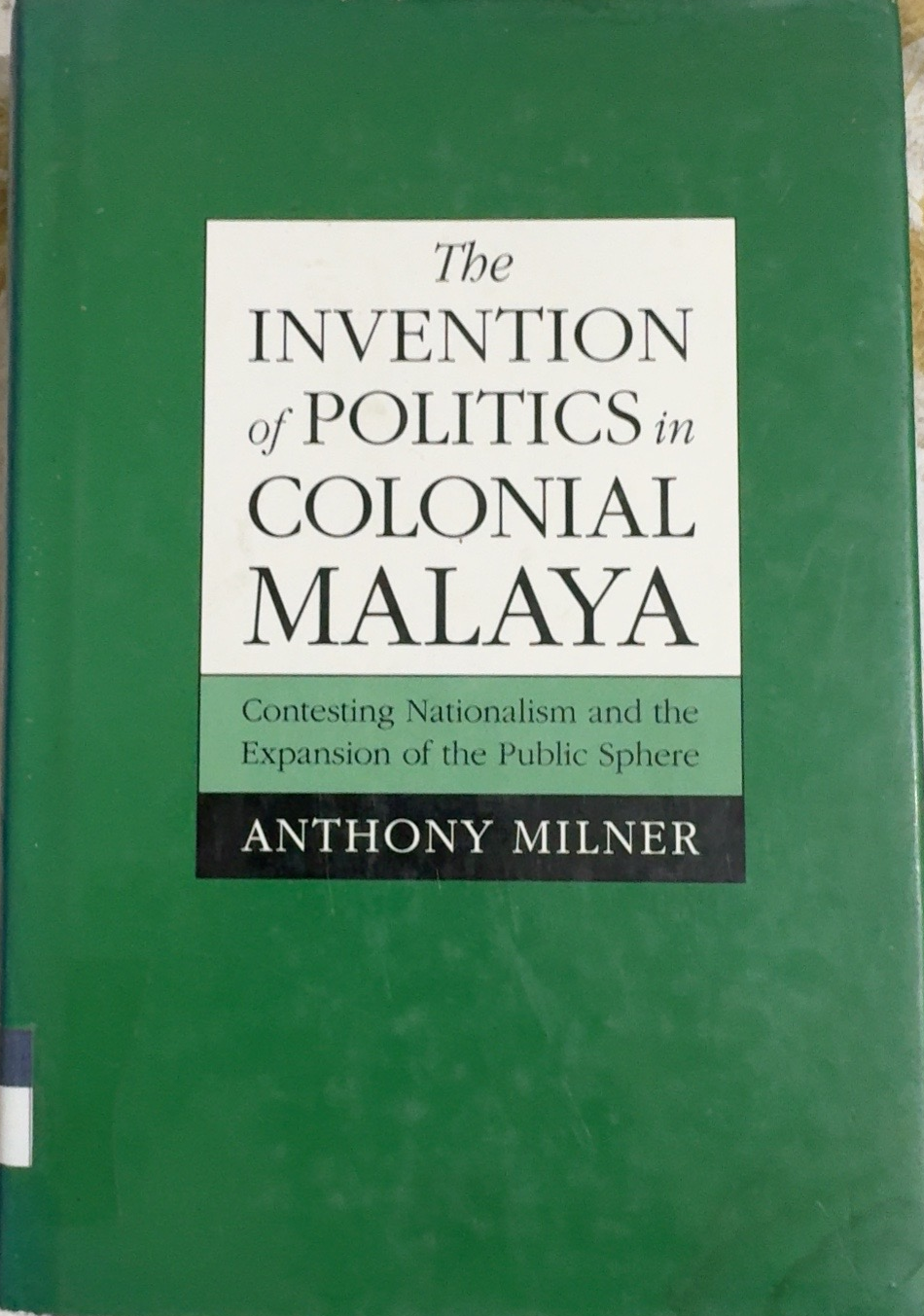
The Invention of Politics in Colonial Malaya: Contesting Nationalism and the Expansion of the Public Sphere by the Australian historian Anthony Milner is one of the most influential studies of the emergence of Malay political discourse during the British colonial period. The copy in this collection is a hardcover edition still fitted with a dark green dust jacket. In the middle of the jacket is a white box containing the title in elegant black serif type, with the words "The", "of", and "in" printed in smaller italics so that the words INVENTION, POLITICS, COLONIAL, and MALAYA stand out. Below the white box is a light green band carrying the subtitle about contested nationalism and the expansion of the public sphere, followed by a black band bearing the name ANTHONY MILNER in white capital letters. The simple cover design, without illustration, reflects the publishing style of Cambridge University Press academic monographs in the mid-1990s, when scholarly books relied more on typography than on images.
Anthony Crothers Milner, born in 1945, is a historian of Southeast Asia who worked for many years at the Australian National University in Canberra, where among other positions he held a professorship in Asian history. He is widely known for his book Kerajaan: Malay Political Culture on the Eve of Colonial Rule (1982), which examines how precolonial Malays understood power, sovereignty, and the relationship between ruler and subjects through hikayat texts. Later he also wrote The Malays (2008) in the series The Peoples of South-East Asia and the Pacific, a synthesis of the history and formation of Malay identity. Milner is among the scholars closest to the Malaysian academic world, often involved in Australian foreign policy forums on Asia, and known as an advocate of a historical approach that gives primary place to sources in local languages.
The main argument of the book can be summarised as an effort to shift the way historians read the formative period of Malay nationalism. For several decades, Malaysian historiography tended to read the late nineteenth century and the first half of the twentieth century as a straight road to national awakening, as if all the figures and ideas of that period culminated in independence in 1957. Milner rejects that teleological framework. In his view, the colonial period was instead marked by competition among several visions of political community: the vision of the kerajaan centred on the ruler, the vision of the umat rooted in Islam, and the vision of the bangsa resting on the idea of the Malays as a single community. These three visions challenged one another, borrowed one another's vocabulary, and at times adjusted to one another. Hence the phrase "invention of politics" in the title refers to the birth of a new domain, namely politics as an arena of open debate about how society ought to be governed, something not known in that form in the old order of the kerajaan.
To support this argument, Milner closely reads nineteenth- and twentieth-century Malay texts, including the work of Abdullah bin Abdul Kadir Munsyi, who criticised the old kerajaan order; reformist Islamic periodicals such as Al-Imam; early twentieth-century Malay newspapers; court chronicles rewritten to present a self-renewing sultanate; and the writings of young nationalists on the eve of the Second World War. The book's table of contents shows this trajectory: from the depiction and denunciation of the Malay ancien régime, the formation of a liberal critique, the expansion of vocabulary to describe the real world, the conceptualisation of the bangsa community through moderate newspapers, the building of a bourgeois public sphere, the Islamic challenge to the kerajaan, the kerajaan's efforts to renew itself, and political practice in the mid-colonial period, to a chapter on awareness (sedar) and the survey of the homeland that closes the sequence of analysis. The conclusion discusses the Malay political legacy shaped by this long contest.
The concept of the public sphere in the subtitle clearly owes a debt to Jürgen Habermas's thinking about the emergence of the bourgeois public sphere in Europe. Milner does not simply transfer the concept to the Malay Peninsula, but shows how Malay-language newspapers, associations, schools, and publishing created forums for discussion that allowed ordinary people to talk about common affairs outside the circle of the court. It was within these forums that ideas about the Malay bangsa, progress, and religious reform were contested. This approach also intersects with Benedict Anderson's idea of imagined communities and the role of print capitalism, but Milner places greater emphasis on ideological tensions within Malay society itself, not only on the relationship between coloniser and colonised.
The intellectual context of the book is also important. Its title recalls the long debate triggered by John Smail's essay on the possibility of an autonomous history of Southeast Asia, that is, history written from the standpoint of the internal dynamics of local societies, not merely as an appendix to colonial history. Milner places himself within that tradition by treating Malay texts as serious sources of political thought. At the same time, the book's publication in 1995 coincided with a period when Malaysia under Mahathir Mohamad was actively formulating national identity, the role of Islam in the state, and the position of the institution of the monarchy, so that Milner's analysis of the tensions among kerajaan, Islam, and bangsa felt highly relevant to contemporary readers.
For the study of Indonesia, Aceh, and Southeast Asia in general, the book offers a valuable comparative mirror. The debate between the Kaum Muda (Young Faction) and the Kaum Tua (Old Faction) on the Peninsula has close counterparts in Minangkabau, Java, and Aceh, because the networks of Islamic reformism linking Cairo, Mecca, Singapore, and Sumatra moved across colonial boundaries. Al-Imam itself is often compared with Al-Munir in Padang, and Malay reformers had many connections with Sumatran ulama. For scholars of Aceh, Milner's analysis of the relationship among royal legitimacy, ulama authority, and the idea of the nation can be used to reread the position of the uleebalang (local chiefs), the ulama, and movements such as PUSA (the All-Aceh Ulama Association) in the first half of the twentieth century. For courses on Islam in the Malay World and the Indian Ocean, the book is a key reference on how Islam functioned as one of the languages of modern politics, not only as a belief system.
From the perspective of anthropology and the history of ideas, the book is interesting because it traces changes in vocabulary. Words such as bangsa, kerajaan, umat, kemajuan (progress), and politik itself underwent shifts in meaning with the arrival of modern education, the colonial bureaucracy, and print media. This kind of approach is in line with historical semantics, which attends to how social concepts are formed and contested. Students researching Islamic political discourse, the history of the Malay press, or the formation of ethnic identity can use the book as a model of careful textual analysis that is sensitive to context.
As a critical note, a number of reviewers have observed that Milner's focus on the written texts of the educated makes the voices of Malay peasants, workers, and women relatively faint. The public sphere he describes is largely the space of the literati, journalists, teachers, and educated aristocrats. In addition, his rejection of the nationalist framework can be read as a healthy corrective, but some Malaysian historians see it as an attempt that goes too far in distancing the period from the national narrative they regard as legitimate. The Chinese and Indian communities in Malaya are also not the focus of attention, so that the picture of the colonial public sphere is Malay-centric. Nevertheless, the strength of the book lies in the sharpness of its reading of sources and in its boldness in opening new perspectives.
Comparative publication data from library catalogues, including the catalogue of Joyner Library at East Carolina University and the publisher's page, state that the book was published in Cambridge by Cambridge University Press in 1995, with vi and 328 pages and maps, measuring 24 centimetres, with a bibliography on pages 298 to 317 and an index. The ISBN of the hardcover edition is recorded as 0-521-46565-6, with the Library of Congress call number DS596.6 .M55 1995. The book later also became available in a digital version on Cambridge Core and was reprinted in paperback. The year, printing, and ISBN of the photographed copy still need to be checked against the copyright page, because this copy may come from a later printing.
The physical condition of the copy shows a dust jacket that is still intact but displays spots and light stains, especially at the bottom and on the right edge, as well as slight wear at the corners. On the lower left, near the spine, is a blue-and-white library label indicating that the book was once part of an institutional library collection. The green of the cover appears slightly faded in places, which is natural for a book nearly three decades old. This note is a curatorial introduction based on the cover and catalogue information, not a summary of the entire contents of the book.
Suitable search subjects include Malay nationalism, the political history of colonial Malaya, the public sphere, the Malay press, Kaum Muda Islamic reformism, the institution of the Malay kerajaan, the intellectual history of Southeast Asia, and Malaysian historiography. For citation purposes, references should give the author's name, the full title with subtitle, the publisher, the year, and the pages read directly in the copy.
- Rights
-
Koleksi pribadi KBA13 Academy