Ateneo de Manila University Press, Quezon City · Tahun, cetakan, jumlah halaman, dan ISBN eksemplar belum diperiksa. Rujukan pembanding: Quezon City: Ateneo de Manila University Press, 2001, 261 atau 272 hlm. (sumber berbeda), ilus., 23 cm, ISBN 971-550-369-1 (belum diverifikasi pada halaman hak cipta eksemplar) · Tanpa tahun
Abstract
A longitudinal ethnography by the anthropologist H. Arlo Nimmo of the Sama Dilaut, a seafaring people who traditionally lived on boats in Tawi-Tawi, in the Sulu Archipelago of the southern Philippines. Based on fieldwork between 1963 and 1997, the book traces the cultural and economic forces that shaped their seasonal patterns of movement. Nimmo shows that cultural change over more than three decades arose from the commercialization of marine and forest products, the strengthening of Islam, the armed rebellion of local Muslim groups, the military presence, and the arrival of tourism and marine investment. The Sama Dilaut lost their houseboats and traditional fishing techniques, but retained their worldview and their distinctive relationship with ancestral spirits. The book is relevant to the study of the Sama-Bajau across the Philippines, Malaysia, and Indonesia, maritime anthropology, processes of Islamization in peripheral regions, and the method of long-term ethnography.
- Identifier
-
KBA-BKU-TT-0026
- Type
-
Buku
- Publisher
-
Ateneo de Manila University Press, Quezon City
- Date Issued
-
Tanpa tahun
- Bibliographic Citation
-
Tahun, cetakan, jumlah halaman, dan ISBN eksemplar belum diperiksa. Rujukan pembanding: Quezon City: Ateneo de Manila University Press, 2001, 261 atau 272 hlm. (sumber berbeda), ilus., 23 cm, ISBN 971-550-369-1 (belum diverifikasi pada halaman hak cipta eksemplar)
- Creator
-
H. Arlo Nimmo
- LC Classification
-
DS666.S35 — Etnografi Sama (Bajau), Filipina
- LCSH Subject
-
Bajau (Southeast Asian people) -- Philippines -- Tawi-Tawi
Ethnology -- Philippines -- Tawi-Tawi
Tawi-Tawi (Philippines) -- Social life and customs
- BISAC Category
-
SOC002010 SOCIAL SCIENCE / Anthropology / Cultural & Social
- Language
-
Inggris
- Description
-
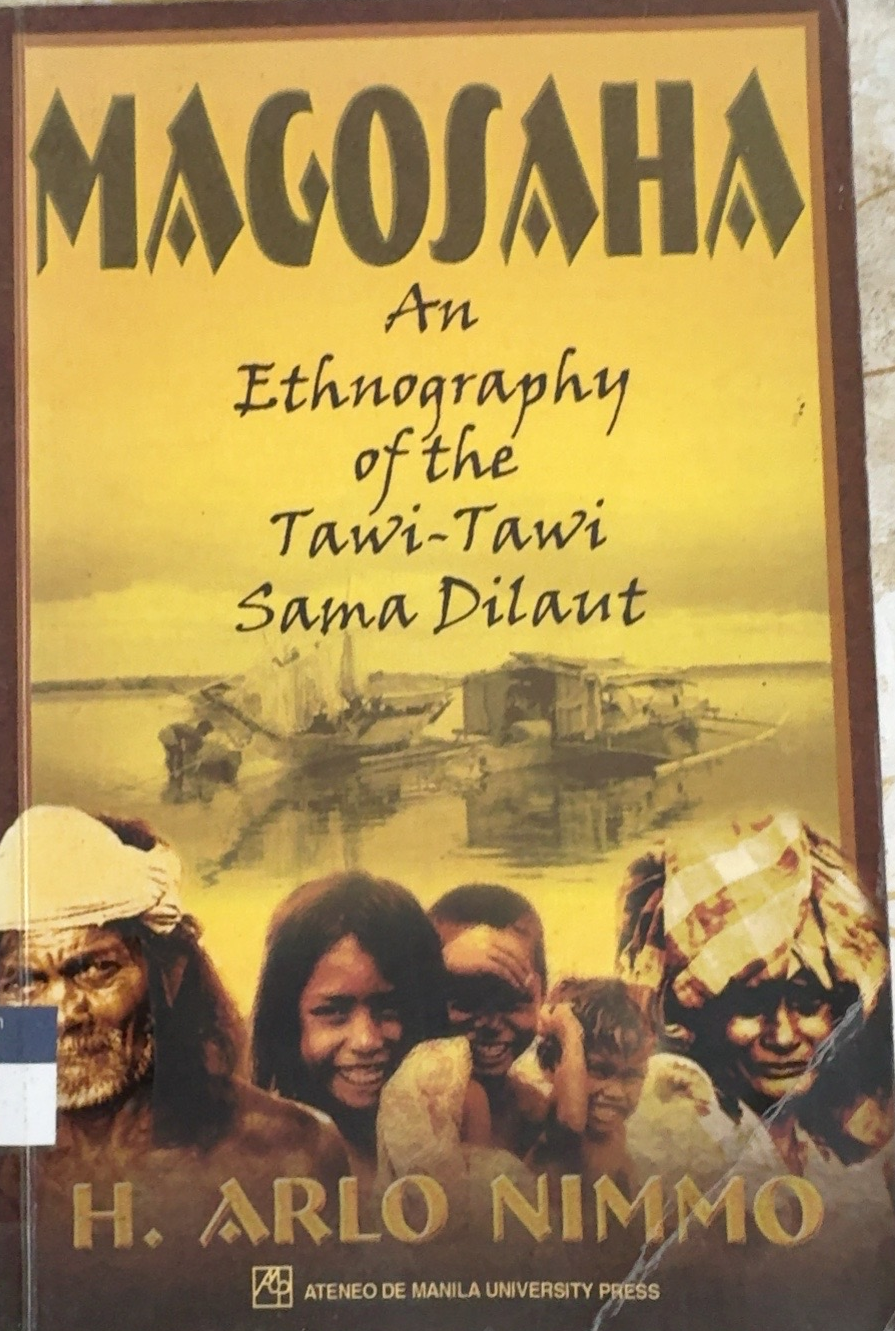
Magosaha: An Ethnography of the Tawi-Tawi Sama Dilaut by the American anthropologist H. Arlo Nimmo is an ethnography of the Sama Dilaut, a seafaring group who traditionally lived on boats in the Sulu Archipelago of the southern Philippines and who in Indonesia and Malaysia are better known as the Bajau or Bajo. The cover of this copy has a golden-yellow tone with a dark brown frame at its edges. The word Magosaha is printed very large at the top in black decorative lettering with triangular ornaments resembling carving motifs, while the subtitle is written in calligraphic-style hand lettering arranged in tiers. The middle of the cover features a sepia-toned photograph of roofed houseboats in calm shallow waters, and the bottom contains a photograph of the faces of a group of Sama Dilaut people, namely an old man with a white headcloth, several smiling children, and a woman with a checked head covering. The author's name is printed in golden capitals beneath the photograph, followed by the logo and name of Ateneo de Manila University Press at the very bottom.
Harry Arlo Nimmo is an anthropologist who taught for many years at California State University, Hayward, and is known as one of the earliest and most dedicated researchers of the Sama Dilaut. He began fieldwork in the Sulu Archipelago in the early 1960s and returned many times over a span of several decades. His earlier works, such as The Sea People of Sulu, as well as the collections of stories and songs he recorded from this community, have become classic references in the study of sea peoples in Southeast Asia. It is this long experience that enables Magosaha to present a longitudinal view, something that ethnographies generally seldom have.
According to the summary in Yale University's eHRAF World Cultures database, the book is based on fieldwork in 1963, 1965 to 1967, 1977, 1982, and 1997, thus covering changes over more than three decades. Its main subject is the cultural and economic forces that shaped the seasonal patterns of movement of the Sama Dilaut in Tawi-Tawi. The author shows that their cultural change was the result of interrelated pressures, namely the intensifying commercialization of marine and forest products, the growing influence of Islam, the armed rebellion of local Muslim groups against the Philippine government, and the military presence in the archipelago. In the late 1990s, upscale tourist facilities and lucrative marine investment began to enter the region. In this process, the Sama Dilaut lost important elements of their material culture, especially houseboats and traditional fishing techniques, but retained their distinctive worldview, including their ways of honouring and maintaining relationships with ancestral spirits. The title Magosaha itself comes from the Sama language and, as far as can be interpreted from the content of the book, relates to the activity of making a living or livelihood; its precise meaning should be checked directly in the book's introduction.
The historical context of the book is the dynamics of the Sulu Archipelago from the sultanate period, through Spanish and American colonialism, to integration into the modern Philippine state. In the Sulu social order, the Sama Dilaut were long placed in the lowest position by the Tausug and land-dwelling Sama groups, partly because of their itinerant way of life and because they were considered not yet to have fully embraced Islam. The armed conflict between the Moro National Liberation Front and the Philippine government from the 1970s shook life in the archipelago, while regional markets for sea cucumber, seaweed, and other marine products changed the economic orientation of coastal communities. Nimmo's ethnography records how all these forces entered the lives of the boat-dwelling families.
Comparative data show that the book was published by Ateneo de Manila University Press in Quezon City. Kathleen M. Nadeau's review in the November 2003 issue of the Journal of Asian Studies gives the year 2001 and a length of 272 pages, while the Ortigas Foundation Library catalogue records 261 pages with illustrations, 23 centimetres in size, and call number DS666.S35 2001. The eHRAF database records ISBN 971-550-369-1 and gives the year 2000. These differences in year and page count indicate that the printing, year, page count, and ISBN of the photographed copy still need to be checked against the copyright page.
For Southeast Asian studies, this book is relevant because the Sama-Bajau peoples are spread across the maritime border regions of the Philippines, Malaysia, and Indonesia, from Sulu and Sabah to Sulawesi, Nusa Tenggara, and Maluku. This ethnography helps to understand how peoples living in transnational waters confront modern political boundaries, development policies, and market expansion. For Islamic studies, the book is of interest because it shows a slow and layered process of Islamization among a group previously regarded as marginal by the surrounding Muslim communities, thus opening a discussion on the relationship between Islam, social status, and practices of ancestor veneration. For maritime anthropology, the book is an important example of change in material culture and coastal ecology. For readers in Aceh and Indonesia, this study can be compared with the lives of the Bajo communities in Sulawesi and Nusa Tenggara, and with the coastal fishing communities of Aceh, which have likewise experienced the pressures of conflict, the commercialization of the sea, and post-disaster change.
As a critical note, a longitudinal ethnography such as this depends heavily on the author's personal relationship with a community he has known since his youth, so that the picture of cultural loss may at times be coloured by the researcher's nostalgia for the early period of his research. Readers also need to be aware that the author studied one group of Sama Dilaut in Tawi-Tawi, so his findings do not automatically apply to all Sama-Bajau communities, which are highly diverse. More recent studies by Filipino and Indonesian anthropologists, as well as by researchers such as Clifford Sather on the Bajau Laut in Sabah, can serve as useful comparisons. Nevertheless, the value of this book as a first-hand record of change in a sea people over more than thirty years is hard to replace.
In teaching, this book can be used in courses on cultural anthropology, ethnographic method, and Islamic studies in the Malay World and the Indian Ocean. Students can learn how an ethnographer returns to the same field after many years, records what has changed and what has endured, and then formulates explanations of the causes of those changes. The book can also prompt discussion of the ethics of long-term research, for example about the relationship between a foreign researcher and the community he writes about, about the use of photographs of community members' faces on the cover, and about the researcher's responsibility when the community he studies faces conflict, poverty, and development pressures. In a policy context, the book's findings are relevant to debates about the rights of indigenous peoples over marine territories, the protection of traditional fishers, and the impact of tourism on vulnerable coastal communities.
In terms of collection documentation, this copy has a blue-and-white library label on the left edge of the cover near the spine. The cover shows wear at the edges, discolouration, and a fairly clear crack line or diagonal fold at the lower right, near the photograph of the woman with the checked head covering. This note is a curatorial introduction based on the cover and catalogue information, not a summary of the entire contents of the book.
Appropriate search subjects include Sama Dilaut, Bajau, Tawi-Tawi, the Sulu Archipelago, sea peoples, maritime anthropology, Philippine ethnography, Islamization, and cultural change. For citation purposes, references should state the author's name, the full title, the publisher, the year, and the pages read directly in the copy.
- Rights
-
Koleksi pribadi KBA13 Academy
How to cite
H. Arlo Nimmo, “Magosaha: An Ethnography of the Tawi-Tawi Sama Dilaut”, Ateneo de Manila University Press, Quezon City, Tahun, cetakan, jumlah halaman, dan ISBN eksemplar belum diperiksa. Rujukan pembanding: Quezon City: Ateneo de Manila University Press, 2001, 261 atau 272 hlm. (sumber berbeda), ilus., 23 cm, ISBN 971-550-369-1 (belum diverifikasi pada halaman hak cipta eksemplar). KBA13 Academy Archive and Library, KBA-BKU-TT-0026.