NIAS Press, Copenhagen · Tahun, cetakan, jumlah halaman, dan ISBN eksemplar belum diperiksa. Rujukan pembanding: Copenhagen: NIAS Press, 2011, 288 hlm., 24 gambar, ISBN 978-87-7694-081-2 (sampul lunak) (belum diverifikasi pada halaman hak cipta eksemplar) · Tanpa tahun
Abstract
An ethnography by the anthropologist Gerhard Hoffstaedter on the negotiation of religion and ethnicity among middle-class Malay Muslims in Malaysia, based on about eighteen months of fieldwork in Shah Alam, Selangor, and Kota Bharu, Kelantan. The book highlights the efforts of the state, civil society, and ordinary citizens to build cultural and religious cohesion, while everyday practice often runs counter to that aim. The discussion covers the origins of Malay identity, Islamic public space including Putrajaya, the discourse of Islam Hadhari and opposition criticism of it, civil society, reactionary Islamic groups, Islamic consumption, the arts as a contested space, and the influence of Indonesia on Malayness. The book is relevant to studies of Islam and the state in Southeast Asia and to comparisons between Kelantan and Aceh. One reviewer praised the richness of its field data but criticised its scope being limited to the Peninsula and its tendency towards a primordial view of ethnicity.
- Identifier
-
KBA-BKU-TT-0027
- Type
-
Buku
- Publisher
-
NIAS Press, Copenhagen
- Date Issued
-
Tanpa tahun
- Bibliographic Citation
-
Tahun, cetakan, jumlah halaman, dan ISBN eksemplar belum diperiksa. Rujukan pembanding: Copenhagen: NIAS Press, 2011, 288 hlm., 24 gambar, ISBN 978-87-7694-081-2 (sampul lunak) (belum diverifikasi pada halaman hak cipta eksemplar)
- Creator
-
Gerhard Hoffstaedter
- LC Classification
-
BP63.M27 — Islam di Malaysia
- LCSH Subject
-
Islam -- Malaysia
Malays (Asian people) -- Ethnic identity
Islam and state -- Malaysia
Malaysia -- Ethnic relations
- BISAC Category
-
SOC048000 SOCIAL SCIENCE / Islamic Studies
- Language
-
Inggris
- Description
-
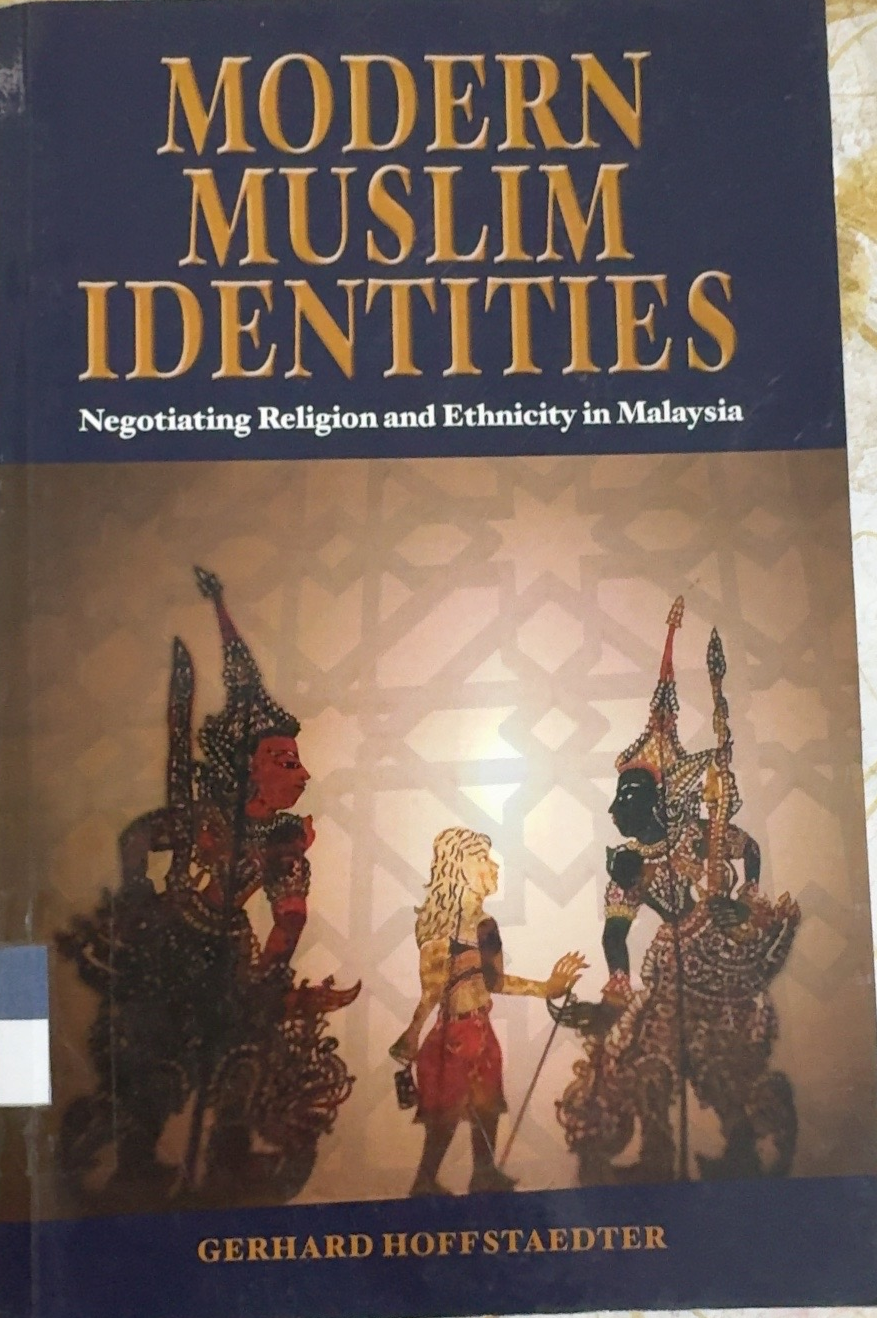
Modern Muslim Identities: Negotiating Religion and Ethnicity in Malaysia by the anthropologist Gerhard Hoffstaedter is an ethnographic study of how the state, civil society, and ordinary citizens in Malaysia negotiate the relationship between Islamic identity and Malayness. The cover of this copy is divided into two parts. The upper part has a dark blue background with the title Modern Muslim Identities in large golden-yellow serif capitals, followed by the subtitle in bold white type. The lower part displays a photograph of a wayang kulit (shadow puppet) performance against a warmly lit screen decorated with an Islamic-style geometric star pattern. On the left and right are two puppet figures adorned with tall crowns, one with a red face and one with a black face, while in the middle stands a puppet figure with long blond hair and a red cloth who seems to be reaching out to the figure on the right. This composition cleverly combines a Malay performing art rooted in pre-Islamic tradition with Islamic geometric motifs, immediately suggesting the book's theme of the negotiation of identity. The author's name is printed in golden capitals on a dark blue band at the very bottom.
Gerhard Hoffstaedter is an anthropologist who, according to the distributor NUS Press, teaches anthropology at the University of Queensland, Australia, and was previously a researcher at La Trobe University. His research interests include the relationship between religion and the state, international development, and refugees. The book is based on about eighteen months of fieldwork among the Malay middle class, as noted by one reviewer. The research sites were Shah Alam in Selangor, an urban area close to Kuala Lumpur, and Kota Bharu, the capital of Kelantan, which is often regarded as the heartland of Malay culture and the political base of the Pan-Malaysian Islamic Party. The choice of these two contrasting sites allows the author to compare the experiences of Malay Muslims at the centre of state modernisation and in a more conservative region.
The book's main argument, according to the publisher's description, highlights the efforts of the Malaysian state, civil society, and ordinary people to build cultural, religious, and social cohesion, even though everyday practice often runs counter to that aim. The author pays attention to political elites who seek to maintain control and cultural dominance, while responding to pressure from Islamist and Malay supremacist groups on one side and moderate civil society groups on the other. At the centre of the study is the link between Malay ethnicity and Islam, including the state discourse of civilisational Islam or Islam Hadhari promoted during the administration of Abdullah Ahmad Badawi. The author also discusses the arts as a contested space, for example how traditional performances such as wayang kulit and mak yong in Kelantan were restricted or reorganised in the name of religious purity.
According to Holger Warnk's review in the Journal of Current Southeast Asian Affairs in 2012, the book consists of a preface and eight chapters. The opening chapter lays out a philosophical and anthropological framework with reference to thinkers such as Heidegger, Hegel, Fredrik Barth, and Thomas Hylland Eriksen. The following chapters trace the origins and meanings of Malay identity, Islamic public space including the construction of the administrative city of Putrajaya, the government's Islamic policies and the opposition's criticism of them, the relationship among Islam, identity, and civil society, reactionary Islamic groups and Islamic consumption, and the influence of Indonesia and the wider Muslim world on the formation of Malay identity, before closing with a brief conclusion.
The historical context of the book is Malaysia in the first decade of the twenty-first century, when the wave of Islamisation that began in the 1970s had transformed public space, the bureaucracy, and Malay lifestyles. The Malaysian Constitution defines Malays, among other things, as adherents of Islam, so that religious and ethnic identity are intertwined both legally and politically. The competition between UMNO and PAS for Islamic legitimacy, the emergence of civil society organisations such as Sisters in Islam, and affirmative policies for the bumiputra formed the background that shaped debates about what it means to be a modern Muslim in Malaysia.
Comparative data from the NUS Press website record that the book was published in 2011 by NIAS Press, Copenhagen, with 288 pages, measuring 229 by 152 millimetres, containing 24 illustrations, in paperback with ISBN 978-87-7694-081-2, while the hardcover edition has ISBN 978-87-7694-080-5. The printing, year, number of pages, and ISBN of the photographed copy still need to be checked against the copyright page.
For the study of Islam in Southeast Asia, the book is highly relevant because it shows how a modern state makes religion an instrument of nation-building as well as a tool of social control. For readers in Indonesia, especially in Aceh, the book offers a valuable comparison. Aceh and Kelantan are both known as regions with a strong Islamic identity and both apply sharia-based regulations within the framework of a national state. Comparing how the performing arts, dress, and public space are regulated in the name of religion in the two regions can be a productive subject of research. The chapter on Indonesia's influence on Malay identity is also a reminder that currents of Islamic ideas in the region move in both directions, through education, dakwah (proselytisation), media, and trade. For anthropology, the book is an example of ethnographic research on the state and religion that does not stop at the analysis of policy texts, but observes how those policies are experienced by citizens.
As a critical note, Holger Warnk's review assesses the book ambivalently. He praises the analysis of Putrajaya and its Islamisation, the discussion of performed Islam, and the richness of field data that distinguishes it from text-based studies. However, he also criticises a title that seems to cover the whole of Malaysia when the study is limited to the Peninsula without Sabah and Sarawak. Warnk also argues that the book's theoretical framework, although referring to Barth and Eriksen, tends to fall into a primordial view of ethnicity and is insufficiently critical of the ideology of land and blood in Malay nationalism. Readers should read the book together with other works on the construction of Malay identity, for example the studies of Anthony Milner, in order to obtain a more balanced picture.
In teaching, the book can be used in courses on the anthropology of religion, political sociology, and Islamic studies in Southeast Asia, especially to discuss the relationship among the state, religion, and the formation of ethnic identity. Students can use it as an example of how philosophical and social theory is brought together with field data, as well as material for practising critical reading of the conceptual framework of an ethnography. The cover image of wayang kulit in front of an Islamic geometric pattern can also serve as a starting point for discussing the fate of traditional arts in regions undergoing the Islamisation of public policy, a problem also faced by various regions in Indonesia. In addition, the discussion of Islamic consumption opens the way to discussions of the halal industry, Muslim fashion, and the religious market that is now growing rapidly in both Malaysia and Indonesia.
In terms of collection documentation, this copy has a blue-and-white library label affixed to the left edge of the cover near the spine, at the bottom. The cover is still intact, with slight creases and signs of use along the spine and on the right edge. This note is a curatorial introduction based on the cover and catalogue information, not a summary of the entire contents of the book.
Suitable search subjects include Malay Muslim identity, Islam in Malaysia, ethnicity and religion, Islam Hadhari, Islam and the state, Malaysian civil society, Kelantan, and the political anthropology of Southeast Asia. For citation purposes, references should give the author's name, the full title, the publisher, the year, and the pages read directly in the copy.
- Rights
-
Koleksi pribadi KBA13 Academy
How to cite
Gerhard Hoffstaedter, “Modern Muslim Identities: Negotiating Religion and Ethnicity in Malaysia”, NIAS Press, Copenhagen, Tahun, cetakan, jumlah halaman, dan ISBN eksemplar belum diperiksa. Rujukan pembanding: Copenhagen: NIAS Press, 2011, 288 hlm., 24 gambar, ISBN 978-87-7694-081-2 (sampul lunak) (belum diverifikasi pada halaman hak cipta eksemplar). KBA13 Academy Archive and Library, KBA-BKU-TT-0027.