Penerbit Buku Kompas, Jakarta · Tahun, cetakan, jumlah halaman, dan ISBN eksemplar belum diperiksa. Rujukan pembanding: Jakarta: Penerbit Buku Kompas, 2009, 483 hlm., ISBN 978-979-709-433-1 (belum diverifikasi pada halaman hak cipta eksemplar) · Tanpa tahun
Abstract
A critical edition of the Old Javanese kakawin composed by Mpu Prapañca in 1365 about the Kingdom of Majapahit in the time of Hayam Wuruk, prepared by the Old Javanese philologist I Ketut Riana. Its title contains two names of the text, Dēśa Warṇana and Nāgara Kṛtāgama, in response to the philological debate over the original name of the work. The text describes the royal genealogy, the layout of the city and palace, the king's royal progresses, Shiva-Buddhist religious ceremonies, the structure of government, and a list of Nusantara territories outside Java, including Samudra, Lamuri, Perlak, and Barus in Sumatra. The book places the text within the tradition of scholarship since the discovery of the Lombok manuscript in 1894 and the editions of Brandes, Kern, Pigeaud, and Robson. This edition is useful for the study of the history of Majapahit, Nusantara philology, the relationship between religion and power, and the early history of Islam on the northern coast of Sumatra, with the caveat that the picture of a golden age in a court panegyric kakawin needs to be read critically.
- Identifier
-
KBA-BKU-TT-0028
- Type
-
Buku
- Publisher
-
Penerbit Buku Kompas, Jakarta
- Date Issued
-
Tanpa tahun
- Bibliographic Citation
-
Tahun, cetakan, jumlah halaman, dan ISBN eksemplar belum diperiksa. Rujukan pembanding: Jakarta: Penerbit Buku Kompas, 2009, 483 hlm., ISBN 978-979-709-433-1 (belum diverifikasi pada halaman hak cipta eksemplar)
- Creator
-
I Ketut Riana
- LC Classification
-
PL5161–5179 — Bahasa dan sastra Jawa (termasuk Jawa Kuno)
- LCSH Subject
-
Prapañca, active 14th century. Nāgarakṛtāgama
Kawi poetry -- History and criticism
Majapahit (Kingdom)
Java (Indonesia) -- History
- BISAC Category
-
LIT008000 LITERARY CRITICISM / Asian / General
- Language
-
Indonesia
- Description
-
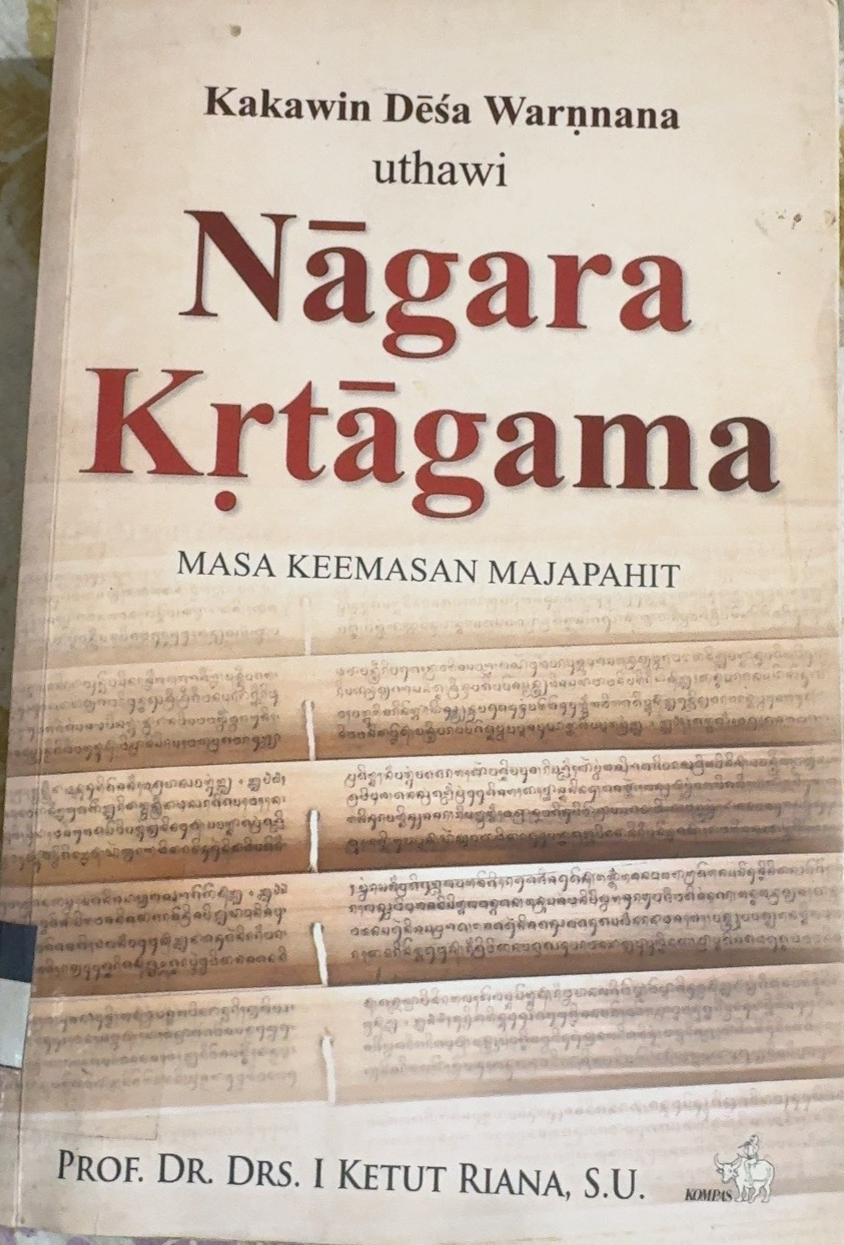
Kakawin Dēśa Warṇana uthawi Nāgara Kṛtāgama: Masa Keemasan Majapahit by I Ketut Riana is a critical edition of one of the most important texts in the history of the Nusantara, namely the Old Javanese kakawin composed by Mpu Prapañca that depicts the Kingdom of Majapahit during the reign of Hayam Wuruk. The title of this book deliberately contains two names of the text at once, Dēśa Warṇana and Nāgara Kṛtāgama, linked by the Old Javanese word uthawi, meaning or. This choice reflects a long-standing philological debate about the original name of the work. The cover of this copy is a brownish cream colour with the main title Nāgara Kṛtāgama printed very large in maroon serif letters complete with diacritics, while the phrase Kakawin Dēśa Warṇana uthawi is placed above it in smaller black letters. The subtitle Masa Keemasan Majapahit (The Golden Age of Majapahit) is printed in black capital letters below. The lower half of the cover is filled with a photograph of palm-leaf (lontar) sheets inscribed in Balinese script, stacked and bound with string, an image that immediately reminds the reader that this text has come down to us through the lontar manuscript tradition. The author's name is printed at the bottom together with his academic titles, accompanied by the logo of Penerbit Buku Kompas, a figure riding an animal, in the bottom right corner.
I Ketut Riana is known as a philologist and scholar of Old Javanese literature from the academic milieu of Bali, the region where the tradition of reading, copying, and interpreting kakawin remains alive to this day. Several sources link him with the study of Old Javanese literature at Universitas Udayana, Denpasar, but the details of his affiliation and academic career should be checked against the author's biography in the copy. This background is important because scholars from Bali generally read kakawin not merely as historical documents, but as literary works bound by the rules of metre, religious teachings, and cultural practices that are still ongoing. This combination of philological expertise and closeness to the lontar tradition gives this edition its distinctive character compared with the studies of European scholars.
The text studied in this book was composed in the Saka year 1287, or 1365 CE, by a court poet who called himself Prapañca, a Buddhist religious official in the court of Majapahit. This kakawin consists of some ninety-eight cantos (pupuh) and describes many things: the genealogy of the royal family, the layout of the city and palace of Majapahit, Hayam Wuruk's royal progresses to various regions of East Java, the śrāddha ceremony commemorating the Rajapatni, the sacred buildings of Shiva and Buddha, the structure of government, and a list of territories outside Java said to be within Majapahit's sphere of influence. Because of the richness of its information, the text has long been used as the main source for reconstructing the history of Majapahit and has even been cited in Indonesian national discourse as evidence of the existence of a political unity of the Nusantara in the past.
Riana's edition, as far as can be inferred from the title and catalogue information, presents the Old Javanese text accompanied by a translation and critical study in Indonesian. The choice of placing the name Dēśa Warṇana before the name Nāgara Kṛtāgama shows that the author has considered the arguments of philologists who state that Prapañca himself called his work Deśawarṇana, that is, a description of villages or regions, whereas the name Nāgarakṛtāgama derives from the colophon of a copy added later. By retaining both names, this book acknowledges the long history of the text's reception while directing readers to the intention of its original author. The subtitle Masa Keemasan Majapahit underlines the book's focus on the picture of the kingdom at the height of its glory, as depicted by a witness from within the court.
The intellectual context of this book cannot be separated from the history of the discovery and study of its manuscript. The lontar manuscript of this kakawin was found in Cakranegara, Lombok, in 1894 when Dutch colonial troops stormed the palace of the Balinese-Lombok king, and was subsequently taken to the Netherlands. The philologist J.L.A. Brandes played a role in rescuing and publishing the text, followed by the translation and commentary of H. Kern, and then the monumental edition by Theodore G. Th. Pigeaud entitled Java in the 14th Century in the early 1960s. In Indonesia, Slamet Muljana wrote a historical interpretation of the text, and Stuart Robson published an English translation entitled Desawarnana in 1995. The Cakranegara manuscript itself was returned to Indonesia in the 1970s and is now kept in the National Library, and in 2013 it was recognised by UNESCO as part of the Memory of the World. The appearance of Riana's edition at the end of the 2000s can be read as an effort to present the text anew to Indonesian readers through the perspective of a domestic scholar familiar with the Balinese manuscript tradition.
Comparative data from the Google Books catalogue record the book as published by Penerbit Buku Kompas, Jakarta, in 2009, with about 483 pages and ISBN 978-979-709-433-1. The printing, year, number of pages, and ISBN data of the photographed copy still need to be checked against the copyright page, because books published by Kompas are often reprinted with minor changes to the preliminary pages.
For the study of Indonesian history, this book is relevant as a gateway to a primary source on the classical Javanese state, the relationship between king and religion, territorial organisation, and the ritual life of the court. For Southeast Asian studies, Prapañca's text provides a picture of how an agrarian-maritime centre of power imagined the network of territories around it, including the Malay Peninsula, Kalimantan, Sulawesi, and Nusa Tenggara. For readers in Aceh, this kakawin is of interest because the list of Sumatran lands mentioned in it includes names such as Samudra, Lamuri, Perlak, and Barus, which are very closely connected with the early history of Islam on the northern coast of Sumatra. This mention opens a discussion of how early Islamic kingdoms such as Samudra Pasai were viewed through the lens of a Hindu-Buddhist court in Java, and to what extent claims of Majapahit's influence can be trusted. For religious studies and anthropology, the text also shows Shiva-Buddhist syncretism, practices of ancestor veneration, and the function of literature as part of state ritual.
As a critical note, readers need to remember that this kakawin is a work of praise written from within the court, so the picture of a golden age and of the extent of Majapahit's territory cannot simply be accepted as political fact. Historians have long debated whether the lists of territories in certain cantos indicate real power, trade relations, or merely symbolic claims. The subtitle of this book, which highlights the golden age, needs to be read with awareness of this debate. In addition, every translation of a kakawin involves interpretive choices regarding Old Javanese words with double meanings, so comparing Riana's translation with the editions of Pigeaud, Robson, and Slamet Muljana will be very useful for serious readers. The added value of this edition lies precisely in the possibility of such comparison, because Indonesian readers obtain a text and interpretation from a philologist who works from within the tradition of reading kakawin.
This book is also useful for teaching philological methodology, particularly regarding the relationship between manuscript, text edition, translation, and historical interpretation. Students can learn how a single text that survived colonial looting by chance became a principal source of national history, and how even the name of a work can become a scholarly problem. In courses on the history of Islamic civilisation in the Nusantara, this text can be read alongside the Hikayat Raja-Raja Pasai and the Sejarah Melayu to see how the Hindu-Buddhist tradition and the Islamic tradition each wrote about power, territory, and royal legitimacy.
In terms of collection documentation, this copy shows a cover that has begun to yellow and is slightly dull, with signs of use on the right edge and small stains in several places. There is a blue and white library label attached to the left edge of the cover near the spine, at the bottom. This description is a curatorial introduction based on the cover and catalogue information, not a summary of the entire contents of the book.
Suitable search subjects include Nagarakertagama, Desawarnana, Mpu Prapanca, the Kingdom of Majapahit, Hayam Wuruk, Old Javanese literature, kakawin, Nusantara philology, and the history of fourteenth-century Java. For citation purposes, references should state the author's name, the full title, the publisher, the year, and the pages read directly in the copy.
- Rights
-
Koleksi pribadi KBA13 Academy