Mata Bangsa (Diva Press), Yogyakarta · Tahun, cetakan, jumlah halaman, dan ISBN eksemplar belum diperiksa. Rujukan pembanding: Yogyakarta: Diva Press/Mata Bangsa, 2017, 382 hlm., 14 x 21 cm; ISBN belum ditemukan; penerbit eksemplar belum dipastikan karena logo tidak tampak pada sampul depan (belum diverifikasi pada halaman hak cipta eksemplar) · Tanpa tahun
Abstract
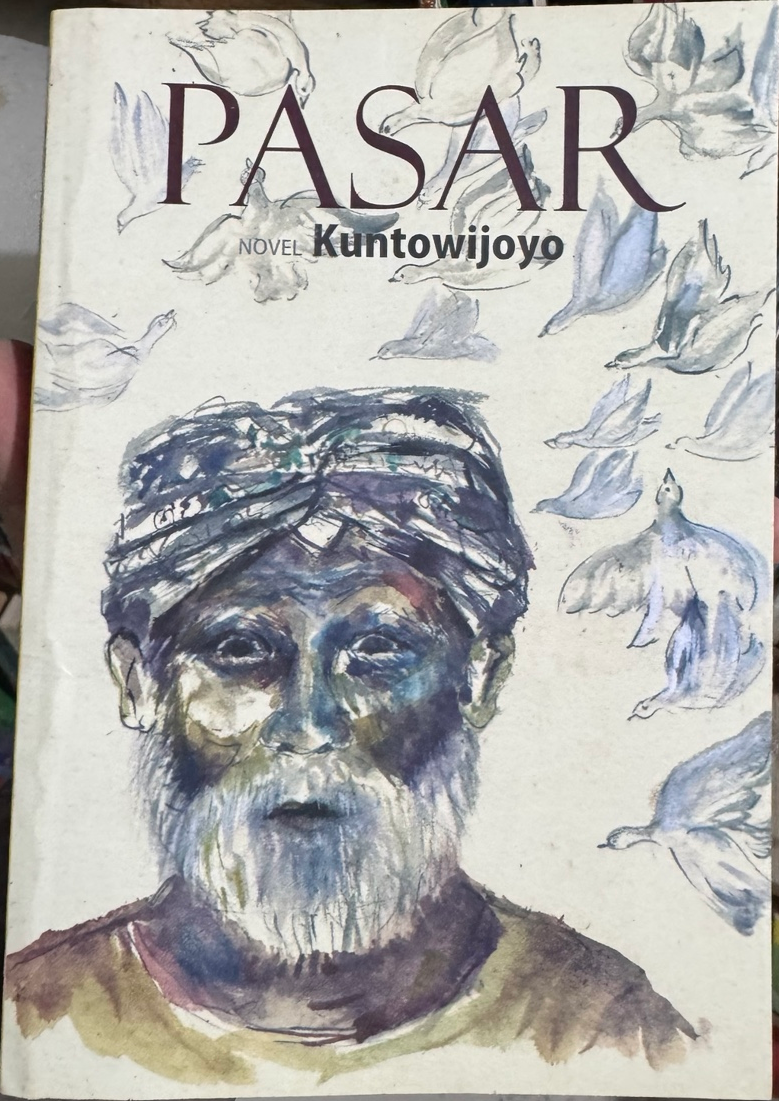
A novel by the historian and writer Kuntowijoyo about Pak Mantri, a Javanese priyayi (member of the traditional gentry) who has long been head of the market of a subdistrict town and who keeps pigeons as a sacred trust (amanah). When the pigeons eat the merchandise and soil the market, the traders grow restless, and the conflict peaks when Kasan Ngali, a wealthy trader and moneylender, opens a rival market. Among them are Paijo, the loyal servant who later succeeds Pak Mantri, and Siti Zaitun, a young woman who captivates the two men. With gentle humour and irony, the novel portrays the clash of the values of the agrarian priyayi, merchant capitalism, modern financial institutions, and the wong cilik (common people), while also questioning who is worthy to lead. This copy has a cover with a watercolour illustration of an old man in a turban and pigeons, probably from the reissue by Diva Press/Mata Bangsa. The work is relevant to the study of Javanese ethics, the anthropology of markets, social change, and prophetic literature.
- Identifier
-
KBA-BKU-TT-0029
- Type
-
Buku
- Publisher
-
Mata Bangsa (Diva Press), Yogyakarta
- Date Issued
-
Tanpa tahun
- Bibliographic Citation
-
Tahun, cetakan, jumlah halaman, dan ISBN eksemplar belum diperiksa. Rujukan pembanding: Yogyakarta: Diva Press/Mata Bangsa, 2017, 382 hlm., 14 x 21 cm; ISBN belum ditemukan; penerbit eksemplar belum dipastikan karena logo tidak tampak pada sampul depan (belum diverifikasi pada halaman hak cipta eksemplar)
- Creator
-
Kuntowijoyo
- LC Classification
-
PL5076–5089 — Bahasa dan sastra Indonesia
- LCSH Subject
-
Indonesian fiction
Markets -- Indonesia -- Java -- Fiction
Javanese (Indonesian people) -- Fiction
Social change -- Indonesia -- Fiction
- BISAC Category
-
FIC019000 FICTION / Literary
- Language
-
Indonesia
- Description
-
Pasar (The Market) is a novel by Kuntowijoyo, a leading Indonesian historian, cultural figure, and writer, which tells of the struggle of Javanese values amid the social change of a small subdistrict town. The copy photographed is an edition with a watercolour-illustrated cover on an ivory-white background. The title PASAR is printed in large dark-purple serif capitals at the top, accompanied by the word NOVEL in small letters and the name Kuntowijoyo in bold letters below it. The lower half of the cover shows a portrait of an old man with a thick white beard wearing a patterned headband or turban, painted in loose and expressive watercolour strokes of blue, purple, and olive green. His gaze is straight ahead, with an expression at once weary and resolute. Around his head and along the right edge of the cover fly doves or pigeons drawn with thin lines and bluish-grey strokes. The presence of the pigeons on the cover clearly relates to one of the important elements of the story, namely the pigeons belonging to the main character. The publisher's logo is not clearly visible on the front of the cover in this photograph, so the identity of the copy's publisher needs to be confirmed via the spine, the back cover, or the copyright page.
Kuntowijoyo was born in Bantul, Yogyakarta, on 18 September 1943 and died in Yogyakarta on 22 February 2005. He studied history at Universitas Gadjah Mada, then obtained a master's degree from the University of Connecticut and a doctorate from Columbia University with a dissertation on social change in the agrarian society of Madura in 1850–1940. As a professor of history at Universitas Gadjah Mada, he is known for the idea of prophetic social science (ilmu sosial profetik), the scientification of Islam (pengilmuan Islam), and studies of the relationship between religion, culture, and politics in Indonesia. His non-fiction works include Paradigma Islam (The Islamic Paradigm), Pengantar Ilmu Sejarah (An Introduction to Historical Science), and Budaya dan Masyarakat (Culture and Society). In the literary field, he wrote short stories, poetry, drama, and novels, including Khotbah di Atas Bukit (Sermon on the Hill), Mantra Pejinak Ular (The Snake-Taming Mantra), and Wasripin dan Satinah. He was also active in Muhammadiyah circles and was among the founders of the Centre for Policy Studies and Research (Pusat Pengkajian dan Penelitian Kebijakan) together with Amien Rais and Chairil Anwar.
The novel Pasar centres on the figure of Pak Mantri, a Javanese priyayi who has long been head of the market in a subdistrict town, which several studies identify as set in Gemolong. Pak Mantri firmly upholds Javanese manners, refinement of character, and worldview, and keeps pigeons that he regards as something entrusted to him and a responsibility before God. Problems arise when the pigeons eat the grain being sold and soil the market, so that the traders feel harmed and are reluctant to pay their market tickets. The conflict sharpens when Kasan Ngali, a wealthy trader who also lends money, opens a rival market in the yard of his house and lures the traders to move. Between the two stand Paijo, Pak Mantri's naive but loyal servant, and Siti Zaitun, a young woman who, in several summaries, is said to work at the local bank and who wins the hearts of both Pak Mantri and Kasan Ngali. The death of the pigeons, the powerlessness of the authorities, and the shifting loyalties of the traders form a series of events that test Pak Mantri's outlook on life. In the end, according to several summaries of studies, it is Paijo who comes forward to take over Pak Mantri's position as manager of the market.
The strength of the novel lies in the way Kuntowijoyo portrays the encounter of various social groups in one small space. Pak Mantri represents the agrarian priyayi with an ethic of harmony and service, Kasan Ngali represents the capitalist trader who measures everything by profit, Zaitun can be read as a representative of the world of modern financial institutions, and Paijo represents the wong cilik, often underestimated yet possessed of sincerity. The conflict among them is narrated with gentle humour, irony, and characteristically Javanese dialogues, so that readers are invited to weigh which character truly deserves to lead. The market in this novel is not merely a place of buying and selling, but a metaphor for a society undergoing change, as old values confront the logic of the market and money.
Concerning its publication history, several sources state that the manuscript of this novel won an award at the commemoration of Book Day 1972, while the book edition later circulated widely through publishers in Yogyakarta. More recent literary studies refer to a 2017 reissue from the Diva Press publishing group in Yogyakarta, under the imprint name Mata Bangsa or Mata Angin. Bookshop data for the Mata Bangsa edition give a length of 382 pages and a size of about 14 by 21 centimetres. Because the cover of this copy matches the illustration style used in the reissues of Kuntowijoyo's works in that period, it is very likely that this copy comes from that edition, but this supposition cannot yet be confirmed. The printing, year, page count, and ISBN of the photographed copy still need to be checked against the copyright page.
For literary and anthropological studies, Pasar is rich material for discussing Javanese ethics, concepts of leadership, and social change in rural areas and small towns of Indonesia. A number of undergraduate theses and scholarly articles have examined the novel from the perspectives of Javanese ethics, social conflict, social values, and speech acts, which shows that the novel continues to be used in the teaching of literature at universities. From the perspective of economic anthropology, the novel can be read together with Clifford Geertz's studies of traders and markets in Javanese towns, especially his work on Mojokuto, since both show the tension between the bazaar economy, private interest, and the moral values of the community. Kuntowijoyo's idea of prophetic literature, which emphasizes humanization, liberation, and transcendence, can also be traced in the way the novel treats its characters with both sympathy and criticism.
For readers in Aceh and for Islamic studies, the novel is interesting because it shows how a Muslim intellectual from the Muhammadiyah milieu wrote about Javanese culture without rigidly opposing it to Islam. Pak Mantri's spirituality, which regards his pet birds as a sacred trust, shows a blending of piety and the Javanese outlook on life. A comparison with market society in Aceh, for example the role of traders, moneylenders, and financial institutions in the local economy, can open a discussion on economic ethics in Muslim societies of the Nusantara.
As a critical note, a reading of the novel needs to take into account that its portrayal of social groups tends to be typological, so that its characters sometimes feel like representatives of ideas. Some readers may also judge that the novel's point of view is more sympathetic to priyayi values than to the new economic dynamics. Yet the irony that Kuntowijoyo builds in fact shows that no group is entirely right, and that social change always contains both loss and opportunity. It is this ambivalence that keeps the novel relevant to read in the climate of present-day economic change.
In terms of collection documentation, this copy appears to be in relatively good condition, with a clean cover, corners still intact, and only a few signs of use at the edges. No library label is visible on the part of the cover seen in the photograph. This note is a curatorial introduction based on the cover, bookshop data, and studies of the novel, not a summary of the entire content of the book.
Suitable search subjects include Kuntowijoyo, the Indonesian novel, modern Indonesian literature, Javanese ethics, priyayi, traditional markets, social change in Java, and prophetic literature. For citation purposes, references should give the author's name, the title, the publisher, the year, and the pages read directly in the copy.
- Rights
-
Koleksi pribadi KBA13 Academy