Harvard University Press, Cambridge, Massachusetts · Tahun, cetakan, jumlah halaman, dan ISBN eksemplar belum diperiksa. Rujukan pembanding: Cambridge, MA: Harvard University Press, 2015, 171 hlm., ISBN 978-0-674-96751-9 (belum diverifikasi pada halaman hak cipta eksemplar) · Tanpa tahun
Abstract
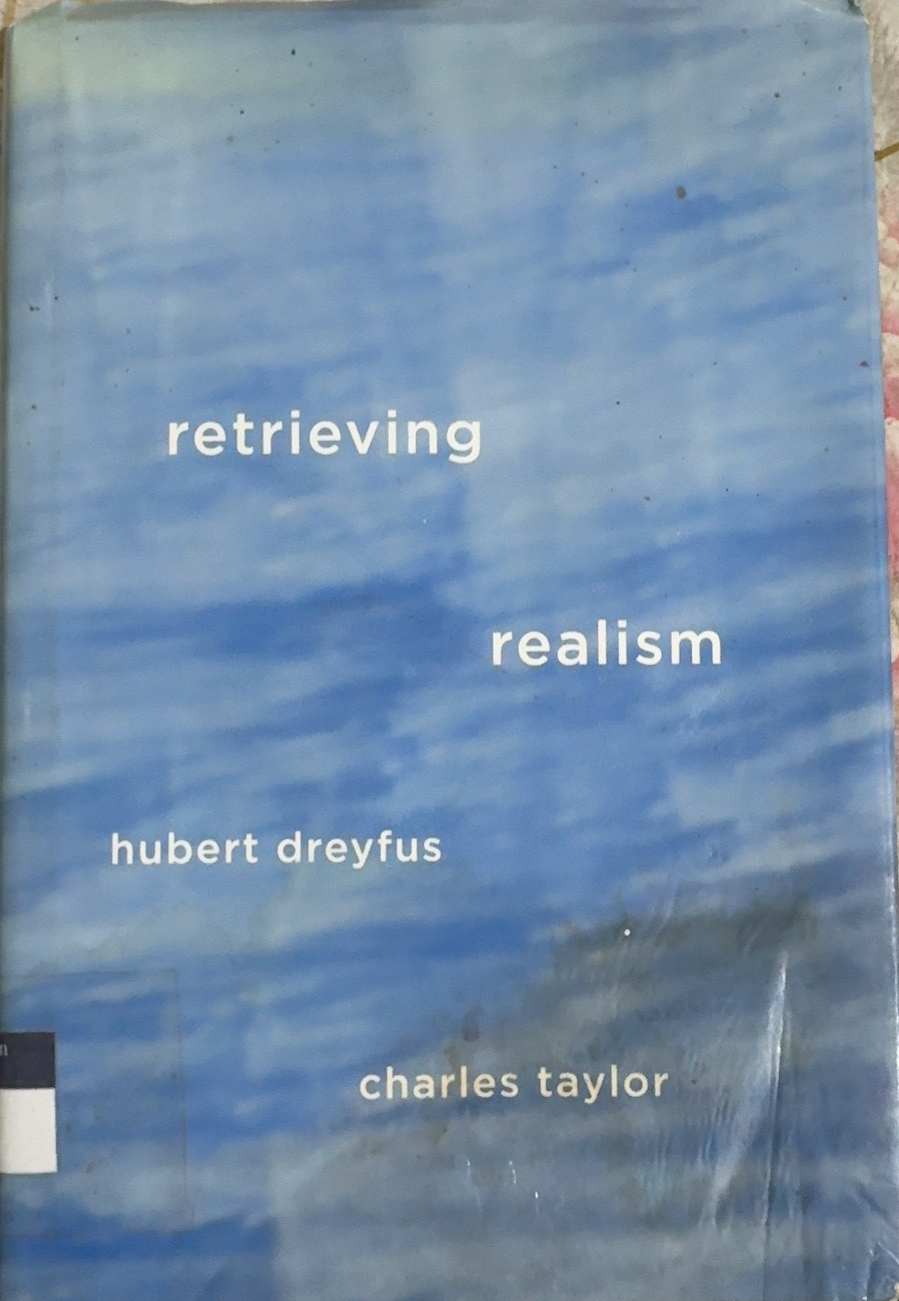
This book by Hubert Dreyfus and Charles Taylor, published by Harvard University Press, challenges the mediational picture of knowledge that has coloured modern philosophy since Descartes, namely the assumption that human beings know the world only through intermediaries in the form of ideas, representations, or language. According to the authors, this picture persists even among its critics such as Rorty and Davidson. Drawing on Heidegger and Merleau-Ponty, they put forward a contact theory: before forming concepts, human beings are already engaged bodily and practically with the world, so that scepticism loses its footing. From there they defend scientific realism as well as a robust pluralistic realism, that is, the possibility of several valid ways of disclosing real aspects of the world, with implications for intercultural understanding. This hardcover copy features a cloudy blue sky, has a library label on the spine, and has stains and creases on the dust jacket.
Identifier
KBA-BKU-TT-0030
Type
Buku
Publisher
Harvard University Press, Cambridge, Massachusetts
Date Issued
Tanpa tahun
Bibliographic Citation
Tahun, cetakan, jumlah halaman, dan ISBN eksemplar belum diperiksa. Rujukan pembanding: Cambridge, MA: Harvard University Press, 2015, 171 hlm., ISBN 978-0-674-96751-9 (belum diverifikasi pada halaman hak cipta eksemplar)
RealismKnowledge, Theory ofPhenomenologyRorty, Richard
BISAC Category
PHI004000 PHILOSOPHY / Epistemology
Language
Inggris
Description
Retrieving Realism by Hubert Dreyfus and Charles Taylor is an English-language book of philosophy that challenges the modern epistemological way of thinking about the relationship between mind and world, and then offers a form of realism rooted in the experience of human beings who are embodied and engaged in their world. This copy is a hardcover book with a dust jacket. The cover is very simple and almost without ornament: the whole front is filled with a photograph of a blue sky or surface with thin, blurred wisps of white cloud, as if seen through glass or water. The title is written in small white lowercase letters in two lines offset diagonally, the word "retrieving" at the centre left and "realism" slightly to the right below it. The names of the two authors, "hubert dreyfus" and "charles taylor", are also written in lowercase letters, stacked at the bottom. This calm design choice is in keeping with the theme of the book, namely the effort to restore direct contact with a world that has seemingly been screened off by a layer of representations.
Hubert L. Dreyfus (1929–2017) was a professor of philosophy at the University of California, Berkeley, and one of the most important interpreters of Martin Heidegger and Maurice Merleau-Ponty in the English-speaking world. His name became widely known beyond philosophy because of his critique of symbolic artificial intelligence in What Computers Can't Do, first published in 1972, and because of his commentary on Being and Time in Being-in-the-World. Charles Taylor, born in 1931 in Montreal, is a Canadian philosopher who taught for many years at McGill University and is known for major works such as Hegel, Sources of the Self, The Ethics of Authenticity, and A Secular Age. He received the Templeton Prize in 2007 and the Kyoto Prize in 2008. The two philosophers had been in dialogue for several decades, and this book can be read as the fruit of a long conversation between existential phenomenology and hermeneutic philosophy of the human being.
The main argument of the book starts from a critique of what the authors call the mediational picture of knowledge. Since René Descartes and John Locke, modern philosophy has tended to imagine that human beings know the world only through intermediaries, whether ideas, mental representations, sentences, or conceptual schemes. This picture, according to Dreyfus and Taylor, persists even among its critics, including in the thought of Richard Rorty and Donald Davidson, who sought to leave epistemology behind but still rested on the assumption that our relationship with the world is always mediated by beliefs and language. The two authors borrow Ludwig Wittgenstein's image of a picture that holds us captive, and then seek to free philosophy from that picture.
As an alternative, the book develops what may be called a contact theory. The authors argue that before human beings form beliefs or concepts, they are already engaged practically with the world through the body, skills, and sensibilities that are not wholly conceptual. The way we walk, reach for objects, grasp the atmosphere of a room, or interact with other people shows a practical understanding that forms the background for all explicit knowledge. Drawing on Heidegger and Merleau-Ponty, the authors state that this embodied engagement gives us direct contact with reality, so that scepticism about the external world loses its footing. In this part, the book also responds to the debate between Dreyfus and John McDowell over whether all human experience is conceptual.
The next step is to defend scientific realism without falling into scientism. The authors argue that natural science can indeed reveal structures of the world that do not depend on human beings. They also highlight the idea of transitions or the replacement of views, namely that once a scientific advance has been accepted, returning to the old view is no longer rational. However, they do not regard natural science as the only access to reality. They propose a robust pluralistic realism, that is, the view that there may be several equally valid ways of disclosing real aspects of the world, including ways that live in other cultures. The final part of the book discusses the implications of this view for intercultural understanding, arguing that encounters with other cultures can change the way we understand ourselves without having to presuppose that all views are equally true or that one view is necessarily superior.
In intellectual context, the book appeared at a time when the debate over realism had once again become heated, both in analytic philosophy and in new movements in continental philosophy known as speculative realism and object-oriented ontology. Retrieving Realism differs from these currents because it remains grounded in phenomenology and hermeneutics. Paul A. Roth's review in Notre Dame Philosophical Reviews appreciates the seriousness with which the book engages Rorty, but doubts whether the argument about the impossibility of returning to an old view can be sustained psychologically and whether the difference from Rorty is really as sharp as claimed. Assessments of this kind help readers see the book as an important intervention in a debate that remains open.
Publisher data and reviews indicate that the book was published by Harvard University Press, Cambridge, Massachusetts, in 2015, with ISBN 978-0-674-96751-9 for the hardcover edition. The Notre Dame Philosophical Reviews review records 171 pages, while a number of bookshops list a slightly different page count because they include the preliminary pages and index. The printing, year, number of pages, and ISBN data of the photographed copy still need to be checked against the copyright page.
For studies in Indonesia and Southeast Asia, this book is relevant in several directions. First, for the study of philosophy and the methodology of the social sciences, the critique of representational epistemology opens the way for approaches that place practice, the body, and context as sources of knowledge, something close to the traditions of ethnography and interpretive anthropology. Second, the idea of pluralistic realism can be used to think about the relationship between modern science and local knowledge systems, including customary knowledge and religious knowledge, without being trapped either in relativism or in the claim that only natural science is true. Third, for Islamic studies, debates about the integration of knowledge, Islamic epistemology, and the relationship between revelation, reason, and experience can be enriched by the argument that there is more than one valid path to disclosing reality. Taylor's thought on secularity is also often cited in studies of religion and modernity in the Muslim world, so this book can be read together with A Secular Age.
As a critical note, the book demands readers who are already familiar with the history of modern epistemology, phenomenology, and debates in analytic philosophy. Its style is relatively lucid, but many arguments presuppose knowledge of Descartes, Kant, Heidegger, Wittgenstein, Davidson, Rorty, and McDowell. Some critics also judge that the idea of pluralistic realism has not been formulated in sufficient detail to distinguish between views that truly disclose reality and views that are merely practically useful. Nevertheless, the book remains important because it shows how two senior philosophers distilled the results of decades of thought into a single dense argument.
In terms of collection documentation, this copy shows signs of use in the form of stains and dark spots in several places on the dust jacket, fold marks and creases in the protective plastic on the lower right side, and wear along the top edge. On the lower left side there is a white and black library label attached to the spine. This description is a curatorial introduction based on the cover and catalogue information, not a summary of the entire contents of the book.
Suitable search subjects include realism, epistemology, phenomenology, philosophy of science, the critique of representationalism, Hubert Dreyfus, Charles Taylor, and contemporary philosophy. For citation purposes, references should state the authors' names, the full title, the publisher, the year, and the pages read directly in the copy.
Hubert Dreyfus, Charles Taylor, “Retrieving Realism”, Harvard University Press, Cambridge, Massachusetts, Tahun, cetakan, jumlah halaman, dan ISBN eksemplar belum diperiksa. Rujukan pembanding: Cambridge, MA: Harvard University Press, 2015, 171 hlm., ISBN 978-0-674-96751-9 (belum diverifikasi pada halaman hak cipta eksemplar). KBA13 Academy Archive and Library, KBA-BKU-TT-0030.