Javanica · Tahun, cetakan, jumlah halaman, dan ISBN eksemplar belum diperiksa. Rujukan pembanding: Javanica, 2015, 364 hlm., ISBN 978-602-72793-7-7 (belum diverifikasi pada halaman hak cipta eksemplar) · Tanpa tahun
- Identifier
-
KBA-BKU-TT-0031
- Type
-
Buku
- Publisher
-
Javanica
- Date Issued
-
Tanpa tahun
- Bibliographic Citation
-
Tahun, cetakan, jumlah halaman, dan ISBN eksemplar belum diperiksa. Rujukan pembanding: Javanica, 2015, 364 hlm., ISBN 978-602-72793-7-7 (belum diverifikasi pada halaman hak cipta eksemplar)
- Creator
-
Sri Hadidjojo
- LC Classification
-
PL5076–5089 — Bahasa dan sastra Indonesia
- LCSH Subject
-
Mangkunagara I, Prince of Surakarta, 1725-1795 -- Fiction
Java (Indonesia) -- History -- 18th century -- Fiction
Historical fiction, Indonesian
- BISAC Category
-
FIC014000 FICTION / Historical / General
- Language
-
Indonesia
- Description
-
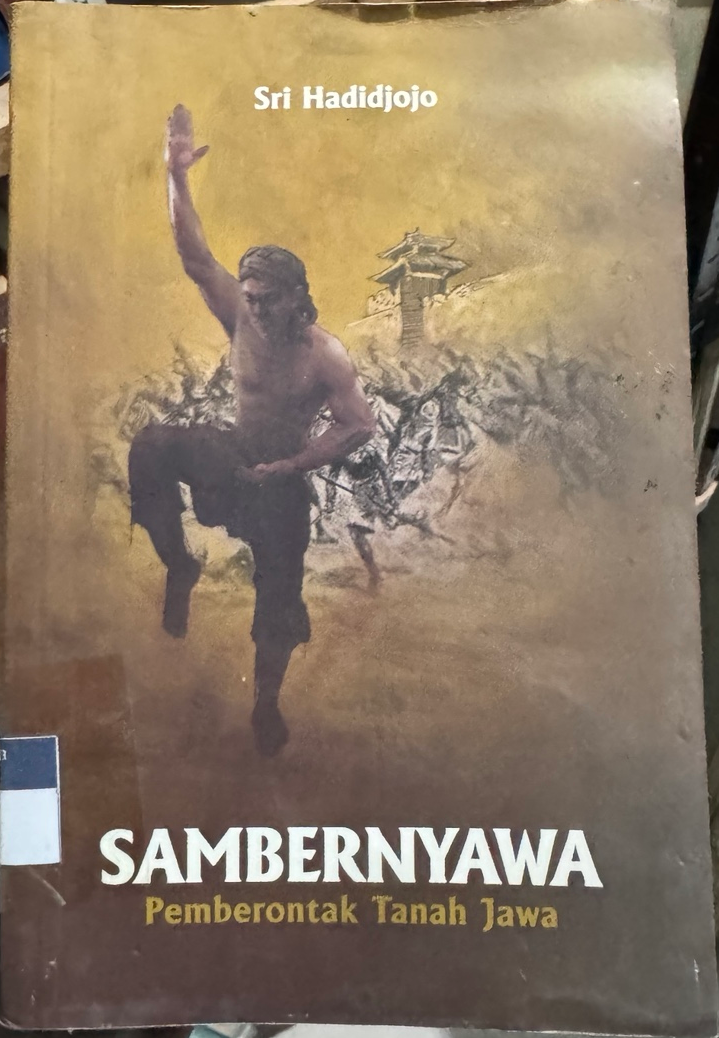
Sambernyawa: Pemberontak Tanah Jawa (Sambernyawa: Rebel of the Land of Java) by Sri Hadidjojo is a historical novel about the youth of Raden Mas Said, a Mataram nobleman who would later be known as Pangeran Sambernyawa and who became the founder of the Duchy (Kadipaten) of Mangkunegaran in Surakarta with the title Mangkunegara I. The cover of this copy is dominated by golden brown with hues of mist and dust, as though depicting a hazy battlefield. In the middle is a bare-chested male figure wearing a headband, raising his right hand high and bending one leg in a martial-arts (silat) stance, as if leaping or attacking. Behind him can be seen the shadows of armed troops running, in dark sketch strokes, as well as a multi-storey building with tiered roofs reminiscent of a tower or a Chinese temple (kelenteng), perhaps a visual hint of the involvement of the Chinese community in the upheavals of eighteenth-century Java. The author's name is printed in white at the top, while the title SAMBERNYAWA is written large in white capitals at the bottom, followed by the subtitle in golden yellow.
Information about the author is rather limited in accessible sources. The publisher's page lists only the name Sri Hadidjojo without a biography. A popular review describes the author as a descendant of Pangeran Sambernyawa, but this information has not been confirmed and should be checked in the author's biography at the back of the book. The catalogue of the National Library of the Republic of Indonesia records that the book was edited by Shalahuddin Gh. Sri Hadidjojo later continued this story in a second volume entitled Sambernyawa: Banjir Darah Bumi Mataram (Sambernyawa: A Flood of Blood in the Land of Mataram), published by the same publisher in 2016. The book in this collection is thus the opening volume of a series of historical novels.
According to the publisher's synopsis, the novel is set in the Land of Java in the first half of the eighteenth century, when the power struggle among the Mataram nobility caused the common people to suffer from crime and war. Raden Mas Said is portrayed as a knight cast out of the palace after his father, Pangeran Arya Mangkunegara, was exiled by the Dutch to Sri Lanka as a result of intrigue involving his own uncle, Pakubuwana II. The protagonist forges himself through wandering, determined to restore his father's good name and to free the people from colonial rule. In the plot, he studies under a mysterious empu in a cave in Gunung Kidul, masters a supernatural power called Aji Brajamusti, and then subdues warriors who subsequently join his resistance. The epithet Sambernyawa, snatcher of lives, attached itself to him because his presence on the battlefield was believed to bring death to his enemies. The novel also features the Sunan Kuning rebellion that breached the Kartasura Palace, as well as the protagonist's struggle against the VOC and the arbitrary rule of the Mataram rulers.
The novel's historical background is very rich. In 1740 the VOC massacred the Chinese in Batavia, which sparked a rebellion by the Chinese on the north coast of Java known as the Geger Pacinan (Chinese Uprising). Some Javanese nobles and commoners joined this rebellion and raised Raden Mas Garendi as king with the title Sunan Kuning. In 1742 the combined Javanese and Chinese forces seized Kartasura, forcing Pakubuwana II to flee. After the palace was recaptured with the help of the VOC, the capital was moved to Surakarta. Raden Mas Said, born in 1725, was drawn into this maelstrom from his teenage years and for almost two decades led a guerrilla war, at times allied with Pangeran Mangkubumi and at times opposed to him. The Treaty of Giyanti in 1755 divided Mataram into Surakarta and Yogyakarta, while the Treaty of Salatiga in 1757 finally gave Raden Mas Said territory and the position of Pangeran Adipati Mangkunegara I. He died in 1795 and was later designated a National Hero of Indonesia.
The figure of Sambernyawa has long been part of Javanese collective memory. His battle motto, tiji tibèh, usually rendered as "one dies, all die; one prospers, all prosper", and the three teachings known as the Tri Dharma, namely rumangsa melu handarbeni (feeling a sense of shared ownership), wajib melu hangrungkebi (being obliged to defend it), and mulat sarira hangrasa wani (introspecting oneself and daring to act), are often quoted in leadership and military education in Indonesia. Historical sources about this figure include babad (chronicles) and the diaries of his accompanying soldiers, which were later studied by historians. Sri Hadidjojo's novel stands at the intersection between historiography of this kind and the Javanese martial-arts tale tradition, because elements of supernatural power, schools of martial arts, and duels between warriors play a large role in its plot.
As a literary work, this book belongs to the wave of popular Indonesian historical novels that developed rapidly from the 2000s, when many publishers presented the stories of figures from the Nusantara kingdoms in the form of easily read fiction, for example series about Gajah Mada, Majapahit, Sultan Agung, or Diponegoro. This phenomenon shows the public's interest in local history presented dramatically, as well as the need for heroic models rooted in one's own culture. Novels of this kind also contribute to the formation of public memory, because for many readers the image of historical figures is shaped more by fiction than by academic works.
For anthropological and historical studies, this novel can be read as a text about how contemporary Indonesian society imagines the Javanese past. Elements such as ascetic practice (laku tapa) in caves, the science of invulnerability (ilmu kanuragan), the relationship between teacher and disciple, and the spiritual legitimacy of a leader show how the Javanese concept of power once analysed by Benedict Anderson and other anthropologists remains alive in the popular imagination. For readers in Aceh and other regions outside Java, the story of Sambernyawa provides comparative material for local narratives of resistance against colonial power, for example the stories of Acehnese fighters, which are likewise framed with elements of karamah (saintly miracles), courage, and loyalty. Comparisons of this kind help to understand how each region constructs its own heroes and memories of resistance within the framework of Indonesian nationhood.
For the study of Islam in Southeast Asia, the eighteenth-century setting is also relevant because Mataram was an Islamic kingdom that blended elements of kejawen (Javanese mysticism) and sharia, while the warring nobles often used Islamic symbols to seek legitimacy. Readers can note to what extent the novel presents the religious dimension of its protagonist, for example his relationship with ulama, pesantren, or spiritual practices that mix the Islamic and Javanese traditions.
As a critical note, readers need to distinguish firmly between historical fact and the author's invention. Events such as the exile of Raden Mas Said's father, the Geger Pacinan, the fall of Kartasura, and the role of the VOC have a historical basis, but details such as the name of the supernatural power, the figure of the empu in the cave, and the duels with warriors are most likely literary elaboration. The portrayal of the VOC and the Mataram rulers as purely arbitrary also risks simplifying political dynamics that were in fact complex, since the relationship between the Javanese nobility and the Company was often transactional and shifting. This novel is therefore best read alongside historical studies of Mangkunegara I and the Javanese wars of succession, such as the work of M.C. Ricklefs and of Indonesian historians who have studied babad and VOC archives.
Comparative publication data from catalogues and the publisher's page show that the book was published by Javanica in 2015, at 364 pages, measuring 14 by 21 centimetres, with ISBN 978-602-72793-7-7. The place of publication and printing number of this copy cannot be confirmed from the cover photograph. The data for this copy still need to be checked against the copyright page, including the editor's name and printing details.
The physical condition of the copy shows a paperback that has seen use, with a slightly dull surface, wear on the top edge and corners, and light creasing on the spine. At the lower left near the spine is a blue-and-white library label, indicating that this book was once part of an institutional library collection. This note is a curatorial introduction based on the cover, the publisher's synopsis, and catalogue information, not a summary of the entire contents of the book.
Appropriate search subjects include Raden Mas Said, Pangeran Sambernyawa, Mangkunegara I, the Indonesian historical novel, the history of eighteenth-century Mataram, the Geger Pacinan, resistance against the VOC, and popular Javanese literature. For citation purposes, references should state the author's name, the full title, the publisher, the year, and the pages read directly in the copy, and should make clear that this work is historical fiction.
- Rights
-
Koleksi pribadi KBA13 Academy
- Contributor
-
Shalahuddin Gh (penyunting)
How to cite
Sri Hadidjojo, Shalahuddin Gh (penyunting), “Sambernyawa: Pemberontak Tanah Jawa [Sambernyawa: Rebel of the Land of Java]”, Javanica, Tahun, cetakan, jumlah halaman, dan ISBN eksemplar belum diperiksa. Rujukan pembanding: Javanica, 2015, 364 hlm., ISBN 978-602-72793-7-7 (belum diverifikasi pada halaman hak cipta eksemplar). KBA13 Academy Archive and Library, KBA-BKU-TT-0031.