Hodder & Stoughton, London · Tahun, cetakan, jumlah halaman, dan ISBN eksemplar belum diperiksa. Rujukan pembanding: London: Hodder & Stoughton, 2000/2001, ISBN 978-0-340-73394-3; satu katalog mencatat 357 hlm. (belum diverifikasi pada halaman hak cipta eksemplar) · Tanpa tahun
Abstract
A spiritual self-development book by Michal Levin, a former journalist on the BBC's Newsnight programme and a management consultant who became a meditation teacher and healer. Starting from the observation that many people who have achieved wealth, success, and education still feel an inner emptiness, Levin offers a guide to a personal spiritual journey: accepting the spiritual dimension within oneself, sharpening intuition, and applying both in daily life. Spiritual intelligence is understood here in a cross-religious sense as an inner sensitivity for grasping meaning and connectedness. Published on the wave of popularity of emotional intelligence and the concept of SQ around 2000, the book belongs to the mind, body, and spirit genre, not to academic scholarship. For Indonesian readers, the book is useful as a cultural document for understanding the global currents that helped shape the discourse of spiritual intelligence and ESQ training, and for comparison with the tradition of tasawuf (Sufism).
- Identifier
-
KBA-BKU-TT-0032
- Type
-
Buku
- Publisher
-
Hodder & Stoughton, London
- Date Issued
-
Tanpa tahun
- Bibliographic Citation
-
Tahun, cetakan, jumlah halaman, dan ISBN eksemplar belum diperiksa. Rujukan pembanding: London: Hodder & Stoughton, 2000/2001, ISBN 978-0-340-73394-3; satu katalog mencatat 357 hlm. (belum diverifikasi pada halaman hak cipta eksemplar)
- Creator
-
Michal Levin
- LC Classification
-
BL624 — Kehidupan spiritual
- LCSH Subject
-
Spiritual life
Intuition
Self-actualization (Psychology)
- BISAC Category
-
OCC019000 BODY, MIND & SPIRIT / Inspiration & Personal Growth
- Language
-
Inggris
- Description
-
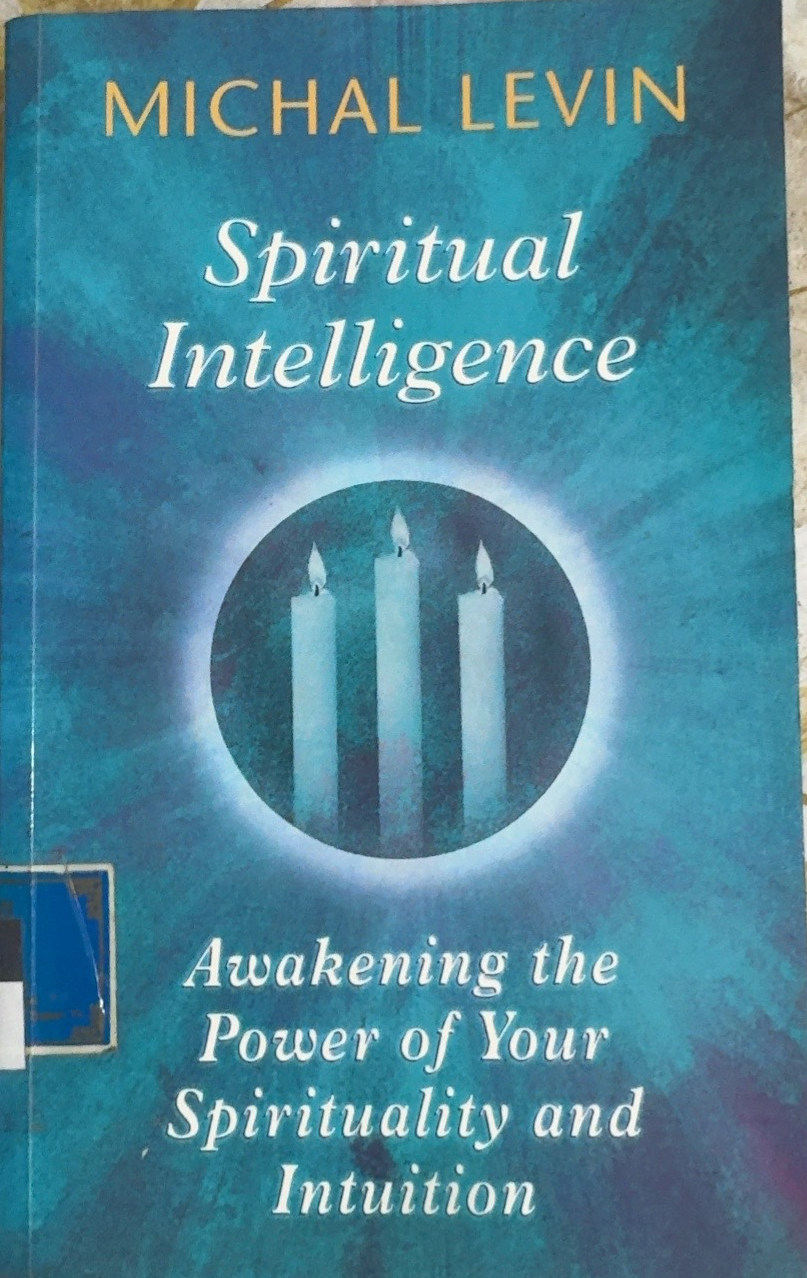
Spiritual Intelligence: Awakening the Power of Your Spirituality and Intuition by Michal Levin is an English-language book on spiritual self-development published in Britain in the early 2000s, a time when the term spiritual intelligence was beginning to become popular among general readers and in the worlds of management and education. The cover of this copy is dominated by bluish green with watercolour-like textured strokes radiating from the centre. The author's name is printed in golden-yellow capitals at the very top, followed by the title Spiritual Intelligence in elegant white italics. In the centre of the cover is a dark circle glowing with white light containing three lit white candles, the middle candle taller than the two beside it. The subtitle Awakening the Power of Your Spirituality and Intuition is printed in white italics at the bottom. The entire cover design conveys an atmosphere of contemplation, meditation, and inner enlightenment, in keeping with the direction of a book addressed to readers seeking meaning in life.
Michal Levin, according to her publisher, once worked as a journalist for the Newsnight programme at the BBC and later as a management consultant. She recounts that in the midst of an established career she experienced an inexplicable inner restlessness, then left her job and began to meditate. In that process she came to see herself as a healer, an intuitive, and a spiritual teacher. The publisher also notes her account that her intuition helped identify a brain tumour that nearly took her life, even though her complaints had been dismissed by doctors. Personal stories of this kind are an important part of the book's appeal, because the author presents herself as a witness to the changes she recommends to readers. These biographical details come from the publisher's promotional material and should be treated as the author's self-narrative, not as independently verified data.
The content of the book, as described by the publisher, starts from the observation that many people who have achieved money, success, education, or even fame still feel an emptiness. Levin offers a guide to a personal spiritual journey that includes accepting the spiritual dimension within oneself, developing intuition, and applying both in everyday life. Spiritual intelligence in this book's sense is not tied to any particular religion, but is understood as an inner capacity to sense connectedness, grasp meaning, and make decisions based on a sensitivity that goes beyond logic. The book takes the form of a practical guide combining stories of experience, reflections, and simple exercises that readers can do on their own.
The intellectual context of the book is important to understand. In the 1990s, Howard Gardner's idea of multiple intelligences and the popularity of emotional intelligence through Daniel Goleman's book opened the way to the idea that human intelligence cannot be measured by IQ alone. Around 2000, Danah Zohar and Ian Marshall published a book entitled SQ that introduced the term spiritual intelligence to the wider public. Levin's book appeared in the same wave, but with an approach closer to the tradition of new spirituality in the West, including meditation, healing, and the development of intuition, rather than to scientific or neurological argument. The book can therefore be placed in the realm of mind, body, and spirit literature, a genre that grew rapidly in British and American bookshops at the end of the twentieth century.
Comparative data from the website of the publisher Hodder & Stoughton record a paperback edition with ISBN 978-0-340-73394-3 marketed from August 2001, while a number of catalogues give 2000 as the year of its first publication in London. A library catalogue of an Islamic higher education institution in Indonesia records a book with the same ISBN published in 2001 with about 357 pages. The printing, year, number of pages, and ISBN of the photographed copy still need to be checked against the copyright page, because there are discrepancies among various catalogue sources and the book may have circulated in more than one printing.
For Indonesian readers, the book has special relevance because the term spiritual intelligence received an extraordinary reception in the country in the early 2000s. The idea of ESQ popularised through the training programmes and books of Ary Ginanjar Agustian, for example, combined emotional and spiritual intelligence with Islamic teachings and was taken up by thousands of civil servants, company employees, and students. English-language books such as Levin's were part of the current of global literature that helped shape that discourse. From the standpoint of the anthropology of religion, the phenomenon is interesting because it shows how cross-religious spirituality from the West was translated, Islamised, and repackaged in the Indonesian context, giving rise to what some researchers call market Islam or corporate spirituality. For Islamic studies, the book can be compared with the tradition of tasawuf, which has long emphasised the cultivation of the inner self, the sensitivity of the heart, and self-knowledge, so that readers can assess the similarities and differences between spirituality without religion and spirituality rooted in revelation.
As a critical note, the book is not an academic study and is not intended to meet standards of scientific proof. Its claims about intuition, healing, and inner abilities rest largely on the author's personal experience and anecdotal stories. Readers from the field of psychology will note that the concept of spiritual intelligence itself is still debated, especially as to whether it can be measured and clearly distinguished from religiosity, emotional intelligence, or personality traits. Nevertheless, the book remains useful as a cultural document showing how the search for meaning was formulated by the professional middle class in the West at the turn of the millennium, and how the language of spirituality entered the world of work and management.
In teaching, the book can be used in courses on the anthropology of religion, the sociology of religion, or the study of new religious movements, especially to discuss the privatisation of religion, the emergence of spirituality without institutions, and the commodification of meditation practices. Students can compare it with academic works on new spirituality and with popular Muslim literature in Indonesia from the same period.
The presence of a book of this kind in an academic collection also has its own documentary value. Spiritual self-development books are rarely kept in scholarly libraries, even though the genre has been very influential in shaping how the middle class understands religion, health, success, and happiness. Researchers who wish to trace the history of the discourse of spiritual intelligence in Indonesia need access to the foreign sources that served as references for local trainers, motivators, and writers. Thus this copy can be read not only as a practical guide, but also as an artefact of an era when spirituality was packaged as a skill that could be learned, trained, and applied in one's career and family life. Critical readers can examine how the language of the book blends the vocabularies of psychology, management, and the mystical traditions of various religions.
In terms of collection documentation, this copy has a blue library label with a white border on the left edge of the cover near the spine, and the label appears slightly torn at its edge. The cover is generally still intact, with slight creases along the spine and light signs of use on the edges. This note is a curatorial introduction based on the cover and catalogue information, not a summary of the entire contents of the book.
Suitable search subjects include spiritual intelligence, intuition, spiritual life, self-development, meditation, new spirituality, and popular psychology. For citation purposes, references should give the author's name, the full title, the publisher, the year, and the pages read directly in the copy.
- Rights
-
Koleksi pribadi KBA13 Academy
How to cite
Michal Levin, “Spiritual Intelligence: Awakening the Power of Your Spirituality and Intuition”, Hodder & Stoughton, London, Tahun, cetakan, jumlah halaman, dan ISBN eksemplar belum diperiksa. Rujukan pembanding: London: Hodder & Stoughton, 2000/2001, ISBN 978-0-340-73394-3; satu katalog mencatat 357 hlm. (belum diverifikasi pada halaman hak cipta eksemplar). KBA13 Academy Archive and Library, KBA-BKU-TT-0032.