
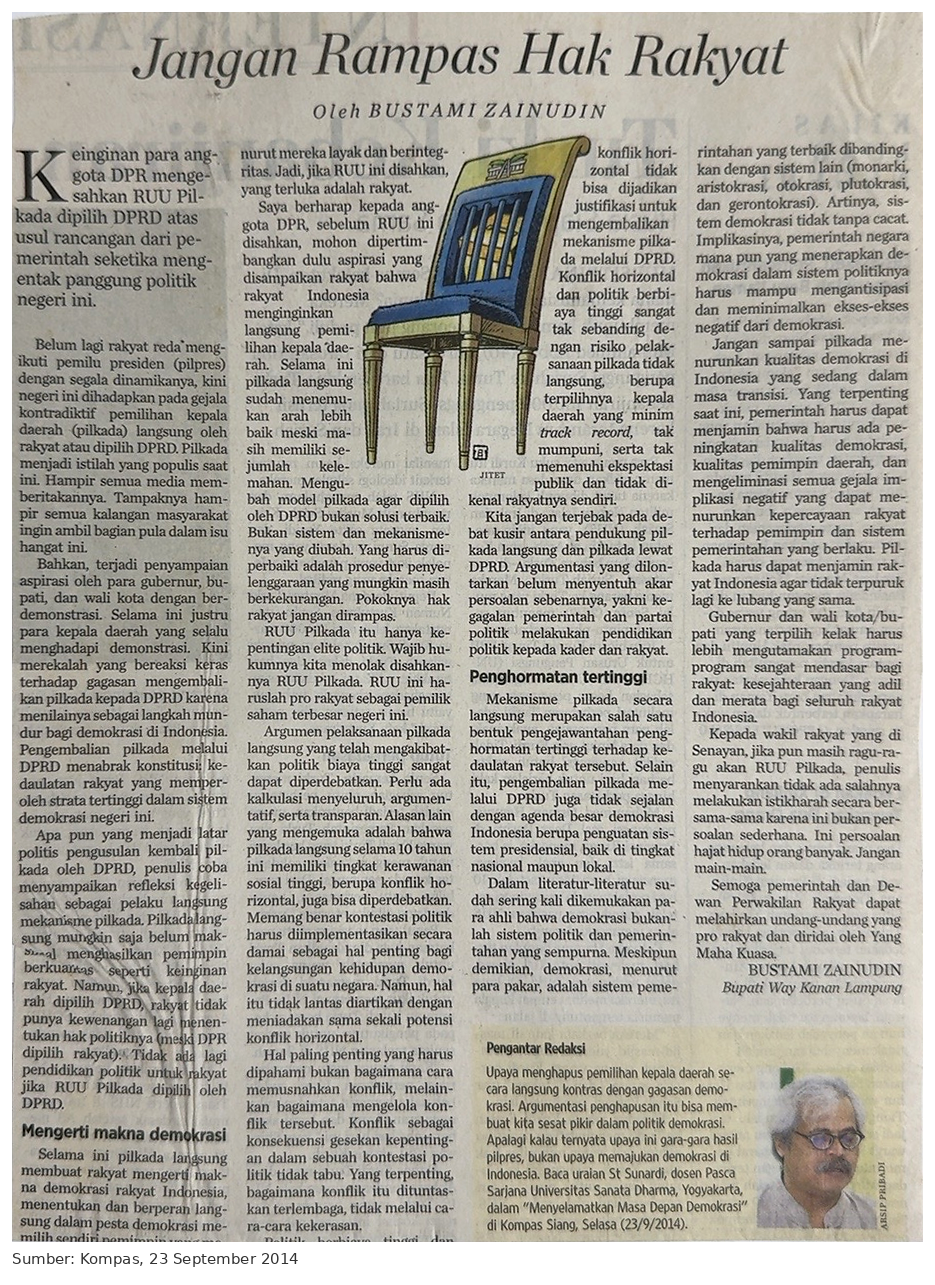
Jangan Rampas Hak Rakyat [Do Not Seize the People's Rights]
By Bustami Zainudin, Jitet (ilustrator)
Kompas · Kompas, Selasa, 23 September 2014; rubrik Opini · 2014-09-23
Abstract
This opinion article by the Regent (Bupati) of Way Kanan, Lampung, Bustami Zainudin, in Kompas on 23 September 2014, rejects the Regional Elections Bill (RUU Pilkada), which sought to return the election of regional heads to the DPRD (regional legislatures). The author argues that direct regional elections have educated the people in understanding democracy and are an expression of the highest respect for popular sovereignty. In his view, the weaknesses of direct elections need only be remedied in the procedures of their administration, not by replacing the system. He describes the arguments about high political costs and horizontal conflict as still debatable, while election through the DPRD risks producing regional heads without track records who are unknown to the people. The root of the problem, the author says, is the failure of the government and the parties to provide political education. The clipping is accompanied by an illustration of a chair by Jitet and an Editorial Introduction referring to a piece by St Sunardi. Three days later the DPR passed the Regional Elections Law providing for election through the DPRD, and President SBY then issued a Perppu (government regulation in lieu of law) in October 2014 restoring direct regional elections.
- Identifier
- KBA-KLP-2014-0030
- Type
- Kliping
- Publisher
- Kompas
- Date Issued
- 2014-09-23
- Bibliographic Citation
- Kompas, Selasa, 23 September 2014; rubrik Opini
- Creator
- Bustami Zainudin
- Subject
- Pemilihan kepala daerah RUU Pilkada 2014 Demokrasi lokal Kedaulatan rakyat Otonomi daerah DPRD Politik Indonesia
- LC Classification
- JQ760–779 — Pemerintahan dan politik Indonesia
- LCSH Subject
- Local elections -- Indonesia Local government -- Indonesia Democracy -- Indonesia
- BISAC Category
- POL008000 POLITICAL SCIENCE / Political Process / Campaigns & Elections
- Language
- Indonesia
- Description
- This clipping contains an opinion article by Bustami Zainudin entitled "Jangan Rampas Hak Rakyat" (Do Not Seize the People's Rights) from the daily Kompas, Tuesday, 23 September 2014. At the end of the piece, the author is identified as the Regent (Bupati) of Way Kanan, Lampung. The scan shows a large italic headline at the top, the author's name in capitals, and then four columns of text opening with a large initial letter. In the middle of the page is an illustration by Jitet of a dark blue chair with a golden frame, a barred backrest resembling a cell window, and slender legs, an image easily read as a symbol of the contested seat of power of a regional head. The article has two subheadings, namely "Mengerti makna demokrasi" (Understanding the meaning of democracy) and "Penghormatan tertinggi" (The highest respect). In the lower right corner is an "Editorial Introduction" (Pengantar Redaksi) box accompanied by a photograph of a bespectacled man captioned as being from a personal archive. The box states that efforts to abolish the direct election of regional heads run counter to the idea of democracy and can lead to fallacious thinking in politics, all the more so if triggered by the result of the presidential election, and then directs readers to the exposition by St Sunardi, a lecturer at the Postgraduate Program of Universitas Sanata Dharma, Yogyakarta, entitled "Menyelamatkan Masa Depan Demokrasi" (Saving the Future of Democracy) in Kompas Siang on the same day. The source note "Sumber: Kompas, 23 September 2014" appears below the image. This piece was born of the struggle of a serving regional official. Bustami Zainudin writes as a regent, that is, as someone who obtained his office through direct election and now faces the possibility that the mechanism that brought him to that seat will be abolished. This position gives the piece the weight of testimony, but it also needs to be read with the awareness that regional heads elected directly had a direct interest in the debate. In the clipping, the author himself notes that governors, regents, and mayors at the time joined in voicing opposition, something he calls a reversal of the usual state of affairs, because regional heads are normally the targets of demonstrations, not the participants. The opening part of the article describes the political atmosphere after the presidential election of July 2014. According to the author, before the people had had time to settle down from the dynamics of the presidential election, the desire of some members of the DPR to pass the Regional Elections Bill with a mechanism of election by the DPRD, which originally came from a government proposal, startled the national political stage. The author argues that returning regional elections to the DPRD is a step backward for democracy and collides with the constitutional idea of popular sovereignty. He acknowledges that direct regional elections may not yet have fully produced leaders matching the people's hopes, but if regional heads are elected by the DPRD, the people lose the authority to determine their political rights, and the process of political education for citizens also comes to a halt. Under the subheading "Understanding the meaning of democracy", the author asserts that direct regional elections have made the people understand the meaning of democracy because they can determine and play a direct role in choosing leaders whom they consider worthy and of integrity. If the bill were passed, the people would be the party most hurt. He asks members of the DPR to consider the aspirations of society before making a decision. His main argument is that the weaknesses of direct regional elections need not be answered by replacing the model. For the author, the problem lies in the still deficient procedures of administration, not in the system itself. He calls the bill a reflection of the interests of the political elite and states that the people are the largest shareholders of this country, an interesting corporate metaphor because it uses the language of ownership to assert sovereignty. The author then responds to the two main arguments of the supporters of election through the DPRD. The first argument concerns high political costs. In his view, that claim is still debatable and requires a comprehensive, reasoned, and transparent calculation. The second argument concerns the risk of horizontal conflict during ten years of direct regional elections. The author does not deny that conflicts have occurred, but argues that political contestation inherently involves friction of interests and that the most important thing is how to manage conflict in an institutionalized way without violence, not to eliminate contestation itself. He then turns the argument around: the risks of indirect elections are in fact greater, because they can produce regional heads with minimal track records, less capable, failing to meet public expectations, and unknown to their own people. The author also invites readers to move beyond the futile debate between the two camps and points to the real root of the problem, namely the failure of the government and political parties to carry out political education for their cadres and for society. The section "The highest respect" places direct regional elections as one form of the embodiment of the highest respect for popular sovereignty. The author adds that returning regional elections to the DPRD is not in line with the agenda of strengthening the presidential system, at both the national and local levels. He refers in general terms to the political literature that holds that democracy is not a perfect system, but remains the best choice compared with monarchy, aristocracy, autocracy, plutocracy, and gerontocracy. The consequence is that the government is obliged to anticipate and suppress the negative excesses of democracy without lowering its quality, especially since Indonesia is still in a period of transition. The author also reminds elected regional heads to prioritize programmes that are fundamental for the people, namely just and equitable welfare. The close of the article displays the characteristic tone of a religious regional official. To the people's representatives in Senayan who are still hesitant, the author suggests a collective istikharah (prayer for divine guidance), because this matter concerns the livelihood of many people and is no trifling affair. He hopes the government and the DPR will produce a law that sides with the people and is blessed by God. This combination of constitutional argument, policy calculation, and religious appeal reflects the way Indonesian local politicians frame institutional issues in a moral language familiar to their voters. The historical context of this clipping is very important. Three days after the article was published, on 26 September 2014, a plenary session of the DPR passed Law Number 22 of 2014 on the Election of Governors, Regents, and Mayors, which provided for election through the DPRD. The decision was taken by a vote after the Democratic Party faction walked out of the chamber, so that the coalition of parties that had supported Prabowo Subianto in the presidential election prevailed. A wave of public criticism, including from associations of regional heads and civil society groups, then prompted President Susilo Bambang Yudhoyono to issue Government Regulation in Lieu of Law (Perppu) Number 1 of 2014 in early October 2014, restoring direct regional elections. The Perppu was subsequently approved by the DPR as Law Number 1 of 2015, and the first simultaneous regional elections were held in December 2015. This clipping thus records a voice of opposition in the final moments before a parliamentary decision that was later reversed through the executive route. For the study of Indonesian politics, this clipping is useful as a document of the debate on decentralization and local democracy after Reformasi. The debate on political costs, money politics, horizontal conflict, and the quality of regional heads continues to recur to this day, including in the discourse on asymmetric regional elections and proposals that some regional heads again be elected by the DPRD. For Aceh, this issue has a special dimension because regional elections in Aceh are also regulated by the 2006 Law on the Governing of Aceh, which provides room for independent candidates and local political parties. The Acehnese experience shows that direct regional elections can also be a means of integrating former combatants into electoral politics, so that changes in the electoral mechanism at the national level always have implications for regions with special status. For political anthropology, the way the author combines the language of rights, the language of shares, and the language of worship can be read as an example of the rhetoric of local leadership in Indonesia. As a critical note, this article is more a normative appeal than an empirical analysis. The author calls for a transparent calculation of costs but does not present data on the costs of regional elections, the frequency of conflict, or the performance of directly elected regional heads. The claim that elections through the DPRD would produce leaders unknown to the people is also not tested against the experience of the New Order and early Reformasi, when regional heads were indeed elected by the DPRD and money politics among council members was frequently reported. Nevertheless, the article remains valuable as a position document of a regional head at a critical time, and the Editorial Introduction box shows that Kompas itself openly took a stance in the debate. Physically, the clipping is a yellowish cut-out newspaper page photographed against a white background. The lower part of the left column shows fairly clear fold marks and creasing of the paper, so that some lines appear distorted, although the text is still legible. The very bottom of the second and third columns is slightly cut off. The chair illustration and the photograph in the editorial box are printed in colour and are still sharp. The full text of the article is not reproduced in this catalogue because its copyright belongs to the author and the publisher; this note is a curatorial description to help users understand its content, context, and research value. Appropriate search subjects include regional head elections, the 2014 Regional Elections Bill, local democracy, popular sovereignty, regional autonomy, the DPRD, Perppu Number 1 of 2014, and Indonesian politics after the 2014 General Election. For citation purposes, the reference can be written as follows: Bustami Zainudin, "Jangan Rampas Hak Rakyat", Kompas, 23 September 2014, Opinion section.
- Rights
- Koleksi pribadi KBA13 Academy
- Contributor
- Jitet (ilustrator)
- Collection
- Clippings
How to cite
Bustami Zainudin, Jitet (ilustrator), “Jangan Rampas Hak Rakyat [Do Not Seize the People's Rights]”, Kompas, Kompas, Selasa, 23 September 2014; rubrik Opini, 2014-09-23. KBA13 Academy Archive and Library, KBA-KLP-2014-0030.